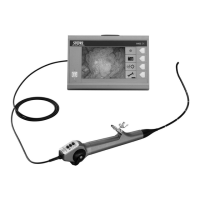
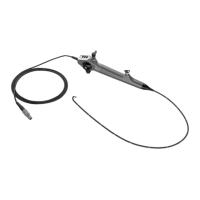
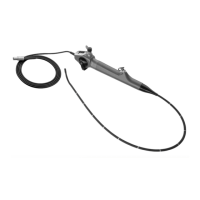
The KARL STORZ Flexible Video-Urethro-Cystoscope (model 11272 VN/VNU) is a medical instrument designed for visual examination and treatment of the urinary tract. It features a working shaft, a distal tip, a CCD video module, and video control buttons for functions like white balance, image capture, zoom, and menu access. The device incorporates a working channel with a T-Luer fitting to accommodate small diameter flexible instruments, electrodes, and laser fibers. It connects to a camera control unit via a dedicated connector cord and to a KARL STORZ compatible light source via a plug.
Important Technical Specifications:
- Model: 11272 VN/VNU
- Direction of view: 0°
- Field of view: 120°
- Depth of field: 3–50 mm
- Tip deflection: 210° up, 140° down
- Tip diameter: 5.5 mm
- Working shaft diameter: 5.3 mm
- Working channel diameter: 2.2 mm
- Working shaft length: 370 mm
- Total length: 635 mm
- Operating Conditions:
- Ambient temperature: 15°–37° C (59°–98.6° F)
- Humidity: 15%–80%
Usage Features:
The device is intended for use by physicians with appropriate medical qualification and who are acquainted with the cystoscopic technique. It is designed for visual examination and treatment of a variety of urological endoscopic procedures, providing optical visualization via a video monitor and therapeutic access.
- Handling: The flexible video-urethro-cystoscope should be handled carefully to prevent damage. The shaft must not be kinked or coiled up too tightly, and it should be stored in a suspended position or a specifically designed tray for sterilization and storage. A water-soluble lubricant is recommended for the distal section of the shaft.
- Deflection Mechanism: The deflection lever allows for precise control of the distal tip. The neutral position of the scope's distal tip is straight, without any deflection. Actuating the deflection lever gently and carefully as far as the limit stop is crucial to avoid injury to the patient or damage to the device. The deflection lever must never be operated with force or abruptly to avoid perforation and injury.
- Accessory Handling: Only flexible accessories listed in the manual should be used. Accessories from other manufacturers may damage the flexible video-urethro-cystoscope. Sharp-tipped accessories must not be inserted into the instrument channel as they may damage it. Foreign bodies should not be removed through the instrument channel.
- Connection to Camera Control Unit (CCU): The flexible video-urethro-cystoscope can be used with various KARL STORZ camera control units, including TELECAM® DX II/SL II, Image 1 HUB NTSC, and Image 1 HUB. The video connection is made using a specific connecting cable. The CCU keyboard should not come into contact with the patient or be placed in their proximity.
- Connection to Light Source: The device can be used with KARL STORZ light sources such as Xenon 175 201321 20-1, Xenon 300 201331 20-1, Xenon Nova 175 201315 20, Xenon Nova 300 201340 20, and Miniature 481-C. The instruction manual of the specified light source must be followed. Reducing the intensity of the light source is recommended to achieve optimal illumination and prevent excessive heat at the tip.
- User Buttons: The flexible video-urethro-cystoscope has three control buttons that can be assigned specific functions in the camera control unit's device menu. The assignment set is retained after switching off and on.
Maintenance Features:
Thorough cleaning, rinsing, and sterilization are critical for the safe and effective use of the flexible video-urethro-cystoscope.
- Unpacking: The device is delivered non-sterile and must be sterilized prior to initial use. Check for missing items and shipping damage upon receipt.
- Water Quality Requirements: Water used for flushing, washing, and rinsing must meet specific quality requirements for hardness, conductivity, pH, chlorides, bacteria, and endotoxin.
- Pre-cleaning (at point-of-use): Prior to pre-cleaning, turn off the light source and detach the flexible endoscope. Wipe the entire exterior with a soft, lint-free cloth, moistened with water or a diluted mild/neutral pH enzymatic cleaning solution. Ensure that one of the Luer's of the instrument port is plugged during this process. Immerse the distal tip in a basin of water and suction a minimum of 100 mL of cleaning solution through the non-plugged port. Repeat with the opposite Luer. Remove the video connection cable and inspect the vent port and video cable connector area for visible debris. Place the protective cap on the video cable connection.
- Leakage Testing: Before proceeding to manual cleaning, always perform a leak test. The KARL STORZ Leakage Tester (P/N 13242 XL) or an automated leak tester must be used. If a leak is detected, the endoscope must be sent for repair. The pressure compensation cap (P/N 11025E) must be removed from the vent port.
- Manual Cleaning: Use a mild/neutral pH enzymatic cleaning solution. All brushing/flushing should be done with the endoscope fully immersed under water to avoid aerosol formation. Never use a needle or other sharp objects for removing dirt particles. The flexible endoscope must be in the neutral (distal end straight) position when a cleaning brush is inserted into the working channel.
- Drying: Remove the flexible video-urethro-cystoscope from the water and dry the exterior with a soft, lint-free cloth. Discard all disposable cleaning accessories.
- Inspection: Visually inspect the flexible video-urethro-cystoscope for cleanliness and dryness. Open the video protective cap and visually inspect the video connector for cleanliness and dryness. Do not proceed with sterilization if residual debris is visible. Inspect the flexible video-urethro-cystoscope for signs of damage (cuts, dents, or scratches). Clean the distal lens using a 70% isopropyl alcohol wipe.
- Sterilization: The pressure compensation cap (P/N 11025E) must be removed from the vent port for endoscopic interventions, plasma sterilization, venting, and shipping. KARL STORZ recommends sterilizing the Flexible Video-Urethro-Cystoscope via STERIS Amsco V-PRO maX Sterilization System. Only use FDA-cleared polypropylene sterilization wraps. Do not use paper pouches or sterilization wraps containing wood pulp or cotton.
- Storage: To prevent biofilm formation, the endoscope channel must be thoroughly dried prior to storage. Care must be taken during handling to prevent contact with other objects and the distal end from swinging freely. The distal end must be under control at all times. If the distal end is allowed to swing freely and strike objects, damage can result. The channels must be dry, and a medical grade filtered air ("channel-purge" endoscope storage cabinet) is the preferred method of storage. If this is not available, adequate manual drying using forced air (<5 psi) must be performed for at least 10 minutes prior to storage.
- Endoscope Return: If a leak is detected or if the endoscope is contaminated, it must be sealed with waterproof tape, cleaned, and sterilized before returning to KARL STORZ for repair or full manual cleaning and sterilization.

 Need help?
 General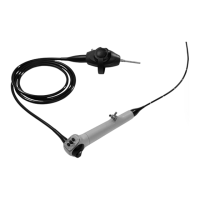

 To Next Page