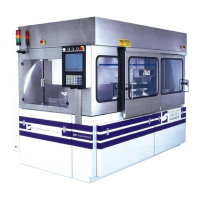
Strasbaugh Mechanical Description
Version 4.0 - February 1998 4 - 15
The wafer carrier mounting assembly has a flat underside with an aluminum
chuck equipped with 0 rings. The 0 rings form two vacuum chambers between
the chuck and the carrier. An applied vacuum source evacuates air from one
chamber to firmly attach the wafer carrier to the spindle drive assembly. The
end of the quill shaft is a ball joint for alignment to the center of the wafer
carrier. Vacuum for this runs between the back pressure feed tube and the quill
shaft wall. The vacuum fills the space not taken up in the quill shaft by the back
pressure feed tube, providing the vacuum source required to attach the wafer
carrier to the wafer carrier mounting assembly. The feed tube, which supplies
back pressure to the wafer during polishing, transferring air and vacuum (as well
as water for carrier flushing), is located inside the quill shaft, running the entire
length and extending out the top above the servo motor. A rotary joint is
mounted to the top of the feed tube. The vacuum supply line attaches to the quill
shaft.
To secure the wafer during polish liftoff and cleaning, controlling wafer position
and preventing breakage, the spindles use back pressure technology, transferring
air or vacuum as needed (to retain or release the wafer) down through the carrier
to the wafer. Back pressure is used for wafer transport and unloading whether or
not it is enabled for polishing.
During wafer transport to and from the table, the machine will attempt to apply
the minimum back pressure of 0 PSIA (-14.7 PSIG) of vacuum. This condition
encourages the wafer to remain on the carrier. The actual minimum reached,
shown on the status display, will be several PSIA or PSIG below atmosphere.
During unloading, back pressure is used for wafer blow off. During idle times,
the source for back pressure is set to a nominal value near atmosphere, but this
source is disconnected from the carrier. Instead, the carrier is vented to
atmosphere.
During polishing, selectable and controllable pressure is routed through the spindle
and carrier to the back side of the wafer. This pressure may be displayed in either
PSIA or PSIG (absolute pressure which is the pressure above perfect vacuum) on
the status display at the right side of the display screen by setting calibration
variable 65 at the Calibration/Configuration Menu. If enabled at page 1 of the
Machine Parameters Menu, back pressure will be used during polishing. If not, the
back side of the wafer is vented to atmosphere during polishing. Enabling or
disabling back pressure during polishing has no effect on the other functions of
back pressure, used when not polishing.


 To Next Page
 Loading...