just
the high
frequency response
(
I0
-
12 kc,/s
)
by
means
of the
trimmer corre-
sponding
to the
tape
speed
on the approprlate amplifier.
There ls
no
lnteractlon
between
the trlmmers
for the two tape speeds.
For the
measurement of
weighted
ard
section
of the test tape ls used.
The
unwelghted slgnal-to-noise
ratlo,
the 1000 c,/s
"full-mod"
galn
control
of the sync-playback amplifier
under test
as
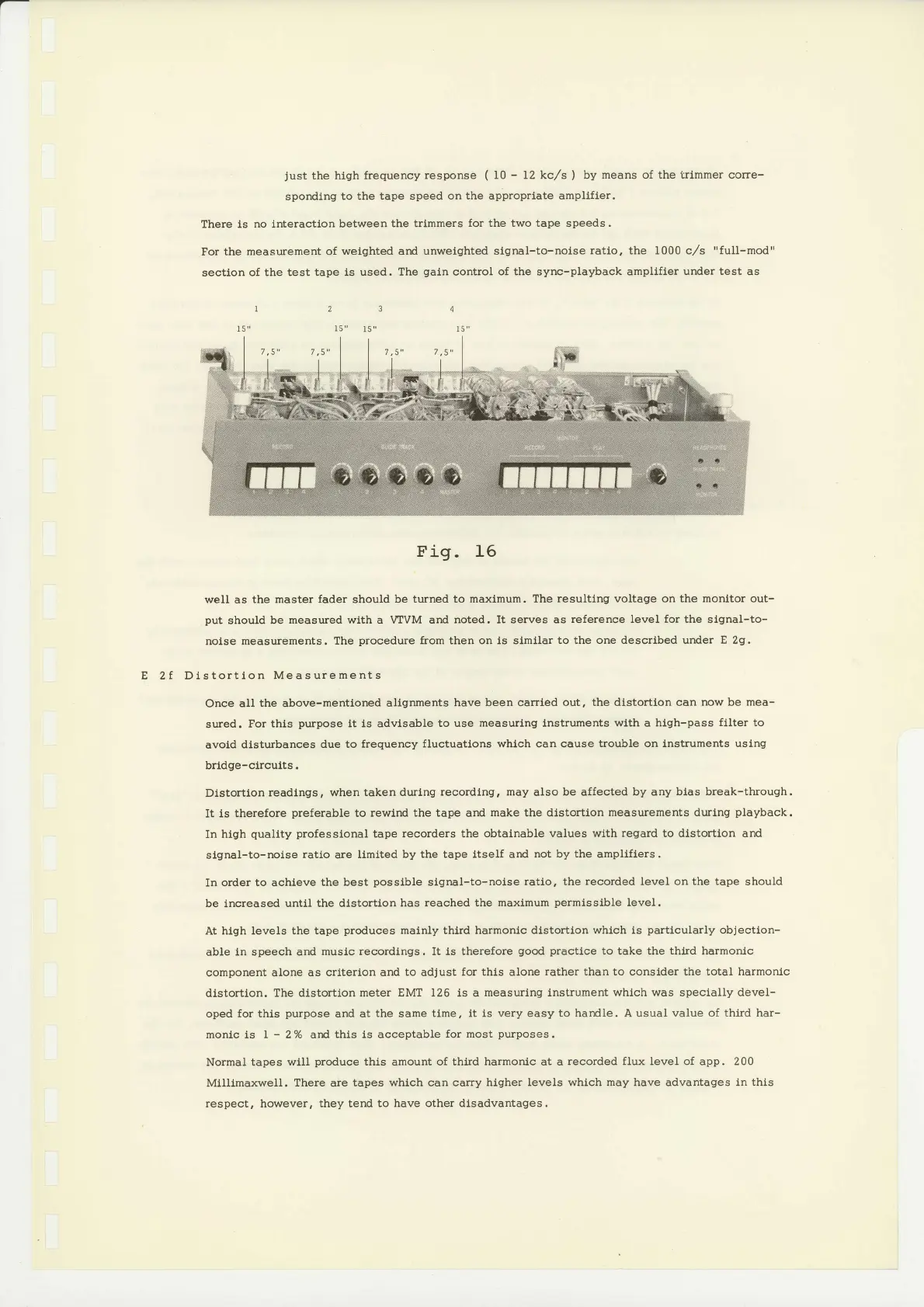
4
15,,
E2f
Fig. 15
well as
the master fader should
be turned to maxlmum. The
resultlng voltage on the monltor out-
put
should
be
measured with a WVM and noted. It serves
as
reference level for the
signal-to-
noise measurements.
The
procedure
from then on ls simllar
to the one descrlbed under E 29.
Dlstortlon
Measurements
Once
all
the
above-mentloned
alignments
have been carried
out, the dlstortlon can
now
be
mea-
sured.
Por thls
purpose
lt is advlsable
to use measurlng lnstruments
with
a
htgh-pass
fllter to
avoid
disturbances
due to frequency
fluctuatlons whlch can cause
trouble on lnstruments uslng
brldge-clrcults .
Distortion
readlngs, when taken
durlng
recordlng, may
also
be affected by
any
blas break-through.
It ls therefore
preferable
to rewind the
tape
and
make the dlstortion
measurements during
playback.
In high
quality
professlonal
tape
recorders the obtalnable
values wlth regard to dlstortlon
and
signal-to-nolse
ratlo
are
limlted by the tape ltself and
not by the ampllfiers.
In order
to
achleve
the best
possible
slgnal-to-noise
ratio, the recorded level on the tape should
be increased
until the dlstortion
has
reached
the
maximum
permisslble
level.
At high levels the
tape
produces
mainly thlrd harmonic
distortion which is
particularly
objectlon-
able
ln speech and
music recordings. It ls
therefore
good practice
to take the
third
harmonic
component alone
as criterlon and
to
adjust
for thls alone
rather than to
conslder
the total harmonlc
dtstortlon.
The distortion meter EMT
126
ls a
measuring instrument whlch was speclally devel-
oped
for this
purpose
and at the same
time, it is very easy to hardle. A usual
value of third har-
monic is I
-
2% ard thls ls acceptable
for most
purposes.
Normal tapes wtll
produce
thls
amount
of third harmonic at a
recorded flux level of app, 200
Milllmanarell.
There
are
tapes whlch can carry
higher levels which may have advantages in
this
respect, however, they tend
to have other disadvantages.


 To Next Page
 Loading...