Distortion
is usually measured
at 1000 c,/s
at
l5
ips as well
as 7
I/2
lps so that the third har-
monic will be 3 kc/s.
At 1000 c/s, lhe distortion measurement
is carried out
at
full
modulation,
but lf measurements are carried out
at higher
frequencies
the
lnput level should be reduced
ln
accordance
wlth
the
recordinq
pre-emphasls.
This
pre-emphasis
is not
a characteristic of the
tape recorder but of
the
tape
and lt is
absolutely
permlsslble
for
speech
ard
music recordings
as
the
peak
energy distribution
is
lower
ln the htgh frequency region.
In
the
section
E
2b
"Blas',
lt was mentioned that distortion
ls
very much
a
function of
the btas
current.
The settlng-up
procedure
for the bias current
descrlbed ln that
paragraph
is
the most
usu-
al
one. To
achieve
optlmum results
it may
at
times be
advantageous to alter thls Ievel
and check-
ing the resulting thlrd
harmonlc component
and signal-to-nolse
ratlos.
For thts
purpose,
the
third
harmonic distortion meter EMT 126
is again very suitable
as
it is independent
of tnput voltage
provided
that
the
lnput ls not Iess than
app.
4
V. Accordingly, tt is necessary but only for
this
particular
measurement to increase the
galn
of the
playback
amplifier by turning the
pre-set po-
tentiometer up.
E
2g
Nolse
Level Measurements
In
order to
achieve
optimum results, the following
precautlons
should be taken:
-
De-magnetize the heads
as
well
as any steel
parts
whlch come into
contact
wlth
the
tape, in
a
gradually
diminishing
AC
field.
Thls should be done
at
regular
intervals
to maintain mlnimum nolse level
ln the
recorder
-
-
The bias breakthrough in the
playback
amplifier should be reduced to
a
minimum
by
tuning the
bias-trap. The best
way
to do this is by connecting
a
sensltlve
wide-
band oscllloscope to the output of the
playback
ampllfier.
-
A
particularly
"quiet"
valve may
be selected
for
the first
stage in
the
playback
am-
pllfier.
However,
for normal
purposes
this ls not necessary.
The nolse measurement
should be carrled out
with
a
VTVM with
a
frequency response
extendlng
not too far
above 15 kc,/s.
Noise
measurements
are
flrst taken with no tape
in
the recorder
both wlth the machine in
"stop"
and
in
"playback".
The
tape
tenslon balance
should
be turned out of
its
"rest[
position
in order
to
energise the capstan
motor.
After
these measurements the tape
is
threaded, the
lnput of the record
ampllfier short-clrculted
durlng
"record"
and
the measurement
ls repeated with the machine running
ln
"playback".
The
noise level will be higher than
prevlously.
The
difference shows that the tape ls the
controlllng
factor for
the
flnal
nolse level and this is
a
special feature
of
the
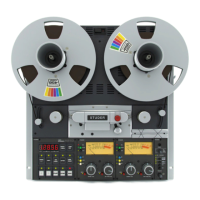
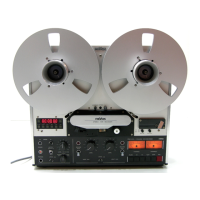
STUDER
J-37.
The nolse measurements may be repeated
"weighted'
wlth an equal loudness curve
according to
the relevant
standards.
As
regards
noise
measurement
1t should be noted that ln certain countries noise measurements
are
taken excluslvely wlth
peak
reading volt meters
ard
the figures
quoted
are
peak
readlngs.
On the
other hand, in countries under Anglo-American influence, RMS readings
are
preferred.
The
welgh-
ted and unweighted slgnal-to-noise
ratlos
are therefore
also
glven
ln RMS values. The technlcal
detalls for the
STUDER
J-37
therefore
quote
the readings obtained by both methods.


 To Next Page
 Loading...