UMGEBUNGSBEDINGUNGEN
/
AMBIENT CONDITIONS
Vor
der
Inbetriebnahme
muss das
System auf all fall
ige interne
Betauung
oderEisbildung
uberprilft werden.
Nur bei
sehr leichter
Eisbildung kaim mit
direkter Verdunstung
(Sublimation) gerech-
net
werden; andemfalls
muss das
System im abgeschalteten
Zustand gewarmt und
getroeknet
werden.
Das
System ohne feststellbare interne Eisbildung oder Betauung
soil
mogliehst homogen
(und somit
langsam) mit eigener Warme-
lei
stung aufgewarmt
werden; die Lufttemperatur
der Umgebung
soli standig
etwas defer als
diejenige
der Systemabluft
sein.
1st es unumganglieh, das
abgektihlte
System sofort
in warmer
Umgebungsluft
zu
betreiben, so muss diese entfeuchtet
sein. Die
absolute Luftfeuchtigkeit muss dabei so tief sein,
dass
die
relative
Feuchtigkeit, bezogen auf die kal teste Oberflache
im System,
immer unterhalb
100% bleibt.
Es ist dafar zu sorgen, dass beim Abschalten des
Systems die
eingeschlossene Luft mogliehst trocken
ist (d.h. vor dem
Ab-
schalten im
Winter
den
Raum
mit kalter, trockener
Luft beltiften
und feuchte Gegenstande, z.B. Kleider, entfemen).
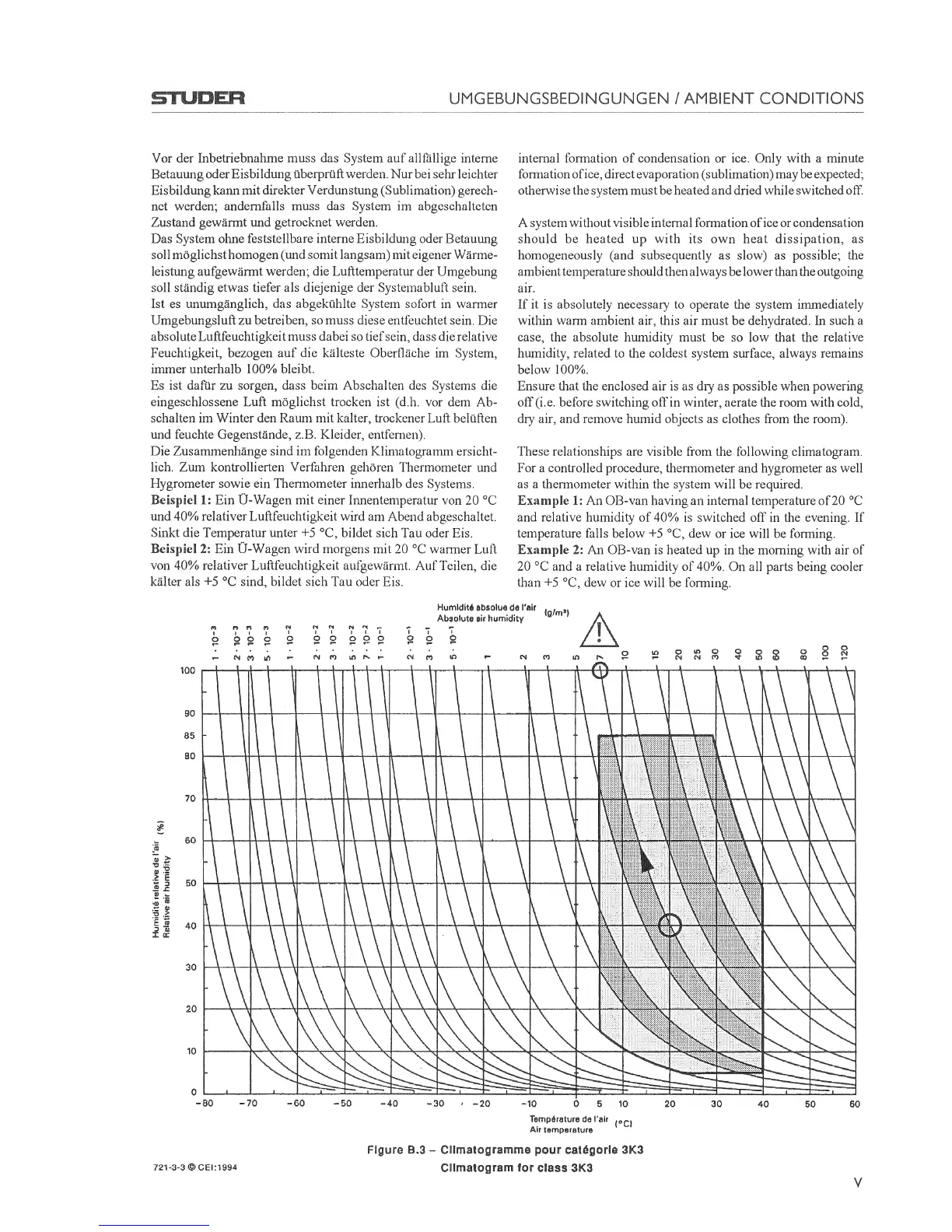
Die Zusammenhange sind im folgenden
Klimatogramm ersicht-
lich. Zum kontrollierten Verfahren gehoren
Tliermometer
und
Hygrometer sowie ein
Thermometer
imierhalb des
Systems.
Beispiel 1: Ein U-Wagen mit einer Innentemperatur
von
20 °C
und 40% relativer Luftfeuchtigkeit wird
am Abend
abgeschaltet.
Sinkt die Temperatur unter
+5
°C, bildet
sich Tau
oder Eis.
Beispiel
2: Ein
U-Wagen
wird morgens
mit 20 °C warmer
Luft
von 40% relativer Luftfeuchtigkeit
aufgewarmt.
Auf Teilen,
die
kalter als
+5
°C sind, bildet sich Tau oder
Eis.
internal formation of
condensation
or ice. Only with a
minute
formation ofice, direct
evaporation
(sublimation) maybe
expected;
otherwise the system must be heated and dried while switched off.
A
system without visible internal
formation ofice or
condensation
should be heated up
with
its own heat dissipation, as
homogeneously
(and
subsequently
as slow) as possible; the
ambient temperature should then always
be lower than the
outgoing
air.
If
it is absolutely necessary to operate
the system
immediately
within warm
ambient air, this air must
be
dehydrated.
In
such a
case,
the absolute
humidity
must
be so
low that
the
relative
humidity, related to the coldest system surface, always remains
below
100%.
Ensure
that the enclosed air is as dry
as possible when powering
off
(i.e.
before switching
off in
winter,
aerate the
room
with cold,
dry air, and remove
humid objects as clothes
from
the room).
These relationships
are visible from the following climatogram.
For a controlled
procedure, thermometer
and
hygrometer as well
as a thermometer
within the system will
be required.
Example
1: An
OB-van
having an internal temperature of 20 °C
and
relative
humidity
of 40% is switched
off in the evening. If
temperature
falls
below
+5
°C, dew or ice will
be forming.
Example
2: An OB-van is heated up
in the morning with air of
20
°C
and a relative
humidity of 40%.
On all parts being cooler
than
+5
°C, dew
or
ice
will be forming.
Figure B.3
-
Cllmatogramme
pour cat^gorle 3K3
721-3-3
©
CEi:i994
Climatogram for
class
3K3
V


 To Next Page
 Loading...