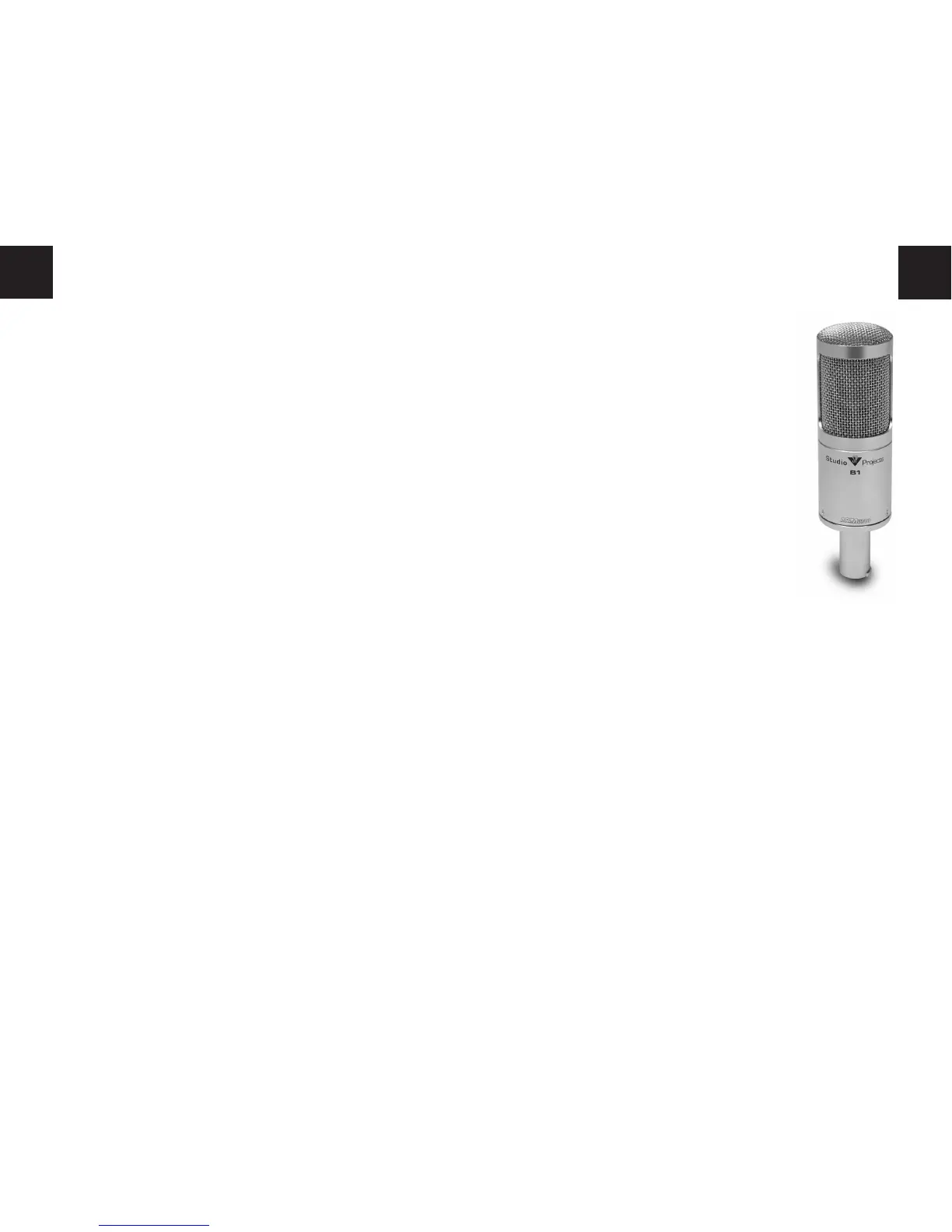
B1
The B1 is a high quality true condensor pressure gradient microphone
with an FET impedance converter. It is a large diaphragm microphone
with a cardiod polar pattern and a 3 um capsule for natural reproduction
of the vocal and instrument range. The B1 uses a transformerless circuit,
that features extremely low noise and wide dynamic range. The B1’s
polar response is very linear over a wide incidence angle. Signals
coming from the side are reproduced accurately and without any
coloration. The microphone capsule is immune to typical interference
and outside contamination.
B1 SPECIFICATIONS
Sensitivity: -34dB,(0dB=1V/Pa)
Polar pattern: Cardioid.
Frequency response: 20~20000Hz.
Noise level: 12dB-A (IEC651).
S/N ratio: 82 dB.
Max. Output: 3.3V 0.5% THD @1000Hz at 1KOHM load impedance.
Max. SPL: 137 dB
Power requirement: 48 +/- 4V, 3mA.
Accessories: Mic Clip clamp, Foam Windscreen.
CONNECTING UP
Using a high quality balanced and screened(shielded) audio cable, connect the B1 or B3
microphone to the microphone amplifier input and switch on the 48V phantom power. NOTE,
the microphone will not operate unless 48V phantom power is provided. The microphone
should be powered up for at least one minute before it will operate correctly as the polarizing
voltage on the capsule needs to stabilize. Some background noise is possible during the first
few seconds after switch on. Keep the gain controls on the microphone amplifier or mixer well
down as the output from the microphone is high (as most capacitor microphones). For the TB1,
use the supplied cable to hook the microphone and power supply together. Use a balanced
and screened(shielded) audio cable to connect to a mic amplifier. DO NOT USE A PHANTOM
POWER SOURCE FOR THE TB1. The TB1’s supply powers the mic.
USING STUDIO PROJECTS MICROPHONES
Studio Projects is a high quality true condensor pressure gradient microphone with FET
impedance converter. (NOTE, this is NOT an electret microphone).
The capacitor element is manufactured to the classic ‘center electrode’ design which provides
smooth extended frequency response without low frequency boominess. Quality is further
enhanced by using dynamic feedback actually at the capacitor element. This original
technique eliminates distortions which can occur when using this type of microphone for high
volume levels. The capacitor membrane is microfine 3 um ‘mylar’ with gold sputtering, voltage
polarized by phantom power. The polar response is linear over a wide incidence angle, so signals
coming from the side are reproduced without coloration.
The B1 & B3 are more sensitive to sounds from the front than from the rear when used in the
CARDIOD pattern. The front of the microphone is indicated by the Studio Projects logo. To
get the best quality, be sure the sound source is in line with the front of the microphone. For
vocals, a ‘nylon’ pop shield is recommended. AVOID using foam plastic ‘pop’ shields. These
may be effective at stopping ‘popping’, but can also affect the working of the microphone so
the sound is dulled. To get that classic early capacitor microphone sound, the singer should
sing across the front of the microphone at a distance of 6” to 24” from the microphone.
The B3 is a Multi-Pattern microphone that provides Cardiod, Omni, and Figure Eight patterns.
These multiple patterns allow the user more flexibility in their recordings. The Omni pattern
picks up sounds uniformly from all over the capsule, while Figure 8 rejects sounds from the
sides (left/right). Using these patterns correctly will give the user a wide variety of recording
applications.
ORIGINS AND MANUFACTURE
Studio Projects Microphones are manufactured in Beijing, China by 797 Audio to a specification
created by Studio Projects, Torrance, California. All Studio Projects microphones are inspected
and tested at the factory, then inspected and tested again at PMI Audio Groups facility prior to ship-
ping. Studio Projects microphones meet the requirements of electronic equipment sold both in
the USA, Canada, and the European Union. All Studio Projects products are CE Approved.
APPLICATIONS
• Close miking of instruments with high sound pressure levels
• Announcer’s mic for broadcasting/dubbing
• Home recording and project studios
• Vocalist recording
• Spot mic for: wind instruments, strings, percussion and guitar amps.
5
4



 To Next Page
 Loading...