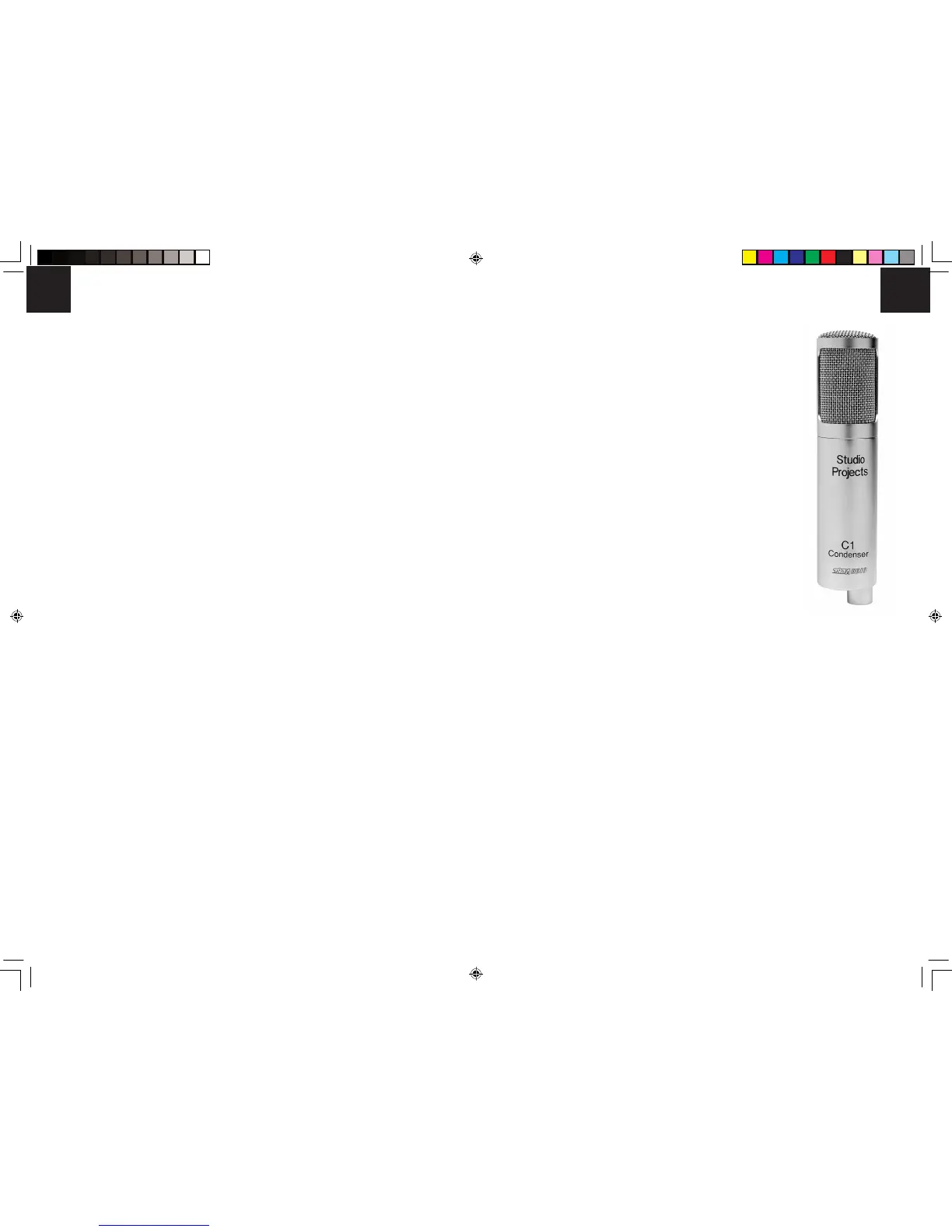
C1
The C1 is a high quality true condenser pressure gradient microphone with
a FET impedance converter. The polar pattern is fixed cardioid. The C1
uses a transformerless circuit which features low noise and wide dynamic
range. The polar response is very linear with a slight rise in frequency
response between the 5 kHz to 12kHz range. Signals coming from the
side and rear are attenuated with very little phase coloration. The C1 also
features a three position switch on the rear which alternately enables a
-10dB pad, and a 150Hz high-pass filter.
The microphone is supplied with a shock mount, windscreen and heavy
duty road case with locking latches.
The capacitor element is manufactured to the classic Braunmuhl Weber
‘center electrode’ design which provides smooth extended frequency
response. The diaphragm material is 6 um Mylar with a vapor deposited
gold coating.
C1 SPECIFICATIONS
Type: Single diaphragm pressure
gradient condenser microphone
Polar pattern: cardioid.
Frequency response: 30Hz~20000Hz.
Sensitivity: 14mV/Pa=-37dB (0dB=1V/Pa).
Output impedance: <200 Ohm.
Load impedance: >1000 Ohm.
Max. SPL: 131 dB SPL for 1% THD @1000Hz (0dB SPL=0.00002Pa).
Noise: (Line): 27 dB (A weighted) ---17 dB.
S/N ratio: 77 dB.
Power requirement: 48 +/- 4V.
Current consumption: <2.5mA.
Circuit: transformerless output circuit, featuring low self noise
and large dynamic range.
Connector: Gold-plated 3-pin XLR
Pad: -10 dB
Low cut: 6 dB/Octave at 150 Hz.
Diameter: 2.1” length: 8.9”
Weight: 26.9oz
USING STUDIO PROJECTS MICROPHONES
Studio Projects solid-state microphones employ high quality externally polarized pressure
gradient transducers with FET impedance converters driving balanced, class-A output circuits.
The vacuum tube model T3 is a transformer balanced class-A circuit designed around the
12AY7 (6072) vacuum tube.
The 27mm capacitor element is based on the classic Braunmuhl Weber ‘center electrode’
design which provides a smooth extended frequency response with a slight bump in response
generally in the 5 kHz to 12 kHz region. The capacitor membrane is 6um Mylar with a vapor-
deposited coating of gold over a proprietary bonding agent.
All models are supplied with an elastic shock mount system and although the microphones
are not particularly susceptible to sounds transmitted through the case, it is advisable to use
this shock mount wherever possible. The C1, C3, T3, and LSD-2 are more sensitive to sounds
from the front than from the rear and sides when used in the cardiod pattern. The front of the
microphone is indicated by the Studio Projects logo. To get the best quality, be sure the sound
source is in line with the front of the microphone. -IMPORTANT NOTE- For up close vocals,
a ‘nylon’ pop shield is recommended to avoid moisture damage to the transducer. Vocalists
should sing across the front of the microphone at a distance of 6” to 24”.
The C3, T3, and LSD-2 are Multi-Pattern microphones which provide cardioid, omni direc-
tional, and figure of eight patterns. This allows the microphone to be utilized in a variety of
recording conditions: The cardioid pattern is directional and used to attenuate sound tran-
sients occurring on the sides and to the rear of the microphone. The omni directional pattern
picks up sounds uniformly from all directions, although it becomes more directional at higher
frequencies. The Figure of 8 pattern rejects sounds from the sides (left/right) while equal but
180° out of phase signals are picked up from the front and rear of the microphone. These pat-
terns will provide the user with a variety of approaches to a given recording application. The
T3 is additionally capable of hypercardioid - which is quite directional and especially useful in
attenuating sound from the sides and sub-cardioid - which offers some of the depth and pres-
ence of the omni, while maintaining directionality as that of a cardioid.
ORIGINS AND MANUFACTURE
Studio Projects Microphones are manufactured in Beijing, China by 797 Audio to a specification
defined by Studio Projects, Torrance, California. All Studio Projects microphones are inspected
and tested at the factory, then inspected and tested again at PMI Audio Groups facility prior to
shipping. Studio Projects microphones meet the requirements of electronic equipment sold both
in the USA, Canada, and the European Union.
APPLICATIONS
• Close miking of instruments with high sound pressure levels
• Announcer’s mic for broadcasting/dubbing
• Home recording and project studios
• Vocalist recording
• Spot mic for: wind instruments, strings, percussion and guitar amps.
• XY - Coincident Cardioids
• Mid-Side Method
• Stereosonic Technique (Blumlein)
• Overheads
5
4



 To Next Page
 Loading...