
 Need help?
Do you have a question about the Studiomaster 16x4x2 and is the answer not in the manual?
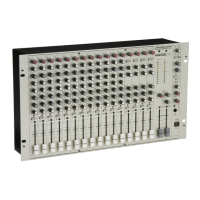
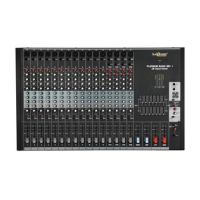
Details the use of the 16x4x2 mixer for demanding live sound situations, emphasizing its versatility and control.
Explains how the 16x4x2 interfaces with 4-track transports for multi-track masters and 2-track mix-downs.
Highlights the flexibility and expandability of the 16x4x2 for theatrical users, supporting dramatic and musical presentations.
Describes the 16x4x2 as a unit for professional audio results in commercial film and video mediums.
Discusses the mixer's suitability for permanent installations, noting its multiple inputs and outputs for signal distribution.
Controls for selecting input type (mic/line) and attenuating high-level signals.
Adjusts preamp gain and features semi-parametric EQ for treble, mid-range, and bass.
Controls for bussing signals to auxiliary masters for effects or monitor feeds.
Controls for signal balance, previewing, and routing to master or subgroup outputs.
Output level control and visual signal status indicator.
Detailed explanation of input switching, attenuation, and variable gain settings.
In-depth description of the semi-parametric EQ with treble, mid-range, and bass controls.
Explanation of Aux 1 (post), Aux 2 (pre/post), and Aux 3 (pre) signal bussing.
Details on pan control, solo function for cueing, and master/subgroup assignment switches.
Functionality of the overload LED and the 100mm channel fader for output control.
Switches for monitoring tape inputs and bussing subgroup outputs to master/monitor sections.
Routing subgroup signal to Aux 3 and controlling subgroup output level with a fader.
Controls for soloing, 1kHz tone generation, and talkback communication.
Controls for monitor output level and assigning aux sends to solo circuit.
Details on monitoring tape inputs and bussing subgroup outputs to master/monitor sections.
Controls for subgroup signal balance, soloing, and output level adjustment.
Function of the slate tone switch and details of Aux 1, 2, & 3 master sections.
Indicators for solo circuit status and bussing 2-track signals to monitor outputs.
Controls for talkback communication and overall monitor output level.
Equalization controls and program faders for master output level adjustment.
Networks for returning auxiliary signals, allowing bussing to subgroups or program outputs.
Controls for panning auxiliary signals and assigning them to master or subgroup outputs.
Detailed EQ specifications for program masters: treble, middle, and bass.
Explanation of 100mm faders for accurate relative signal level indication for program outputs.
Details on auxiliary return networks and control of returning signal levels.
Controls for auxiliary signal balance and routing to program or subgroup outputs.
Console power switch and indicator light functionality.
Details the sixteen input connections, including microphone, line, and patching access points.
Specifications for XLR microphone inputs and 1/4" phone line inputs.
1/4" stereo phone jacks for adding or deriving line level signals to/from individual channels.
Jacks for auxiliary sends and unbalanced line level outputs for subgroups.
1/4" phone jacks for returning -10dB signals from 2-track tape machines for playback.
Details 1/4" monitor outputs and balanced XLR program outputs.
XLR talkback input and 1/4" auxiliary return jacks for signal bussing.
Provides a -10dB signal for recording remixed master tapes.
Switch for 48v phantom power and AC power connection with voltage selection.
Explores various ways the 16x4x2 can be used for live sound, including concert and theatrical applications.
Provides guidance on logical channel layout, initial gain settings (30 for mic, 20 for line), and EQ flat setup.
Explains the use of primary, subgroup, and auxiliary busses, and how to route signals for effects and monitoring.
Details routing signals via auxiliary busses for external effects and monitoring.
Explains grouping inputs for easier mixing, setting levels, and using subgroup pan for placement.
Explains the function of master outputs for overall level control and the addition of three-band equalization.
Illustrates a setup using all 16 inputs, subgroups as sub-masters, and main outputs for program signals.
Shows individual channel patching to external effects devices like limiters, noise gates, and flangers.
Explains that monitor signals are derived from the aux 3 output, which can be pre-fader or both.
Details a larger live system with more critical subgroup assignments and output area changes.
Shows how three independently controlled monitor signals are derived from aux 2 and 3, and monitor output.
Details routing of channels to aux 1 and 2 for effects, allowing blending of 'wet' or 'dry' signals.
Explains how to add a 2-track tape machine for system checkout or intermission fill material.
Describes input setup for multi-track recording, using subgroups as masters for individual tracks.
Explains generating foldback signals for performers using aux 3, subgroups, or tape monitor switches.
Details how to remix 4-track masters to 2 tracks using line inputs and program outputs.
Explains remixing 8 or 16 track masters to 2 tracks by connecting to line inputs.
Discusses routing multi-track signals to program outputs or subgroups for submixing and final outputs.
Explains control room monitoring via program outputs and studio foldback from aux 3 or monitor output.
Details assigning inputs to subgroups for recording and remixing channels directly to masters.
Highlights the need for flexibility and equalization control in theatrical sound mixing due to varied microphones and pickups.
Explains assigning inputs to subgroups for pre-setting scenes and changing them via crossfading.
Shows the use of both live and taped music inputs, with switching from mic to line level.
Details using talkback input and aux 3 output for effective communication between audio engineer and offstage personnel.
Discusses interfacing with video equipment like VTRs, VCRs, cart machines, and film chains.
Explains using channel patching for noise gating seldom-used inputs without consuming auxiliary bussing.
Highlights the compact design's benefit in minimizing editing bay size where space is critical.
Explains how EQ defeat prevents accidental tonal changes and allows technical director to roll off rumbles or boost mids.
Discusses feeding main outputs to a stereo distribution amplifier for multiple VTR/VCR masters and back-ups.
Explains providing foldback for voice-over talent from aux 3 or monitor output.
Details talkback availability for directions and cues from the Tech. Director.
Highlights the mixer's suitability for churches, auditoriums, and meeting rooms due to features and flexibility.
Explains how central mixer location allows mixing and distributing various signal feeds for permanent installations.
Discusses using subgroups as independent outputs for flexible signal distribution in permanent installations.
Illustrates a church application with signal assignments to program outputs and subgroups for sound reinforcement.
Details assigning input 1 to subgroup 3 for feedback to a separate meeting room system.
Specifies maximum input levels and nominal/maximum output levels for various signals.
Details maximum gain figures, signal-to-noise ratio, and crosstalk specifications.
Lists EQ ranges, noise figures, frequency response, and THD specifications.
Specifies input voltage, power consumption, and calibration of LED meters.
 General
| Brand | Studiomaster |
|---|---|
| Model | 16x4x2 |
| Category | Music Mixer |
| Language | English |


 To Next Page