Lighting the fire
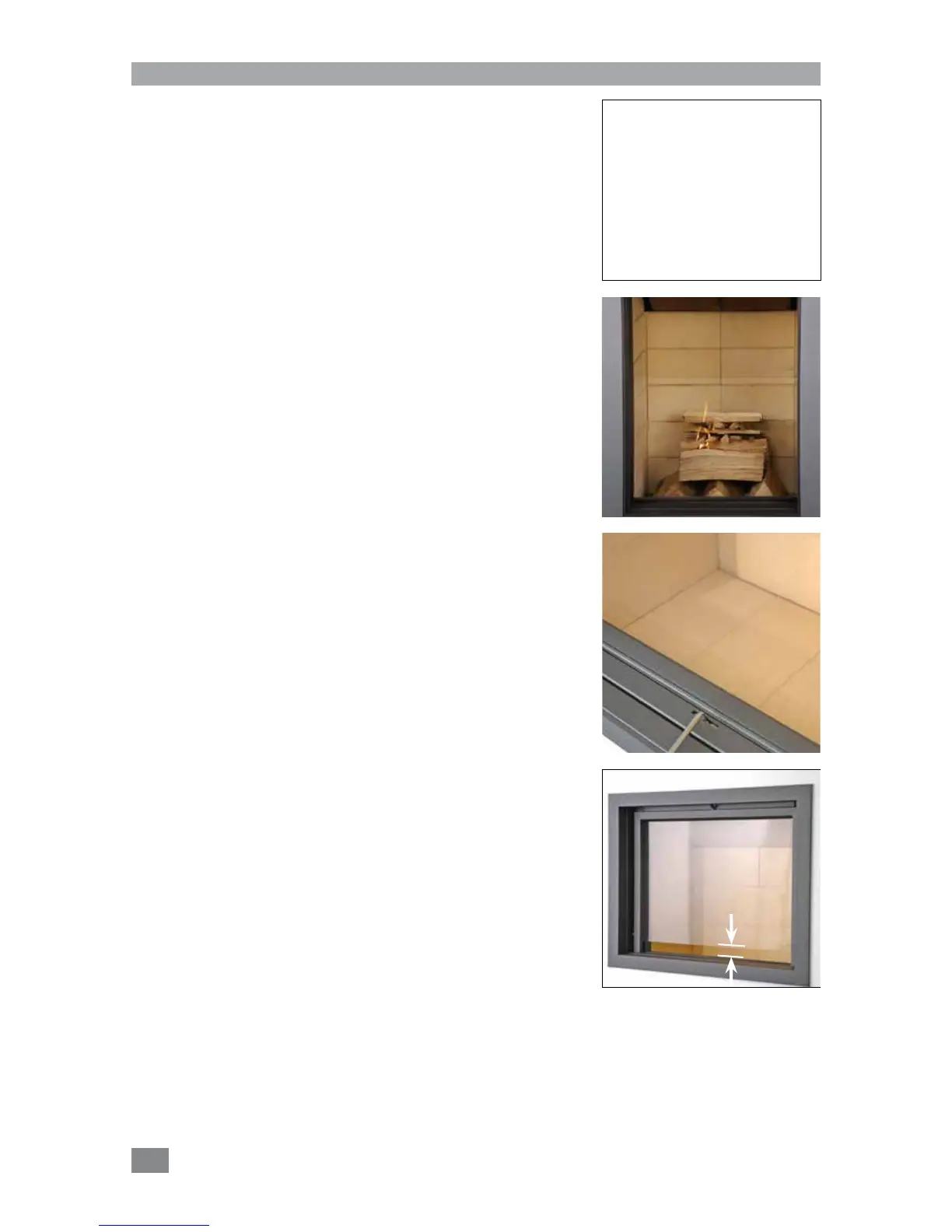
The upside-down fire ! [photo 1]
To light the stove, Stûv recommends
the upside-down fire technique, which
is more environmentally friendly
and subsequently results in better
combustion.
This technique involves placing a bed
of logs in the bottom of the stove and
lighting the fire on top of them.
The benefits :
– By placing the logs underneath, you
will considerably reduce the amount
of smoke generated on lighting the
fire, while gradually increasing the
temperature.
– Once the logs underneath have
caught fire, the gases they release
must pass through the flames. These
gases rise in temperature and are
almost entirely burnt off. The result
is less CO and less particulates !
– Using this method, you no longer
need to wait for the kindling to be
blazing before adding the logs and
there is no longer any risk of these
collapsing during combustion.
– What's more, you improve the
stove's efficiency with more
complete combustion.
Note
In certain atmospheric conditions
(if the temperature outside is higher
than inside), the operation of the flue
can be hindered. Therefore use more
paper and kindling wood to heat
up the flue and to re-establish the
draught.
Combustion is not optimal below a
certain rate, the waste is greater, the
glass door gets dirty quickly and in
some cases there is a risk of the fire
going out.
If your stove is fitted with a fan and
an electricity failure occurs, reduce
the rate by turning the regulator
lever to “slow fire down” to avoid
overheating.
Before lighting
After a period of inactivity, check
that there are no obstructions in the
system, its ducts or the air inlets and
outlets or any mechanical blockages.
Your Stûv requires air
Your Stûv requires air for combustion.
Your installation engineer will ideally
have created a fresh air inlet under the
stove.
Open this outside air inlet : completely
to operate the stove in open-fire
mode, or partially (around 20%) to
operate with the door closed.
If you have not created an outside
air inlet under the stove (or nearby)
to feed combustion, ensure there is a
sufficient outside air inlet (see table)
and adhere to all local and national
regulations in force.
Always keep this air inlet clear.
Please note that the operation of
your stove may be affected (risk of
draught-back) if other air consuming
systems are installed in the same
room (air extractor, kitchen hood,
air conditioning system). Create
additional air inlets in the room based
on their consumption.
Principle
Start the fire rather briskly to heat
up the fireplace and create a good
draught.
When the fire is lit, the flue is filled
with cold air (heavier than the smoke).
If the fire does not start vigorously
enough, the smoke will not get past
this bottleneck and the stove will
produce a draught-back.
Therefore make sure you use enough
kindling wood.
Minimum section for combustion air feed
from outsider
Model Section
Values given for information purposes for
just one stove.




 To Next Page