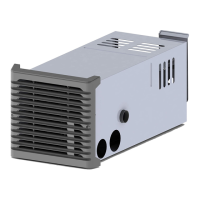
B.
INSTALLATION DIRECTLY AGAINST INNER WALL OF COACH
(See Figure 2)
I
Maximum wall thlckness for thls
type
Installation Is 2 114.
1
1. Locate the furnace near lengthwise center of the coach. Do not install the
furnace with the vent facing toward the forward end of
the coach.
2. Choose a location for installation out of the way of wires, pipes, etc. which
might interfere with the installation. Adhere to the
mihimum clearances from the
cabinet to combustible construction as listed in Table 1. Refer to Figure 3 for
illustration of furnace clearances.
3.
When an wpliance is installed Jirectly on carpeting, tile or other combustible
material, other than wood flooring, the appliance shall be installed on a metal or
wood panel extending the full width and depth of the appliance.
If
preferred, the
carpeting, tile or combustible materials, other than wood may be cut away the full
length and depth of the appliance plus the appliance minimum clearances to
combustibles. (See Table 1
.)
4.
Locate center lines forexhaust and intake tubes as shown in Figure 1. Cut two
2
314 diameter holes through coach wall for exhaust and intake. (See Figure
2.)
5.
Put furnace in place, making sure that rear of furnace cabinet is as close to
inner wall of coach as possible and still assure proper vent tube overlap. (See
Installing Vent Assembly).
6.
Fasten furnace to floor of coach using the two holes provided in front plenum
area of furnace cabinet. (See Figure 1
.)
7.
Install vent assembly. (See instructions for ~nstalling vent.)
C. INSTALLATION USING VENT EXTENSION TUBES
When it is not possible to install the furnace as described in installations A or
0.
extension tubes must be used to connect the exhaust and intake tube to the vent
assembly on the outside of the coach.
Avoid the use of extension tubes whenever possible.
If
they must be used, it is
important that the correct length tubes are used.
In order to determine the correct extension tube kit, you must determine the range
in which the extension falls. To do this, position the furnace in its permanent
location and measure the distance from the end of the exhaust and intake tube
lo the outer edge of the coach skin. This determines the extension tube range you
need. Figure 4 lists by kit number the vent extension range up to
9".
Example: If the distance you measured is 2
7/8",
using Figure 4as your guide, you
will order Kit
#520498, which accommodates a range from 2 114" to 3 118". The
extension tube kit comes with complete installation instructions.
TABLE
1
INSTALLING VENT ASSEMBLY
The vent outlet must be installed so it is in the same
atrnosplleric pressure zone
as the combustion air intake. The exhaust and intake tubes must be installed
from the outside, pass through the RV skin and slide onto the furnace exhaust
and intake.
I
WARNING! Do not alter the vent assembly supplied with this furnace. Any
modifications will result in improper installation which could cause
I
(unsafe furnace operation.
I
CAUTION! Combustion air must not
be
drawn from the living area. All alr for
combustion rnust
be
drawn from the outside atmosphere. All exhaust gases
must be vented to the outside
atmosphere
-
never inside the
RV.
Therefore,
it is essential to insure that the vent cap and tube assemblies are properly
installed.
1. Apply caulking to RV skin behind vent cap as shown in Figure 2. Apply caulking
generously around perimeter of vent cap and across center as shown.
2. lnsert intake tube through RV skin and slide it onto the furnace intake
(See
Figure 2.) Minimum tube overlap of 112" is required.
3.
lnsert vent cap exhaust tube through RV skin and slide it onto the furnace
exhaust (See Figure 2.) Minimum tube overlap of 1 114" is required.
4.
Attach vent cap assembly to outer skin of RV with the six (6) screws provided.
Do not install vent assembly upside down. The words "Suburban" and "Dayton.
Tenn." must be right side up.
5.
Attach the vent assembly to the furnace using the special 3 112" screw
provided. Insert screw through hole provided in exhaust opening of vent assembly
and secure to bracket in exhaust tube of fumace. This anchors the fumace to the
vent assembly and the outer skin of the RV (See Figure 2.)
CONNECTING GAS SUPPLY
Connect the gas supply to the fumace
at
the manifold, following the suggestions
outlined below:
NOTE: The compound usea on threaded joints must be resistant to liquefied
petroleum
(LP) gas.
NOTE: The
appli&,~ce must be dis~&~inected from the gas supply piping system
during
anyaressure testing of that system at test pressure in access of 112 PSIG.
The
appl~ance must be ~solated from the gas supply plplng dur~ng any pressure
testing
of the gas supply piplng system at test pressure equal to, or less than. 112
PSIG
1. Be sure that the gas fitting is outside of the furnace jacket and easily
accessible. (See Figure 1
.)
The fitting may be connected directly to the 90" elbow
at the gas inlet to the furnace. To assure an airtight seal, be sure the gasket
provided with the furnace is installed between the fitting and the furnace cabinet,
as illustrated in Figure 1.
If
this gasket is omitted, it could result in overheating of
component parts within the furnace.
2. In order to maintain a check on gas supplied pressure to the fumace, a
118"
NPT plug tap must
be
installed and accessible for test gauge connection
immediately upstream of the gas supply connection to the fumace.
3.
After the furnace has been connected to the gas supply, all joints must
be
checked for leaks.
WARNING! Never check
for leaks with an open flame. Turn on the gas and
apply soapy water to all joints to
see
if bubbles are formed.
CONNECTING ELECTRICAL SUPPLY
CAUTION: This furnace is designed for negative ground 12 volt D.C. system
only. Do not attempt to alter the furnace for a positive ground system or
connect the furnace directly to 115 volts A.C. Damage to furnace
component parts will occur.
Be sure all wiring to the fumace is of heavy enough gauge to keep the voltage
drop through it to a minimum. No. 12 gauge wire is recommended.
If
any of the
original wire that is supplied with the appliance must be replaced, it must
be
replaced with Type 105°C or its equivalent.
Connect the power supply to the quick connect pigtail on the
right side of the
fumace. The wires are color coded, red for positive
(+)
and yellow for negative
(-).
This polarily must be observed so the furnace motor will run with the proper
direction of rotation to insure correct air delivery. (See wiring diagram.)
If the furnace power supply is to
be
from a convertor, we recommend that the
convertor system used to power the fumace be wired in parallel with the battery.
This will service two purposes.
1. Provide a constant voltage supply to the furnace.
2. Filter any A.C. spikes or volt surges.
CONNECTING DUCTS TO FURNACE
The following duct requirements must be followed in order to assure proper
operation of the furnace.
1. For Models NT-24SP and
NT-30SP, maintain a minimum of 36 square inches
open duct area throughout entire duct system including through register.
(Minimum 3 ducts
-
4" diameter.)
For Model
NT-34SP, maintain a minimum of
48
square inches open duct area
throughout entire duct system including through register. (Minimum 4 ducts
-
4"
diameter.)
On all models,
maintair~ a minimum of 48 square inches throughout entire duct
system including through register when under flwr ducting is used.
NOTE: Ducts terminating in a dead air space (like holding tank
compartments) with no means for return air recirculation should not
be
counted in the required duct area. Also, ducts
2"
In diameter or smaller
should not
be
counted in the required duct area.
2. Make the duct connections at the furnace cabinet tight. Loose connectionswill
result in overheating of the component
parts on the fumace and a reduction of the
heated air flow through the duct system.
3.
Avoid making any sharp tums in the duct system. Sharp turns will increase the
static pressure in the plenum area and could cause the fumace to cycle.
4.
Avoid making a lot of tums in the duct system. The straighter the duct system,
the better the performance of the fumace.
5.
Maintain a minimum of 1" clearance where ducts pass through any
combustible construction such as, coach cabinetry. (See Figure
3.)
NOTE: UL
listed duct materials can
be
"0" clearance.
6.
Do not install air boosters in the duct system. Such devices will cause the
furnace to cycle on limit and cause erratic sail switch operation.
NOTE: After installation of the furnace and duct system is completed.
adjustments must
be
made to obtain a temperature rise within the range specified
on the Rating Plate.
INSTALLING THERMOSTAT
Locate the rwm thermostat approximately 4
112 feet above the floor on an inside
bulkhead where it is not affected by heat from any source except rwm air.
Connect thermostat wires to the blue wires leaving power supply plug on right
side of fumace. (See wiring diagram.)



 To Next Page
 Loading...