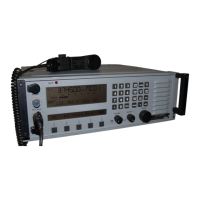
RT-9000C Hardware Supplement
Document No. 8121000602
Revision A (19 Mar 2007)
8-25
RT-9000 C
The Audio Assembly also contains circuitry that supports other radio operations. The following describes
these additional functions:
• Keyline signals from front and rear panels, CW key, and specialized internal sources are combined
for integrated keyline control. Regenerated keyline signal outputs are also created for companion
equipment control.
• Audio metering circuits provide the capability to measure audio levels at USB and LSB receive and
transmit 600-Ohm Line Audio points.
• Receive BITE audio circuitry switches signals during BITE operation.
• High-current drivers supply switched +12 V Receive and +12 V Transmit voltages. Drivers for RX
Antenna and TX Antenna relays are also included. The 1A2A1 CPU Assembly controls all these
functions.
• The Audio Assembly also provides digital communication with its companion Digital IF Assembly.
This interface point allows Audio Assembly to pass control signals to and from the Digital IF
Assembly. This is necessary to support backward compatibility of this Digital Audio and IF board
set with earlier radio equipment.
8.3.2.2.2 Transmit-State Operation
1A2A3 Digital Audio Assembly
Operator microphone audio or CW key input signals enter the transmitter circuitry from the front panel.
Audio can also originate from the 600-Ohm Line Audio inputs on the rear panel. These signals enter the
1A2A3 Digital Audio Assembly through card edge connector P1. Each signal source enters the circuitry at
different points and has separate signal paths.
Microphone audio is routed to internal adjustment potentiometer R152, which sets its level. The
microphone signal is amplified by U3-A and is then low-pass filtered by U3-B, U15-A, and U15-B.
Two rear-panel 600-Ohm transmit Line Audio inputs are used to introduce audio signals into dedicated
USB and LSB signal paths. USB audio is coupled through transformer T1 to amplifier U37-A and then
low-pass filtered by U1-D, U2-A, and U2-D. LSB audio similarly is coupled through transformer T2 to
amplifier U37-B and then low-pass filtered by U1-C, U2-B, and U2-C.
When the radio is used in CW Mode, the CW key signal is detected by U5-F. This CW signal and all three
main audio signals are routed through top connector 1A2A3J1 to the Digital IF Assembly.
1A2A4 Digital IF Assembly
USB and LSB Line Audio, microphone audio, and the detected CW signal enter the Digital IF Assembly
through top connector 1A2A3J1. The USB, LSB, and microphone audio signal paths are directed to
analog-to-digital converters U303, U304, and U305, respectively. This process converts each audio
signal path into a serial digital output stream, which then passes to digital signal processor U401 and is
digitally filtered. U401 also selects and combines these input signal streams according selected emission
mode. The transmit output signal of U401 is a 14-bit parallel-formatted digital signal, which is routed to
direct digital synthesizer U201.
Direct Digital Synthesizer U201 produces a 455 kHz suppressed-carrier analog signal, which can contain
both USB and LSB signals. The USB and LSB signal sidebands are transposed due to the frequency
conversion scheme used by this design. For example, the USB transmit audio
input signal will leave
U201 as an LSB signal. This signal becomes an USB signal
after the last frequency conversion to the
selected radio operating frequency.


 To Next Page
 Loading...