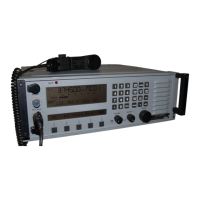
RT-9000C Hardware Supplement
Document No. 8128000602
Revision A (19 Mar 2007)
8-24
RT-9000 C
Solid-state SPDT switches U4 and U5 control the selection of filters FL3 or FL4. These switches operate
together but operate only for specific combinations of Mode and Receive-state or Transmit-states.
The filtered signals from filters FL2 and/or FL3 or FL4 pass through solid-state SPDT switches U3 and U6
for further processing. The operation of switches U3 and U6 is related to receive or transmit states. In
receive-state, both switches always use the “common-to-normally connected” signal path. In transmit-
state, each switch’s operation is dependant upon the selected emission mode and is covered later.
The USB signal leaving solid-state switch U3 is routed to low-noise amplifier U7 and then low-pass
filtered by U17. The signal is then converted to a serial digital stream by analog-to-digital converter U301
and sent to digital signal processor U401.
The LSB or AM signal leaving solid-state switch U6 is similarly processed as the USB signal. In this case,
the signal passes to low-noise amplifier U8 then low-pass filtered by U18. Analog-to-digital converter
U302 converts the signal to a serial digital stream. This signal is also sent to digital signal processor
U401.
Digital signal processor (DSP) U401 evaluates the signal characteristics of these two signal streams and
determines the required gain settings for each signal path. U401 generates appropriate feedback signals
in digital serial format to control the gain of earlier amplifier stages for both signal paths. These digital
signals are sent to digital-to-analog converters U315, U306, and U307. The feedback signals, now
converted to analog equivalents, are applied to pin 10 of low-noise amplifiers U1, U7, and U8,
respectively.
The USB and LSB/AM signal input streams continue their progress in U401 and are digitally filtered. This
filtering process ultimately establishes the receiver bandwidth characteristics.
In receive-state, U401 produces three main digital output signal streams. These are: USB, LSB, and
Speaker Audio. The USB and LSB serial signal streams are converted back to analog signals by digital-
to-analog converters U308 and U309, respectively. These analog output signals are routed through top
connector 1A2A4J1 to the 1A2A3 Audio Assembly and ultimately become Line Output signals.
U401 also develops processed audio for the radio front-panel speaker and produces this signal as a
separate serial digital output. Setting information from front-panel Volume and Squelch controls enter
channel 0 and 1 inputs of multiplexer/analog-to-digital converter U314. These signals are converted to
digital values and enter U401. U401 produces a Speaker Audio digital signal stream output, which passes
to digital-to-analog converter U301. U301 generates the Speaker Audio analog output signal in
accordance to the original Volume control setting sent as part of digital stream. The analog Speaker
Audio signal is routed through top connector 1A2A4J1 to the 1A2A3 Audio Assembly.
When the Squelch feature is enabled by the front-panel control & switch, U401 controls this function. The
squelch function uses both received signal strength and syllabic content to determine its operating
threshold. The front-panel Squelch control sets the signal strength section of the threshold. The syllabic
portion is fixed and a true syllabic type. Its operation uses a special algorithm, which operates on voice
characteristics and rejects unwanted signals such as noise or data. The Speaker Audio digital signal
stream output to U310 is enabled whenever the received signal strength and syllabic content exceed both
threshold sections.
1A2A3 Digital Audio Assembly
USB, LSB, and Speaker Audio signals enter the 1A2A3 Digital Audio Assembly through top connector
A2A3J1. Each receive-state audio signal path is low-pass filtered to remove undesired high frequency
resulting from digital-to-analog conversion process on the Digital IF Assembly. These filters consist of
U13-D, U14-C, and U14-D for the USB path. The LSB filters consist of U13-A, U14-B, and U14-A. The
Speaker Audio filters consist of U15-D, U3-C, and U3-D. The filtered USB and LSB audio signals pass to
the rear-panel 600-Ohm audio drivers, U16-A and U16-B, respectively. Filtered Speaker Audio is routed
to speaker driver U12.


 To Next Page
 Loading...