Need help?
Do you have a question about the SUNBA Analog Series and is the answer not in the manual?
Details common equipment for decoding analog camera signals like DVRs and monitors.
Focuses on initial setup, including bench testing and warnings about power requirements.
Guides on performing a bench test to ensure camera functionality before outdoor installation.
Guides the selection of appropriate mounting brackets, such as ceiling or wall mounts.
Provides steps for aligning the camera mount using specific marks ('L' and 'T') for secure installation.
Covers methods for extending AC/DC power cables and using twisted pair for RS485 connections.
Lists crucial installation precautions, like avoiding IR LED obstruction and improper cable use.
Explains PTZ address bits as unique IDs for camera recognition and the default setting.
Highlights issues with duplicate addresses and their impact on camera control.
Step-by-step guide to changing the camera's address via OSD menu and rebooting for effect.
Covers setting, calling, and managing preset PTZ positions for automated camera movements.
Details special presets for advanced functions like scan boundaries and OSD menu access.
Explains how to set up and activate patrol tours by sequencing multiple preset positions.
Lists all special presets and their functions, including format switching and scan control.
Notes on how patrols and scans interact with user commands and park actions.
Guide to accessing and navigating the camera's On-Screen Display menu using preset commands.
Overview of key OSD menu items like SOFT ADDR, PARK ACT, PARK TIME, and FRAME SPEED.
Explains advanced OSD settings including LED MODE, IR SENS, and camera reset functionality.
Describes the camera's self-diagnostic process and troubleshooting steps for common issues.
Provides solutions for prevalent problems like PTZ failure, video issues, and power loss.
Details the required information for contacting support for warranty claims or requesting replacement parts.
Specifies the return window, the RMA process, and requirements for product returns.
Explains refund processing, complete package requirements for returns, and potential restocking fees.
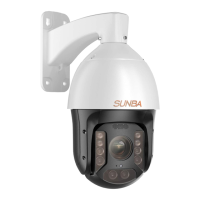
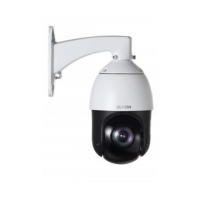
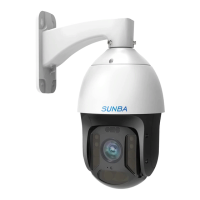
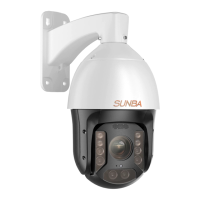
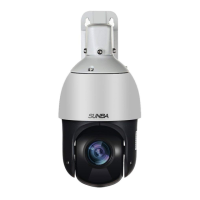
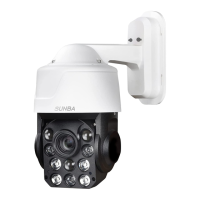
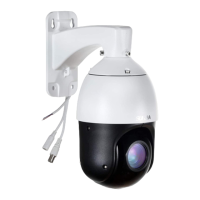
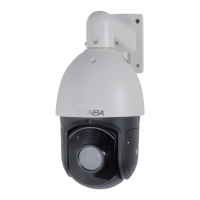
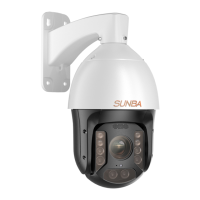
This document serves as a user manual for the Sunba® PTZ Analog Camera Series, providing comprehensive instructions for installation, operation, and troubleshooting. The camera is designed for professional surveillance applications, offering pan, tilt, and zoom (PTZ) functionalities.
The Sunba PTZ Analog Camera is a surveillance device that captures video and allows for remote control of its viewing direction and magnification. It operates by generating a 960H CVBS signal, which requires a decoder to display images on a monitor. Compatible decoding equipment includes 960H Digital Video Recorders (DVRs) or CCTV monitors with built-in CVBS decoders. The camera's PTZ capabilities are controlled using the Pelco D protocol and RS485 standard, enabling users to pan, tilt, and zoom the camera remotely. Control can be achieved through a DVR with an RS485 port or a 3D Pan Tilt Zoom Joystick, which is typically used with DVRs lacking an RS485 port or with CCTV monitors.
The camera features an On-Screen Display (OSD) menu, accessible by calling a specific preset (95+CALL), which allows for configuration of various settings. These settings include the soft address, park action, park time, frame speed, LED mode, IR ON/OFF sensitivity, and a reset option. The soft address is a unique ID assigned to each PTZ camera, enabling the terminal controller (DVR/Joystick) to distinguish and control multiple cameras connected to it. The park action function allows the camera to automatically execute a predefined preset action after a period of inactivity, with a default idle time of 15 seconds. The frame speed determines the rate at which the dome scans continuously between two preset points. The LED mode can be set to AUTO, where IR LEDs turn on and off automatically based on ambient light levels, or MANUAL, allowing for manual control of the IR LEDs. IR ON SENS and IR OFF SENS values define the photoresistor thresholds for activating and deactivating the IR LEDs, respectively, with a recommended difference of at least 30 between these values to prevent flickering.
The camera supports preset positions, which are memorized PTZ locations that can be recalled directly. Users can "add" and "call" these presets, and they can also be "deleted." Special presets are available for advanced commands, such as setting auto scan boundaries, initiating patrols, or configuring IR settings. A patrol, also known as a tour or cruise, allows the camera to travel sequentially between up to 10 saved presets. The camera also supports pattern recording, which allows it to record and replay a sequence of up to 10 actions. Furthermore, the camera can switch its video signal format between AHD, CVBS, NTSC, and PAL using specific special presets.
Before permanent installation, it is crucial to perform an indoor bench test to ensure the camera functions correctly. This involves connecting the camera directly to its default power adapter without extending the power line. This step helps rule out power supply issues that can cause problems like screen flickering, unstable infrared operation, or erratic camera movement. When mounting the camera, specific instructions are provided for aligning the mount with marks on the camera body to ensure proper tightening.
For cable extension, it is recommended to use AWG18 or thicker DC cables for longer distances to minimize voltage loss. For RS485 control, any twisted pair from an Ethernet cable (cat5/5e/6) can be used, ensuring consistent +/- or A/B polarity between the DVR and the camera. It is advised against using 3-in-1 cables designed for bullet cameras, as they often have parallel wiring, which is not ideal for twisted pair communication.
Setting the unique PTZ address bit for each camera is essential, especially when multiple PTZ cameras are connected to the same controller. The default address is 1, and if multiple cameras share the same address, they will respond simultaneously to control commands, leading to confusion. The address can be modified through the OSD menu. After changing the address, the camera must be rebooted for the changes to take effect, and the corresponding address in the DVR's PTZ control setup page must also be updated.
The camera's self-diagnostic process, which involves horizontal and vertical panning upon power-up, confirms the functionality of its PTZ, lens, and other components. This built-in test helps identify initial hardware issues.
The manual provides a troubleshooting section to address common issues. For PTZ not working properly, solutions include checking the RS485 cable for proper connection and polarity, ensuring the RS485 connector is functional, and verifying the address setting in the DVR. If the camera displays a black and white image, it suggests an inconsistency in signal format (PAL or NTSC) between the camera and DVR, which might occur after a reset. Red lights without power indicate a defective power adapter, prompting users to test with another adapter or request a replacement. Video disconnection issues can be resolved by checking or replacing the BNC cable or addressing underpower. Problems like the camera powering off automatically, flashing/flickering screens, reboots at night, or automatic spinning are often attributed to underpower or adapter defects.
The manual also outlines a warranty claim step, requiring users to provide specific information to the Sunba support team, such as the order number, camera features (pan, tilt, zoom, self-test working), and checks on RS485 and BNC connections. A detailed description of how the camera was powered and any relevant extension cable information, along with a description of the problem, is also requested. This information helps the support team diagnose issues and facilitate part replacements.
Sunba offers a 2-year limited US warranty covering parts, with labor fees for repairs inside the warehouse. Parts replacements are covered, and instructions for self-repair are provided. The warranty does not cover physically damaged products or those under abnormal operating conditions due to misuse or improper installation. The return policy allows for product returns within 30 days of receipt, with a Returned Merchandise Authorization (RMA) number required for processing. Products must be returned in their original packaging, including manuals, brackets, and toolkit, to avoid restocking fees. Refunds are processed within 24 hours after the warehouse receives the return package with the RMA.
 General
| Series | Analog Series |
|---|---|
| Category | Security Camera |
| Night Vision | Yes |
| Weather Resistance | Yes |
| Operating Temperature | -20°C to 50°C |
| Lens Type | Fixed |
| Power Supply | DC 12V |

 To Next Page