Need help?
Do you have a question about the Sunex Tools SX113 and is the answer not in the manual?
Lists key specifications like speed, torque, air pressure, consumption, and sound level for the SX113 air ratchet.
Outlines risks from dust exposure, including cancer and birth defects, and provides examples of hazardous chemicals.
Emphasizes reading the manual, following safety codes, and understanding tool operation before use.
Covers essential safety gear, avoiding vibration, maintaining balance, and safe practices with air pressure.
Provides a detailed list of parts for the SX113 3/8" Dr. Air Ratchet Wrench with reference numbers and quantities.
Explains recommended air pressure, quality, hose size, and connection procedures for optimal tool performance.
Guides on daily lubrication and operational advice, including handling rusted nuts and avoiding overcapacity.
This document outlines the operating instructions, warning information, and parts breakdown for the SUNEX SX113 3/8" Dr. Air Ratchet Wrench. It is crucial for users to read and understand all information provided before operating this tool to ensure safety and proper functionality.
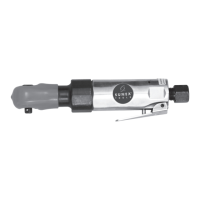
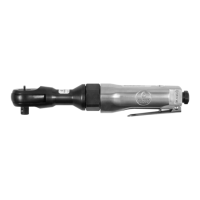
The SUNEX SX113 is a 3/8" drive air ratchet wrench designed for various fastening and unfastening tasks. It operates using compressed air to provide rotational force, making it suitable for automotive, construction, and general maintenance applications where a compact and powerful fastening tool is required. The ratchet mechanism allows for quick and efficient tightening or loosening of bolts and nuts, particularly in confined spaces where a traditional wrench might be difficult to use. Its air-powered operation ensures consistent torque delivery and reduces user fatigue compared to manual tools.
The air ratchet wrench is designed for ease of use and efficiency. To operate, it requires a clean, dry air supply connected via a 1/4" NPT air inlet. The recommended air pressure at the tool, while running free, is 90 PSI (6.2 bar). Operating at higher pressures can increase performance but may also shorten tool life due to accelerated wear and potential injury. The tool's design emphasizes user safety, with warnings against overreaching, carrying the tool by the hose, and prolonged exposure to vibration. It is important to place the tool on the work surface before starting it and to maintain a balanced and firm working stance. The tool's shaft may continue to rotate briefly after the throttle is released, so direct contact with accessories during and after use should be avoided. Gloves are recommended to reduce the risk of cuts and burns. The wrench is rated for a 3/8" USS bolt size, but this rating should be adjusted downward for specific applications such as spring U-bolts, tie bolts, long cap screws, double-depth nuts, badly rusted conditions, and spring fasteners, as these can absorb a significant amount of the impact power. To maximize efficiency, users should employ the simplest possible tool-to-socket hook-up, as every connection absorbs energy and reduces power. When dealing with rusted nuts, it is advisable to soak them in penetrating oil and break the rust seal before attempting removal with the ratchet wrench. If a nut does not begin to move within three to five seconds, a larger size ratchet wrench should be used. Forcing the tool beyond its rated capacity will drastically reduce its lifespan.
Proper maintenance is essential for the longevity and safe operation of the SX113 air ratchet wrench. Lubrication is a critical daily task. The air motor should be lubricated daily with quality air tool oil. If an air line oiler is not in use, a teaspoon of oil can be run through the tool by squirting it into the air inlet or into the hose at the nearest connection to the air supply, and then running the tool. The air supply itself must always be clean and dry. Dust, corrosive fumes, and water in the air line can cause significant damage to the tool. Therefore, the air tank should be drained daily, and the air inlet filter screen should be cleaned at least weekly. The recommended hookup procedure, including a filter, regulator, and oiler, should be followed to ensure a clean and lubricated air supply. The hose diameter should be a minimum of 3/8" I.D., and all fittings should have the same inside dimensions and be tightly secured. Line pressure may need to be increased to compensate for unusually long air hoses (over 25 feet). Regular inspection of hoses and fittings is crucial; any damaged, frayed, or loose hoses and fittings must be replaced immediately. Quick-detach couplings should not be used at the tool. The tool should always be kept in efficient operating condition, and any labels should be maintained and replaced if damaged. Users should never attempt to force the tool beyond its rated capacity. Adherence to these maintenance guidelines will help ensure the tool's optimal performance and extend its service life.
 General
| Model | SX113 |
|---|---|
| Type | Impact Wrench |
| Drive Size | 1/2 inch |
| Air Inlet | 1/4 inch NPT |
| Air Consumption | 4.2 CFM |

 To Next Page