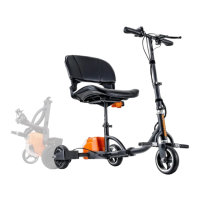
This document describes the SuperHandy 4-Wheels Folding Mobility Scooter, models GUT164 and GUT165, an electrically powered scooter designed to provide mobility for individuals with full use of their upper and lower extremities who can support themselves in an upright position. It is primarily intended for indoor use, with limited outdoor capabilities on hard, flat, and even surfaces. This product is not a medical device.
Function Description
The SuperHandy Folding Mobility Scooter offers personal mobility with a focus on safety and ease of use. It features a foldable design for portability and storage, and is operated via a handlebar with an accelerator and brake controls. The scooter is designed for a single operator aged 16 or older and has a maximum weight capacity of 330 lbs (150 Kgs).
Important Technical Specifications
- Load Capacity: 330 lbs (150 Kgs)
- Forward Speed: Up to 3.7 mph (6 km/h)
- Reverse Speed: 1.5 mph (2.4 km/h)
- Range per Charge: Up to 6.5 miles (10 km)
- Unfolded Dimension: 41.7" x 23.6" x 38.2" (1060 x 600 x 970 mm)
- Folded Dimension: 40" x 23.6" x 12.2" (1020 x 600 x 310 mm)
- Handlebar-to-Ground Height Range: 23.6" - 34.3" (600 - 870 mm)
- Seat-to-Ground Height Range: 21.3" - 23.6" (540 - 600 mm)
- Frame Weight: 37 lbs (16.7 Kgs)
- Detachable Battery Weight: 2.0 lbs (0.9 Kgs)
- Seat Weight: 8.2 lbs (3.7 Kgs)
- Product Weight: 47 lbs (21.3 Kgs)
- Seat Size: 17" x 15" (430 x 380 mm)
- Ground Clearance: 2.5" (65 mm) at midframe
- Tire Size: 6.75" solid
- Brake Type: Drum brake, manual
- Brake Distance: <39" (1.0 m)
- Motor Input Voltage: 48V DC
- Motor Type: Brushless hub motor
- Detachable Battery Voltage: 48V DC
- Detachable Battery Capacity: 2.0Ah
- Detachable Battery Type: Li-ion battery
- Continue Working Time per Charge: Up to 1h20min
- Charger Input Voltage: 100-240V
- Charging Time: 1h30min
Note: Top speed and range per charge depend on rider weight, wind speed, temperature, riding style, riding surface, battery condition, and other factors. The maximum total weight limit of 330 lbs (150 Kgs) should never be exceeded.
Usage Features
- Folding Mechanism: The scooter features a folding lever that allows the handlebar to be folded down for compact storage and transport. To unfold, lift the handlebar until a "click" is heard, indicating it's securely locked. To fold, push the handlebar forward slightly, then push the folding lever forward to unlock, and fold down until it clicks into position.
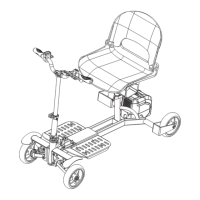
- Handlebar Controls: The handlebar includes an accelerator (right thumb control), a brake handle (left side), a power switch (red knob on the left), and a forward/reverse control knob (left side).
- Accelerator: The right thumb control acts as the accelerator; pressing it further increases speed.
- Brake System: The left brake handle controls a mechanical drum brake on the rear wheels. Actuating the brake handle stops the scooter and cuts power to the motor. Releasing the brake and pressing the throttle reconnects power. A parking brake is located at the front of the handle; actuate the brake handle first, then press the parking brake to lock the rear wheels.
- Forward/Reverse Control: A control knob on the left side allows selection of driving direction. Pushing upward engages forward drive, and pushing downward engages reverse. A one-second delay is built in for electrical system protection when switching directions.
- Battery LED Display: An LED display on the handlebar shows battery capacity: 3 LEDs (100%-70%), 2 LEDs (70%-30%), 1 LED (less than 30%). It is recommended to charge the battery if only one LED is lit.
- Detachable Battery: The scooter uses a 48V Lithium-Ion battery that is easily detachable. It locks into the housing with a "click" and can be removed by pressing a release button.
- Seat Height Adjustment: The seat can be repositioned to different heights by loosening the seat post clamp, removing the seat and post, adjusting the height, aligning adjustment holes, inserting the clevis pin, and tightening the clamp.
- Fender Assembly: Fenders are inserted into assembly hooks above the front wheels and secured with screws.
- Front Wheel Assembly: Front wheels are attached to the shaft with a flat washer and nut, which must be securely tightened.
- Optional Basket: An optional basket can be installed by hooking it over the handlebar and securing it with a Velcro band.
- Safe Operating Conditions: Operators must read the manual, comply with local laws, use both hands on the handlebar, keep feet on footrests, and slow down before turning. Avoid traffic, wet/frozen/oily/unpaved surfaces, and inclines steeper than a standard handicap ramp. Do not carry passengers or exceed weight limits.
- Incline Operation: When climbing inclines, approach straight on at slow speeds, allow more power to the motor to maintain momentum. If momentum is lost, apply the hand brake, place feet on the ground, and walk the scooter up or down. When descending, actuate brakes to control speed.
- Surface Conditions: Intended for hard, flat, dry paved surfaces. Avoid mud, sand, ice, water, sharp bumps, drainage grates, potholes, and uneven surfaces. Small wheels cannot roll over objects higher than 2 inches (5cm).
- Visibility: Do not ride at night or in poor visibility without a lighting system and approved reflectors.
- Temperature: Do not use below 0°C (32°F).
- Water Resistance: While some water resistance measures are in place, avoid riding through standing water, rain, or muddy conditions. Do not immerse or directly spray with water.
Maintenance Features
- Battery Charging: The 48V Lithium-Ion battery should be fully charged before first use and after long periods of non-usage. It is shipped at approximately 50% charge. The charger's LED is red during charging and turns green when fully charged. Charge in a clean, dry, well-ventilated area. Frequent partial discharge/charge cycles prolong battery life. Fully charge before storing for extended periods.
- Battery Storage: When not in use for long periods, remove the battery and periodically recharge it every 8 months. Store on a full charge, indoors, out of direct sunlight, and away from high temperatures.
- Battery Care: Avoid shorting battery terminals with metal objects. Do not leave the charger connected for more than 24 hours. If the battery becomes warm during charging, disconnect it and allow it to cool before attempting to charge again.
- Charger Maintenance: Regularly inspect the charger for damage to the cord, plug, enclosure, and other parts. Do not use a damaged charger. Unplug the charger from the wall outlet when not in use. The charger has overcharge protection and needs to be unplugged from the wall outlet to reset after a full charge.
- Cleaning: Keep the scooter dry. Remove dust and dirt with a wrung-out, damp rag. Do not use solvents or spray water directly on the scooter.
- Pre-Ride Safety Check: Before each use, inspect tire condition, folding clasp lock, electrical connections, handlebar and seat connections, brake operation, and battery charge level. Ensure the parking brake is engaged before sitting.
- Troubleshooting: The manual provides solutions for common issues such as the scooter not operating (check power, battery charge, brakes, battery lock, main circuit), intermittent operation (check battery capacity, battery lock), short ride time/slow speed (check rider weight, riding conditions, battery charge, battery age, main circuit connection), and brake issues (adjust disc brake nut).
- Warranty: Twelve (12) months for workmanship, excluding wearing parts, starting from the purchase date. The warranty covers material quality and workmanship only and does not cover issues from improper usage, non-compliance with manual specifications, or modifications/tampering.


 To Next Page
 General