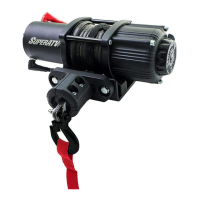
This document describes a winch system, including its components, operation, and maintenance. The winch is designed for pulling loads and is available in several models: WN-2500, WN-3500, WN-4500, and WN-6000.
Function Description
A winch is a powerful piece of machinery designed for pulling heavy loads. It operates using a 12-volt DC motor that powers a mechanical gear system. This system turns a winch drum, which winds or unwinds a synthetic rope. The synthetic rope is specifically designed for the winch's load capacity and has a looped end to accept a clevis hook pin. When operating the winch at an angle, a fairlead guides the synthetic rope onto the winch drum, minimizing damage or abrasion from the winch mount or bumper.
The winch incorporates a braking system that automatically engages when the motor stops and there is a load on the synthetic rope, providing additional braking action. Control of the winch can be achieved through a power cord/switch assembly or a wireless remote control. A free spooling clutch allows the user to manually disengage the winch drum from the mechanical gear system for free spooling, or engage it to lock the winch into the mechanical gear system. Power from the vehicle battery flows through a weather-sealed solenoid switch before being directed to the motor.
The rocker switch, a dual switch, controls the powering in or out of the winch drum, allowing the user to stand clear of the synthetic rope when it is under load. The wireless remote control enables operation from up to 50 feet away. To activate the remote, both buttons must be pressed simultaneously until an LED indicator lights up; to turn it off, both buttons are pressed until the LED goes out. The remote will automatically power off after two minutes of inactivity. For the remote to function, the rocker switch must be connected, and the key on the power wire must be turned on.
A mounting plate is provided, designed to attach to various flat surfaces such as trailers, step bumpers, or truck beds, and includes fairlead mounting holes. For increased pulling power or to change the pulling direction without damaging the synthetic rope, a pulley/snatch block (not included) can be used. It is recommended to use a double line and snatch block when pulling over 70% of the rated line pull.
Usage Features
Before operating the winch, it is crucial to read, study, and follow all instructions to prevent personal injury, death, or property damage. The winch can generate tremendous pulling forces, and unsafe operation can lead to severe consequences. Users should pay close attention to CAUTION, WARNING, and DANGER symbols throughout the manual, as they highlight safety-critical information.
The winch should not be used to lift vertically or as a hoist, nor should it be used to pull or move people. Modifying any part of the winch or synthetic rope by cutting or welding is strictly prohibited. A minimum of five wraps of synthetic rope around the winch drum is necessary to pull and hold the rated load. Users and bystanders must maintain a safe distance from the synthetic rope when it is under tension. The synthetic rope can break before the motor stalls, especially with heavy loads near rated capacity; using a pulley block/snatch block can reduce the load on the rope. Never step over or go near the synthetic rope when it is under load.
Moving the vehicle to pull a load (towing) on the synthetic rope can cause the rope to break. "Shock loads" should be avoided by using the control switch intermittently to take up slack in the synthetic rope, as they can exceed the rated capacity for both the rope and the winch drum. When on an incline, blocks should be applied to the vehicle's wheels. The synthetic rope should never be connected back onto itself.
When handling the clevis hook, a hand strap should be used, and gloves should be worn to protect hands from the synthetic rope. The synthetic rope should never slide through bare hands. For re-spooling, ensure the synthetic rope spools in an "under wind" position, entering the winch drum from the bottom. To spool correctly, maintain a slight load on the synthetic rope while pushing the remote button to draw it in. Walk toward the winch without allowing the rope to slide through hands, and keep hands at least 12 inches away from the winch during re-spooling. Turn off the winch and repeat the procedure until only a few feet of rope remain. Disconnect the remote control and finish spooling by hand, rotating the winch drum with the clutch disengaged. Keep hands clear of the fairlead and winch drum while the winch is under power.
To optimize battery life and maximize winch power and speed, keep the vehicle engine running during winching. The battery can drain if the winch is used for an extended period with the engine off. Users should familiarize themselves with all winch features, rigging techniques, sounds under various loads, and how the synthetic rope spools by performing several test runs before actual use.
In the event of synthetic rope failure, a blanket or jacket should be placed over the rope, approximately 5-6 feet from the clevis hook, to absorb energy. Opening the vehicle hood can provide additional protection.
Maintenance Features
Regular inspection of all components, hardware, and electrical connections is essential before each use. If the synthetic rope is frayed or damaged, it must be replaced immediately with a manufacturer's replacement rope. Any component that appears damaged, worn, or operating abnormally should be replaced or removed.
Never connect the synthetic rope back onto itself; always use a snatch block, sling, or chain of suitable strength. Pull only on vehicle parts specified by the vehicle manufacturer, and use only attachments and adapters supplied by the manufacturer. Test run the winch in both directions before winching.
If the motor stalls, stop winching immediately. Electric winches are designed for intermittent use, not constant duty. Keep winching pulls as short as possible, not exceeding one minute at or near rated load. If the motor becomes hot to the touch, stop winching immediately and allow it to cool before resuming. The free spooling clutch should never be disengaged when a load is on the winch.
For synthetic rope maintenance, minimize abrasion by using a movable abrasion sleeve whenever contact with rocks or other objects occurs. Slide the sleeve up and down the rope as needed, as abrasion reduces rope life. Keep the rope clean; dirt and debris can cause abrasion. Avoid sharp bends, which can decrease the rope's strength under load and cause damage or failure. If the synthetic rope shows signs of wear or breaking, replace it immediately with an identical part number, following SuperATV's instructions.
Periodically check the tightness of all mounting hardware and electrical connections. Keep the winch clean, removing all dirt and corrosion as required. The mechanical gear system should not be disassembled, as high-temperature lithium grease has been applied at the factory, and no user maintenance is required for this component.


 To Next Page

 General