15 —
© 2007 Skier’s Choice, Inc.
Basic Boating Rules
<RXVKRXOGEHDZDUHRIWKHVHUXOHVDQGIROORZWKHPZKHQHYHU
you encounter another vessel on the water.
The rules presented in this manual are condensed and have
EHHQ SURYLGHG DV D FRQYHQLHQFH RQO\ &RQVXOW \RXU ORFDO
86&RDVW*XDUG$X[LOLDU\86&*$RU'HSDUWPHQWRI0R-
tor Vehicles (DMV) for a complete set of rules governing the
ZDWHUVLQZKLFK\RXZLOOEHXVLQJ\RXUERDW,I\RXSODQWR
WUDYHO²HYHQ IRU D VKRUW WULS²\RX ZRXOG EH ZHOO VHUYHG WR
FRQWDFWWKHUHJLRQDO86&*$RU'09LQWKHDUHDZKHUH\RX
ZLOOEHERDWLQJ
Review and understand all local and state laws.
Any time two vessels on the water meet one another, one
vessel has the right-of-way. It is called the stand-on vessel.
7KHYHVVHOZKLFKGRHV127KDYHWKHULJKWRIZD\LVFDOOHG
WKHJLYHZD\RUEXUGHQHGYHVVHO
These rules determine which vessel has the right-of-way, and
accordingly, what each vessel should do.
The vessel with the right-of-way has the duty to continue its
course and speed, except to avoid an immediate collision.
When you maintain your direction and speed, the other vessel
ZLOOEHDEOHWRGHWHUPLQHKRZEHVWWRDYRLG\RX
The vessel which does not have the right-of-way has the duty
to take positive and timely action to stay out of the way of the
VWDQGRQYHVVHO1RUPDOO\WKHJLYHZD\YHVVHOVKRXOGQRW
cross in front of the stand-on vessel. Slow down or change
GLUHFWLRQVEULHÀ\DQGSDVVEHKLQGWKHRWKHUYHVVHO<RXVKRXOG
always move in such a way that the stand-on operator can
see what you are doing.
This rule is called Rule 2 in the International Rules and
says,
³,QREH\LQJDQGFRQVWUXLQJWKHVHUXOHVGXHUHJDUGVKDOOEHKDG
to all dangers of navigation and collision, and to any special
FLUFXPVWDQFHVZKLFKPD\UHQGHUDGHSDUWXUHIURPWKHDERYH
UXOHVQHFHVVDU\LQRUGHUWRDYRLGLPPHGLDWHGDQJHU´
Encountering Other Vessels
There are three main situations in which you may encounter
RWKHUYHVVHOV DQG\RX PXVWREVHUYHWKH 6WHHULQJ5XOHV LQ
RUGHUWRDYRLGDFROOLVLRQ7KHVHDUH
- Meeting (you are approaching another vessel head-on)
- Crossing (you are traveling across the other
vessel’s path)
2YHUWDNLQJ\RXDUHSDVVLQJRUEHLQJSDVVHGE\DQRWKHU
vessel)
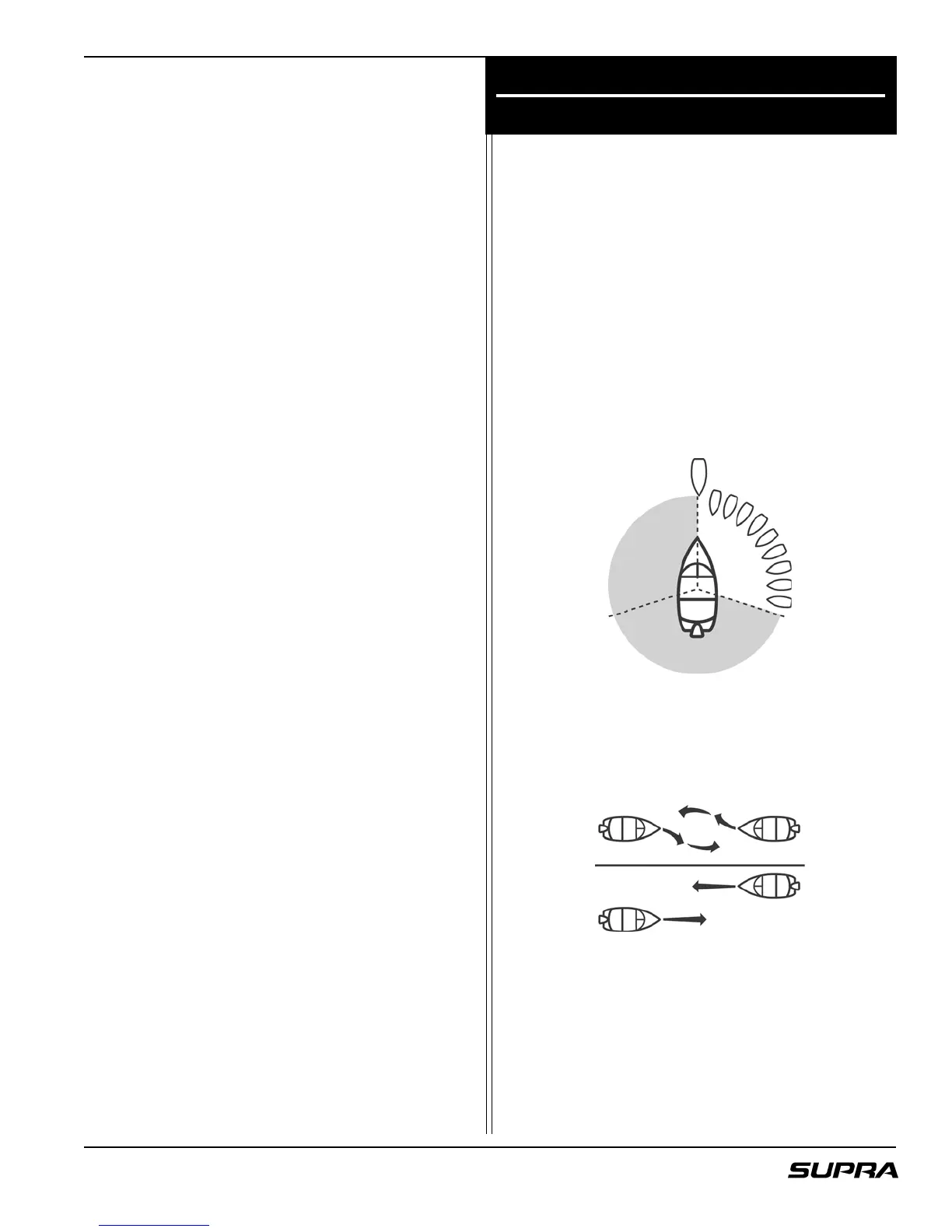
8VLQJWKHIROORZLQJLOOXVWUDWLRQLQZKLFK\RXDUHWKHERDWLQWKH
center, you should give right-of-way to all vessels shown in
the white area. In this instance, you are the give-way vessel.
All vessels in the shaded area must yield to you as you are
the stand-on vessel. Both you and the meeting vessel must
alter course to avoid each other.
If you are meeting another power vessel head-on, and you
are close enough to run the risk of collision, neither of you has
the right-of-way. Both of you should alter course to avoid an
accident. You should keep the other vessel on your port (left)
VLGH7KLVUXOHGRHVQ¶WDSSO\LIERWKRI\RXFDQFOHDUHDFK
RWKHUE\FRQWLQXLQJ\RXUVHWFRXUVHDQGVSHHG
Section IV
Boating Rules



 To Next Page