Battery Charging
Before using the stapler, the battery must be fully charged. (Approximately 5 hours).
Do not recharge the battery after use if it is not to be used for an extended period of time.
Recharge the battery when it is required.
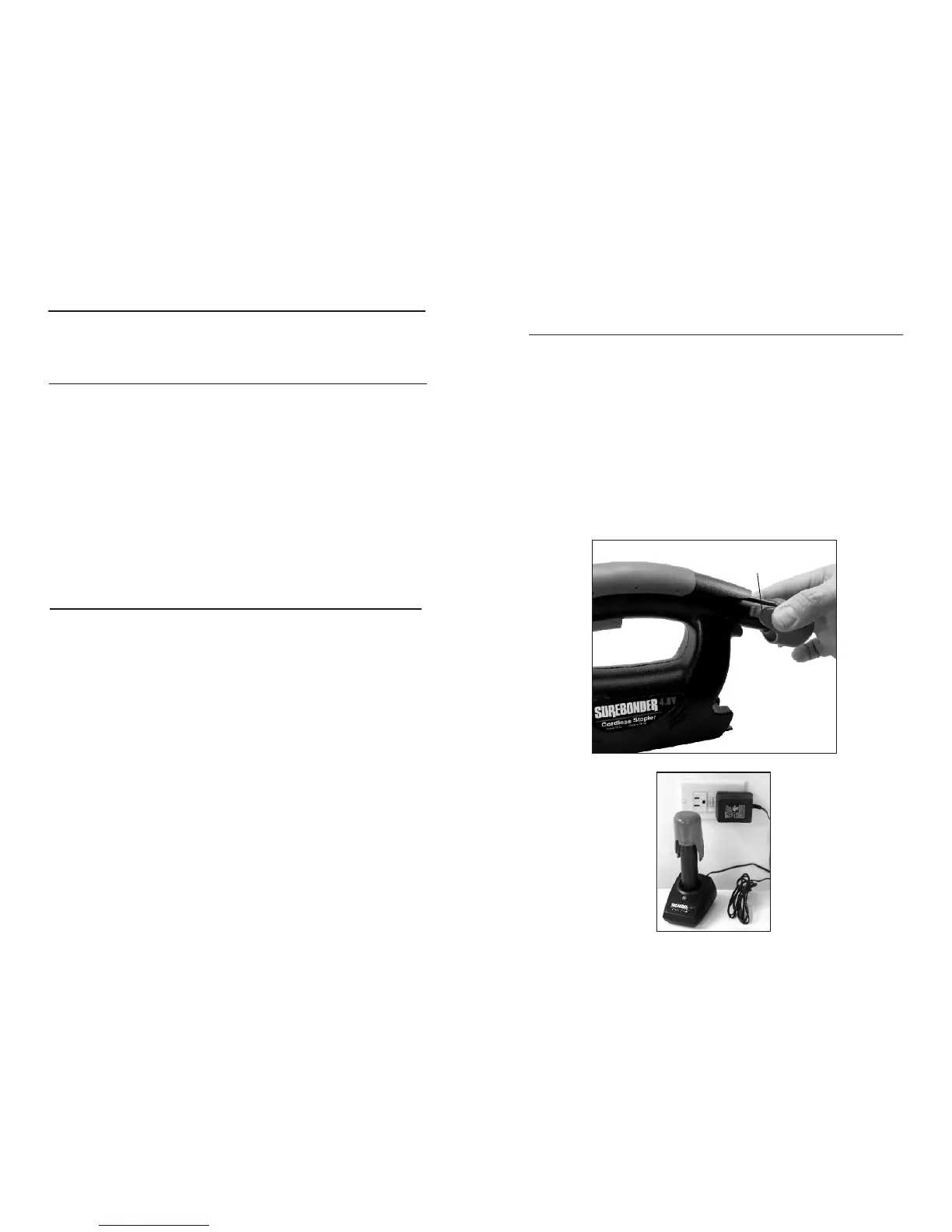
To remove the battery press the unlocking buttons (Fig 1) and pull the battery out of the
cordless stapler. Do not exert any force.
Insert the battery into the battery charger cradle. Plug the wall outlet connector into
battery charger, and plug into the wall outlet (Fig 2).
A significantly reduced working period after charging indicates that the battery is no longer
charging properly and must be replaced.
Depress unlocking buttons
on both sides of the battery
FIG 1.
FIG 2.
Service
Have the cordless stapler serviced by a qualified repair person using only identical
replacement parts. This will ensure that the safety of the cordless stapler is maintained.
Safety Note:
Secure the workpiece. A workpiece clamped with a clamping device or in a vice is held
more securely then by hand.
Before any work on the stapler itself as well as during transport and storage,
remove the battery pack from the stapler.
Protect the battery against heat and also against continuous sun exposure and fire,
otherwise there is a danger of explosion.
Keep your fingers away from the contact mechanism.
Never point the stapler at persons or animals. Staples or nails shot from a short
distance can cause considerable injuries. Do not use the stapler to fasten electrical
wiring. Contact with the electric lines can lead to fire and electric shock.
Battery Charger
Keep the battery charger away from rain or moisture. Penetration of water in the
battery charger increases the risk of an electrical shock or fire.
Keep the battery charger clean. Contamination can lead to danger of an electric shock.
Before each use, check the battery charger, cable and plug. If damaged is detected,
do not use the battery charger. Never open the battery charger yourself. Have
repairs performed only by a qualified technician. Damaged battery chargers, cables,
and plugs increase the risk of an electric shock.
Do not operate the battery charger on easily flammable surfaces (e.g, paper textiles, etc)
or surroundings. The heat of the battery charger during the charging process can pose a
fire hazard.
Disposing of battery packs/batteries
Ni-MH: Nickel metal hydride
These battery packs contain hydrogen and are environmental matters.
Battery packs/batteries should be collected, recycled or disposed of in an environmental-
friendly manner.


 To Next Page
 Loading...