Need help?
Do you have a question about the Suunto COBRA and is the answer not in the manual?
Crucial safety advice and warnings for using the dive computer.
Procedures to follow in case of dive computer malfunction during a dive.
Details the inherent limitations of dive computers and their reliance on theoretical models.
Explains the risks and considerations specific to diving with Nitrox mixtures.
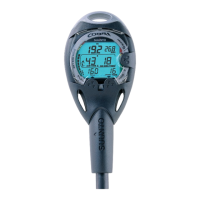
Overview of dive modes, connections, buttons, and water contacts.
Instructions on how to attach the dive computer to a regulator first stage.
Details the functions of the SMART, PLAN, and TIME buttons for navigation and control.
Explains the role of water contacts in automatic activation and data transfer.
Covers activation, pre-dive checks, battery status, planning, and user-definable alarms.
Describes how the computer activates and the crucial pre-dive checks to perform.
Explains the battery indicator levels and warnings.
Details how to use the PLAN button for dive planning and checking no-decompression limits.
How to set user-definable functions and alarms for personal preferences.
Explains the importance and types of safety stops: Recommended and Mandatory.
Details the recommended safety stop procedure and its optional nature.
Explains the conditions for a mandatory safety stop due to ascent rate violations.
Details basic dive data, bookmarks, cylinder pressure, and ascent rate indicators.
Information shown on the display during a no-decompression dive in Air mode.
How to make special marks (bookmarks) in the dive profile memory.
Explains the display of cylinder pressure and remaining air time calculations.
How the no-decompression time is visually represented by bar graphs.
Graphical display of ascent rate and corresponding warnings.
Explains procedures and displays for dives requiring decompression stops.
Explains the display indicators when ascending above the floor.
Describes the display when reaching the ceiling zone for decompression.
Warning and action for ascending above the ceiling during decompression.
Covers setup, oxygen displays, and oxygen limit fraction tracking for Nitrox.
Setting up the computer for Nitrox diving, including entering O2% and PO2.
Details the display of oxygen percentage, PO2, and Oxygen Limit Fraction (OLF).
Explanation of the OLF bar graph for tracking oxygen toxicity.
Explains the operation and display information when using Gauge mode.
Covers surface interval, dive numbering, and flying after diving guidelines.
Information displayed in Surface Mode and how surface interval affects dive numbering.
How the dive computer numbers consecutive dives based on surface intervals.
Guidelines and recommendations regarding flying after diving.
Explains the different types of audible and visual alarms and their meanings.
How to set altitude and personal modes for conservative dive calculations.
How to set the altitude mode for accurate calculations at different altitudes.
How to adjust conservatism based on personal factors affecting DCI risk.
Describes error modes, especially from omitted decompression, and recovery procedures.
Explains the consequences of omitting decompression and entering Error Mode.
Accessing dive logs, profile memory, history, and transferring data to a PC.
Details on viewing dive logs and profile data.
Accessing a summary of all recorded dives.
How to connect to a PC for data download and management.
Using dive and planning simulators to familiarize with features and plan dives.
Simulating dive scenarios to understand computer behavior and warnings.
Simulating dive planning for repetitive dives and adjusting surface intervals.
Accessing modes for setting dive parameters, time, and personal preferences.
Settings related to dive parameters like altitude and personal adjustments.
Setting altitude and personal modes for dive calculation adjustments.
Setting dive time alarms for safety.
Setting depth alarms for safety.
Configuring Nitrox settings, including O2% and PO2.
Adjusting time, date, and daily alarms.
Customizing preferences like backlight, units, and computer model.
Adjusting backlight on/off time.
Selecting between metric and imperial units.
Choosing the dive computer's operating mode (Air, Nitrox, Gauge).
Key points regarding the depth sensor and water contacts cleaning.
General guidelines for maintaining the dive computer's condition and longevity.
Procedures for rinsing, drying, and checking the device after dives.
Importance of checking water resistance, especially the battery compartment for leaks.
Instructions and critical notes for proper battery replacement to maintain water resistance.
Procedures for replacing the display shield and attaching a compass accessory.
Explains core principles like no-decompression limits and dive tables.
Details no-decompression time limits based on depth and personal/altitude modes.
Explanation of the Suunto RGBM algorithm used for decompression calculations.
How the computer calculates and displays oxygen exposure and toxicity.
Lists the physical and functional specifications of the dive computer.
 General
| Display Type | LCD |
|---|---|
| Operating Modes | Air, Nitrox, Gauge |
| Logbook Memory | 36 hours |
| Battery Type | CR2450 |
| Backlight | Yes |
| Temperature Display | Yes |
| Ascent Rate Monitor | Yes |
| Decompression Model | Suunto RGBM |
| Nitrogen and Oxygen Monitoring | Yes |
| Dive Time Display | Yes |
| Decompression Stop Display | Yes |
| Audible Alarm | Yes |
| Depth Rating | 150 m |
| Max Operating Depth | 150 m |
| PC Interface | Yes |
| Type | Dive Computer |
| Battery Life | 2 years |


 To Next Page