Need help?
Do you have a question about the Swann 1200-X and is the answer not in the manual?
Details output power for SSB, CW, and AM modes.
Lists the specific frequency bands the amplifier covers.
Specifies tubes used and minimum drive power required.
Describes meter functions and controls.
Covers relay control, ALC, and Pi-Output circuit.
Details power supply, unit size, and weight.
Steps for connecting coaxial cables and non-Swan exciters.
Detailed procedure for connecting relay control cable.
Special instructions for connecting ALC.
Critical warnings regarding high voltage during installation.
Step-by-step guide for tuning the amplifier for optimal output.
Procedure for SSB operation and using the output meter.
Important warnings for safe operation and tuning limits.
Recommendation for using an oscilloscope for precise tuning.
Using the meter to check feedline and antenna VSWR.
How to connect external ALC for controlled operation.
Methods for adjusting the Automatic Level Control.
Guidance on amplifier maintenance and expected tube longevity.
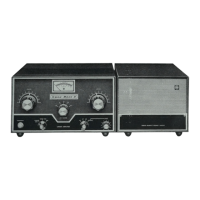
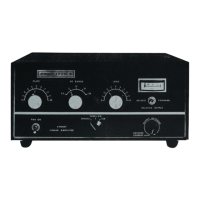
The Swan Model 1200-X is a linear amplifier designed to boost the power of radio signals, primarily for amateur radio applications. It operates in a grounded grid, super-cathode-drive circuit configuration, utilizing four 6LQ6 tubes. The amplifier is designed for use with transceivers or exciters, providing significant power amplification for SSB, CW, and AM modes.
The 1200-X amplifier takes a relatively low-power input signal from a transceiver or exciter and amplifies it to a much higher output power. It features a band switch to select the operating frequency range, and controls for plate tuning and load adjustment to match various antenna impedances. A built-in meter allows monitoring of cathode current and relative forward/reflected power, providing essential feedback for tuning and operation. The amplifier also includes a transmit-receive relay control for seamless integration with a transceiver and an external ALC (Automatic Level Control) connection for maintaining signal linearity.
Power Rating:
Frequency Range: The amplifier covers a wide range of amateur radio bands:
Tube Complement:
Drive Requirements:
Meter:
Additional Features:
Power Supply:
Dimensions:
Weight:
Installation: The installation process involves connecting the amplifier to a transceiver or exciter, an antenna, and the AC power. A short coaxial cable connects the transceiver's output to the amplifier's input. A relay control cable connects to the transceiver's auxiliary relay jack for automatic transmit/receive switching. For TVI (Television Interference) suppression, a low-pass filter can be installed between the amplifier's output and the antenna. Specific modifications are detailed for connecting the relay control with Swan 270B and other transceivers, as well as for external ALC connections.
Tuning Instructions:
Relative Output Metering: This feature provides a check on the feedline and antenna. With the switch in the "REVERSE" position, the meter reads relative reflected power. For meaningful readings, adjust the "OUTPUT METERING" control for a 600-900 reading in "FORWARD" position, then switch to "REVERSE" without changing the control. A reading of 125-200 or more indicates a VSWR of 2:1 or greater, suggesting antenna system work is needed.
ALC Adjustment: The best method for ALC adjustment is using an oscilloscope to prevent flattopping. If an oscilloscope is unavailable, adjust the ALC pot on the back of the amplifier while speaking into the mic, until occasional peak readings of 100-120 mA (for 270B) or 200-225 mA (for 500CX) are obtained on the exciter-driver's cathode current meter.
General Maintenance: The Swan 1200-X amplifier requires little maintenance. The 6LQ6 tubes are designed for thousands of service hours. Deterioration of a tube is typically indicated by a change in idling current or an inability to draw normal plate current. However, the tubes are expected to operate reliably for many months or years. In the grounded grid circuit, matching of the 6LQ6 tubes is not normally required.
Component Longevity: Other components are conservatively operated and within nominal ratings. The electrolytic filter capacitors are computer grade, offering high purity and quality control with an expected life of approximately 10 years. The silicon diodes in the power supply are hermetically sealed and are unlikely to fail or wear out.
Safety Precaution:

 To Next Page
 General