Need help?
Do you have a question about the Swegon Actionair SmokeShield PTC and is the answer not in the manual?
Product application details for Actionair SmokeShield PTC.
Procedure for installing and configuring the control mode assembly.
Recommended intervals and actions for regular damper service and inspection.
Wiring diagram and specifications for Mode 5 PTC 24V actuator.
Wiring diagram and specifications for Mode 6 PTC 230V actuator.
Wiring diagram and specifications for Mode 5-3P PTC 24V actuator.
Dimensional data for rectangular dampers, series 501.
Dimensional data for circular dampers, series 601.
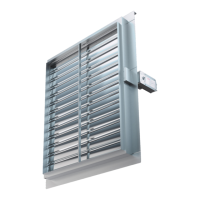
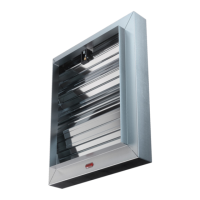
The Actionair SPAN Installation Guide describes the installation, maintenance, and troubleshooting of Actionair SmokeShield PTC dampers, which are actuated fail-safe close dampers designed for use with fire-separating elements to maintain fire compartments. These dampers are often referred to as Fire/Smoke dampers due to their low smoke leakage. The guide also references smoke control dampers, specifically Actionair SmokeCommand, which are tested to BS EN 12101-8 and designed for drive open, drive closed operation without a fail-safe position for smoke control applications.
Actionair SmokeShield PTC dampers are designed to automatically close upon loss of electrical power or a temperature rise in the ductwork, acting as a critical component in fire safety systems. Their primary function is to prevent the spread of fire and smoke through ductwork in buildings, thereby maintaining the integrity of fire compartments. The dampers are actuated, meaning they rely on an electrical actuator to control their open and closed positions. In the event of a fire or power failure, the actuator releases, allowing the damper blades to spring closed to a fail-safe position.
The guide details three control modes for the actuators: Mode 5 PTC 24V, Mode 6 PTC 230V, and Mode 5-3P PTC 24V.
The installation process for horizontal dampers in SPAN applications is detailed for both "access side above" and "access side below" scenarios. This involves bolting Unistrut supports to damper cleats, fixing supports to the floor with fire-rated fixings, and carefully sealing the damper interface shroud to prevent mortar penetration, which could render the damper inoperable. The use of thick consistency compound is emphasized to ensure all gaps are fully sealed, and specific instructions are given to prevent compound from entering the interface shroud.
The installation guide emphasizes that the installation process must be undertaken by competent persons, often requiring more than one individual for safe handling of large dampers and materials. Access equipment is recommended to ensure safe practices. Standard site PPE, including steel toe cap boots, hard hats, protective eyewear, gloves, and masks, is required, especially when drilling or cutting. Hearing protection is advised when loud equipment is in use.
The control mode installation procedure involves several steps, including removing the transit plate, sliding the interface and mode assembly into the shroud, and pushing it home until the retaining pin engages. The control mode can be fitted in three orientations (vertically down, horizontally, and vertically up), offering flexibility depending on height restrictions. The ETR must be mounted through the ductwork, ideally in the top half or above the interface level, and secured with screws to ensure proper operation. For ductless installations, the ETR should be fitted onto the damper spigot above the interface shroud.
A key usage feature is the ability to manually reset and release the damper using a winder. This allows for verification of correct mechanical operation and can be used to mechanically lock the damper open if electrical power is not yet available. However, it's crucial to note that in this state, the ETR is not operable, and the damper will not automatically release in case of a temperature rise or fire.
After wiring, the unit must be checked for correct electrical operation (power on to reset, power off to release). The test switch on the ETR should also be used to confirm that the damper releases, and that it resets when pressure is removed from the switch. This periodic operation simulates actual fail-safe release under smoke/fire conditions. The ETR cable must not be cut or damaged, as this will render the unit inoperable and void warranties due to a built-in safety feature.
The guide outlines a comprehensive periodic maintenance program to ensure compliance with standards like BS EN 15650:2010 and BS 9999:2017. Regular service and inspection are crucial for the correct operation of dampers. The manufacturer recommends using a dedicated damper control panel with a digital reporting mechanism (e.g., Actionpac LNS system) for frequent remote damper testing.
The guide also references requirements from Approved Document B, Volume 2, BS 9999:2017 (Code of Practice for Fire Safety in the Design, Management and Use of Buildings - Annex I and Annex W), and BS EN 15650:2010 (Ventilation for Buildings - Fire Dampers). These standards mandate regular testing and inspection intervals, with some automatic systems allowing for more frequent testing (e.g., 48 hours or less).
A troubleshooting section provides a quick guide to common problems and recommended actions, such as ensuring adequate clearance, correctly fitting the ETR, checking wiring, and removing foreign matter impeding blade movement. The guide explicitly states that modifications made to units will invalidate warranties. An inspection and handover check sheet is provided for installers to complete, verifying that the damper is of the correct type, correctly located and identified, properly supported, oriented correctly, and that access to the damper is unobstructed. It also requires checking that blades open and close, internal cleanliness, and that the damper has been released and reset following a thermal release simulation.
 General
| Material | Galvanized steel |
|---|---|
| Actuator voltage | 24V AC/DC or 230V AC |
| Standards | EN 1366-2, EN 13501-3 |
| Leakage | Classified according to EN 1751 |
| Operation | Motorized |
| Fire rating | E120 |
| Mounting position | Horizontal or vertical |


 To Next Page