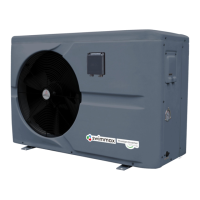
This document is a user and service manual for a Swimmax Swimming Pool Heat Pump. It provides detailed information on specifications, installation, operation, troubleshooting, and maintenance for various models, including Swimmax 07, Swimmax 09, and Swimmax 13.5.
Function Description
The Swimmax Swimming Pool Heat Pump is designed to heat swimming pool water efficiently. It operates by extracting heat from the ambient air and transferring it to the pool water via a heat exchanger. The unit requires a continuous supply of fresh air, electricity, and a functioning swimming pool filtration system to operate correctly. It can be used for both heating and cooling modes, depending on the model and settings. The heat pump is equipped with an automatic flow switch to protect against inadequate water flow and includes a 3-minute start-up delay to protect its circuitry.
Important Technical Specifications
The manual provides specifications for three models: Swimmax 07, Swimmax 09, and Swimmax 13.5.
Performance at Air 28°C, Water 28°C, Humidity 80%:
- Swimmax 07: Heating capacity 7.5 kW, Power consumption 1.34 kW, COP 5.6
- Swimmax 09: Heating capacity 9.5 kW, Power consumption 1.70 kW, COP 5.6
- Swimmax 13.5: Heating capacity 13.5 kW, Power consumption 2.33 kW, COP 5.8
Performance at Air 24°C, Water 26°C, Humidity 70%:
- Swimmax 07: Heating capacity 7.35 kW, Power consumption 1.33 kW, COP 5.49
- Swimmax 09: Heating capacity 9.31 kW, Power consumption 1.69 kW, COP 5.49
- Swimmax 13.5: Heating capacity 13.23 kW, Power consumption 2.32 kW, COP 5.68
Performance at Air 15°C, Water 26°C, Humidity 70%:
- Swimmax 07: Heating capacity 4.9 kW, Power consumption 1.14 kW, C.O.P. 4.3
- Swimmax 09: Heating capacity 6.7 kW, Power consumption 1.56 kW, C.O.P. 4.3
- Swimmax 13.5: Heating capacity 9.2 kW, Power consumption 2.14 kW, C.O.P. 4.3
General Data (common across models unless specified):
- Compressor type: Rotary / R32
- Voltage: 220~240V/50Hz/1PH
- Rate current: Swimmax 07 (5.9 A), Swimmax 09 (7.5 A), Swimmax 13.5 (10.3 A)
- Minimum fuse: Swimmax 07 (15 A), Swimmax 09 (15 A), Swimmax 13.5 (20 A)
- Advised pool volume*: Swimmax 07 (15-26 m³), Swimmax 09 (25-32 m³), Swimmax 13.5 (40-68 m³)
- Advised water flow: Swimmax 07 (2.5~3.7 m³/h), Swimmax 09 (2.6~5.1 m³/h), Swimmax 13.5 (4~7.9 m³/h)
- Water pressure drop: Swimmax 07 (12 Kpa), Swimmax 09 (12 Kpa), Swimmax 13.5 (15 Kpa)
- Condenser: Twist-titanium tube in PVC
- Water connection: 40mm/1.5"HP
- Fan quantity: 1
- Fan speed: Swimmax 07/09 (830~870 RPM), Swimmax 13.5 (650 RPM)
- Power input of fan motor: Swimmax 07/09 (80 W), Swimmax 13.5 (120 W)
- Noise level at 10m: Swimmax 07 (41 dB(A)), Swimmax 09 (42 dB(A)), Swimmax 13.5 (44 dB(A))
- Noise level at 1m: Swimmax 07 (50 dB(A)), Swimmax 09 (51 dB(A)), Swimmax 13.5 (54 dB(A))
Dimension / Weight:
- Net weight: Swimmax 07 (45 kg), Swimmax 09 (50 kg), Swimmax 13.5 (79 kg)
- Gross weight: Swimmax 07 (52 kg), Swimmax 09 (57 kg), Swimmax 13.5 (94 kg)
- Net dimension (mm): Swimmax 07/09 (1000*380*580), Swimmax 13.5 (1045*440*710)
- Packaging dimension (mm): Swimmax 07/09 (1072*420*590), Swimmax 13.5 (1121*510*740)
Usage Features
The heat pump is designed for user-friendly operation through an LED wire controller.
- Start/Stop: The unit can be started or stopped by pressing the ON/OFF button on the electronic control panel.
- Mode Selection: Users can choose between heating and cooling modes by pressing the "MODE" button until the corresponding "HEAT" or "COOL" light illuminates.
- Temperature Setting: The desired water temperature can be adjusted using the up and down buttons while in standby or running mode. The unit will only run if the water circulation/filtration system is active.
- Automatic Start/Stop: The controller allows users to set specific times for the unit to automatically start and stop. This feature is linked to the water pump operation, ensuring the heat pump only runs when water is circulating.
- Real-time Clock: The controller includes a real-time clock that can be set and adjusted.
- Parameter Monitoring: Users can check various operational parameters such as inlet water temperature, outlet water temperature, heating condenser temperature, gas return temperature, ambient temperature, cooling condenser temperature, and actual steps of the electronic expansion valve.
- Error Code Display: The LED controller displays error codes (e.g., PP1, EE1, EE3) to indicate malfunctions, aiding in troubleshooting.
- Accessories: The unit comes with anti-vibration bases, draining jets, a winter cover, a 10M signal wire, and water connection assemblies for installation.
Maintenance Features
Regular maintenance is crucial for the optimal performance and longevity of the heat pump.
- Water Supply System Check: It is recommended to regularly check the water supply system to prevent air entry and ensure adequate water flow, which can impact performance and reliability.
- Pool and Filtration System Cleaning: Pools and filtration systems should be cleaned regularly to avoid damage to the unit from clogged or dirty filters, which can reduce water flow.
- Winterization: If the unit is to be shut down for an extended period, especially during winter, the water should be discharged from the bottom of the water pump.
- Pre-Startup Check: Before starting the unit after a long period of inactivity, ensure it is full of water.
- Condensation: The manual notes that a small amount of water discharge under the unit during operation is normal due to condensation. Excessive water may indicate an issue requiring installer consultation.
- Electrical Connections: All electrical connections and repairs should be conducted by a licensed electrician, and the power supply should always be shut off before opening the heat pump cabinet.
- Bypass Adjustment: Proper adjustment of the bypass is essential for optimal operation and to prevent damage, which could void the warranty.
- Chemical Dosing: Any automatic chemical dosing equipment must be installed downstream from the heat pump to protect the heat exchanger from high chemical concentrations. A check-valve is recommended to prevent reverse flow.

 Need help?

 To Next Page
 General