6
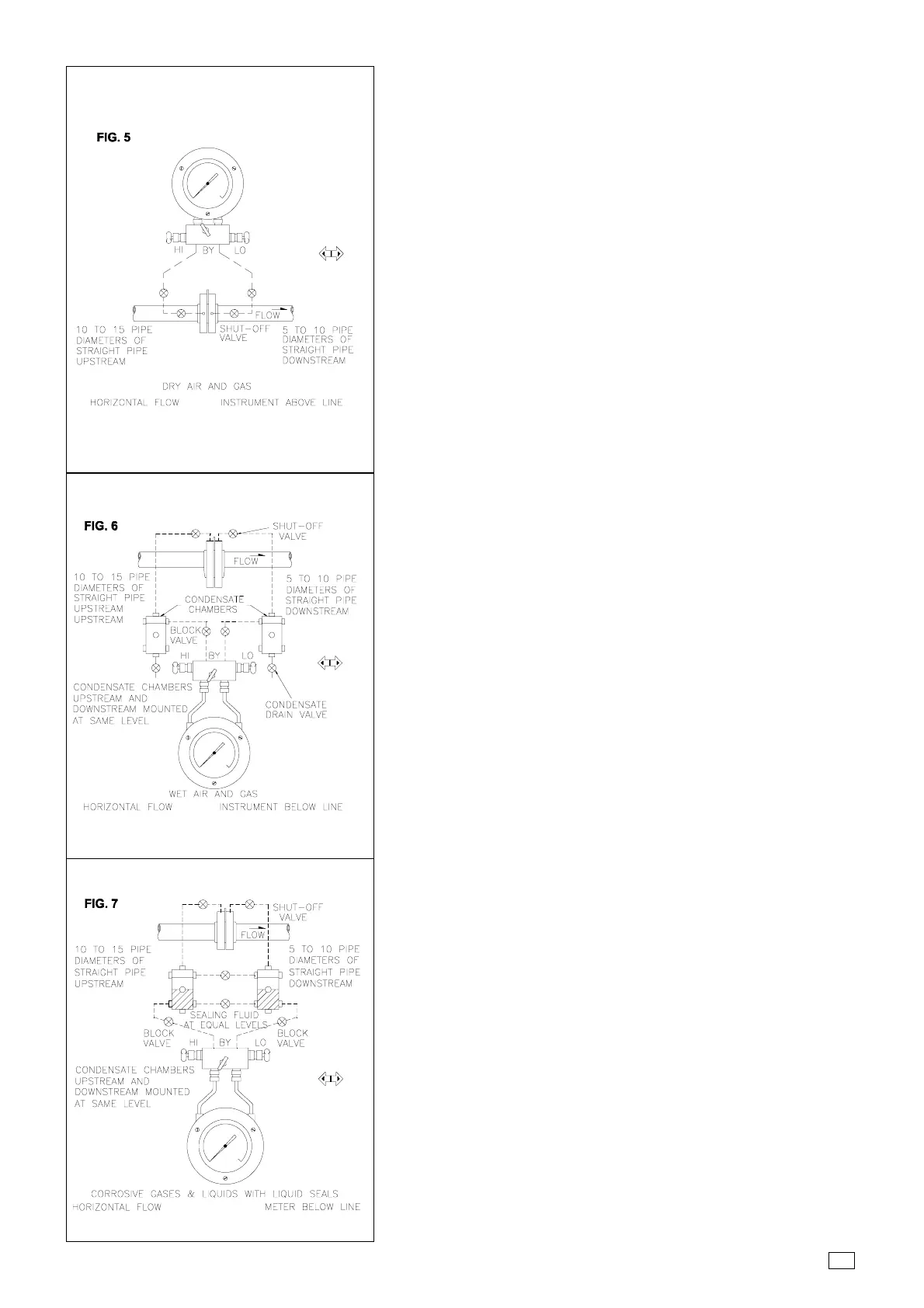
FOR GAS SERVICE (FIG.5)
START-UP
Recommended when Instrument located above primary element
and where self draining is possible NOT recommended when
hydrates are present
1. Whatever the location of the meter body, make all primary element
taps at or near the top of the pipe.
2. Open manifold valves and bypass valve, open one block valve
and one shutoff valve to pressurise instrument.
3. Then close block valve and bypass valve .
4. Check for leaks as explained in clause I.
5. Open bypass valve, open block valves and slowly open both
shutoff valves simultaneously.
6. Close bypass valve for D/P reading.
If hydrates are present, or the instrument to be located below the
primary element, see fig.6.
FOR GAS SERVICE (FIG.6)
START-UP
Recommended when hydrates or heavy solids are present. Piping
diameter not less than ½". Drain valves are required
1. through 5. Follow steps in Fig. 5.
7. Drain condensate chambers of hydrates at regular intervals.
CORROSIVE FLUIDS (FIG.7)
START-UP
Recommended when the flowing medium is highly corrosive,
contains solids in suspension, is highly volatile, Or for some other
reason would damage the instrument. Use 109 Model with liquid
or chemical seals to prevent the medium entering the instrument.
L
OCATION FOR SEALS
Place as close as possible to the primary element to reduce the length
of piping filled with process fluid.
On high temperature applications, locate the seal at least 36" from
the primary element shutoff valves to prevent overheating.
NOTE : When measuring liquids, locate pressure taps at or near
BOTTOM of pipe. Diaphragm type Seals can be used in place of
condensate Chambers (eliminate steps 2 through 6).
1. Close shutoff valves; open manifold valves and block valves.
2. Remove fill and side plugs from seal pots.
3. Fill seal pots, piping and meter housings with the immiscible
seal fluid by pouring into upper fill ports.Instrument housings,
tubing and seal ports must be filled to seal pot side ports with
bubble-free liquid. Pointer will indicate zero when both high
and low pressure chambers are filled equally.
4. Install side plugs and close all valves.
5. Slowly open each shutoff valve alternately until fill port (skip
this step in gas application)
6. Replace fill plugs.
7. Check for leaks as explained in clause I.
8. Open manifold valves and block valves, then SLOWLY open
both shutoff valves simultaneously.
9. Close bypass valve for D/P reading.


 To Next Page
 Loading...