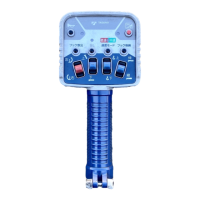
This document is an operation and maintenance manual for a TADANO Radio-control System (RCS-FT1) for Boom Truck Series.
Function Description:
The TADANO Radio-control System (RCS-FT1) is designed to remotely operate boom trucks, providing a safe and efficient method for controlling crane functions. The system consists of a transmitter (remote control unit) and a communication unit, which interacts with the crane's control unit and radio control valve. Key functions include engine start/stop, speed mode selection (high-speed, medium-speed, low-speed), power control, horn operation, emergency stop, elevation, hook, extension, and swing selections. The system also incorporates safety features such as automatic power-off, switch failure detection, continual operation restriction, and an instant stop alarm function to ensure safe operation.
Important Technical Specifications:
- Applicable Models:
- Transmitter: RCS-FT1
- Radio-control system: RCS-FR1
- Control unit: RCS-FC1
- Power Supply: The transmitter is powered by batteries.
- Communication: The system uses radio wave transmission for communication between the transmitter and the crane.
- Indicators: The transmitter features various LED indicators for power, speed mode (Red/Green), emergency stop (Red), and mode indicator lamps (L0, L1, 88). The control unit also has a mode indicator lamp.
- Alarm Functions:
- Speaker: The communication unit includes a speaker for alarms (e.g., emergency stop, two-tone alarm for battery exhaustion, emergency stop state).
- Warning Sounds: The system provides warning sounds for abnormal stop, operation lever movement, battery exhaustion, and emergency stop state.
- Safety Features:
- Automatic Power-off: The transmitter automatically turns off after approximately one hour of non-operation to save battery consumption.
- Switch Failure Detection: The system detects failures in motion selection switches and speed control levers, indicated by an error number (e.g., "13") on the mode indicator lamp.
- Continual Operation Restriction: If a motion selection switch is kept in the operation state for approximately five minutes due to a failure, the operation is trapped.
- Instant Stop Alarm Function: The system issues a "Beep, Beep" alarm if the radio wave from the transmitter is hindered or if there's a wrong operation.
- Emergency Stop: A dedicated emergency stop switch on the transmitter and an emergency stop lamp on the crane.
- Neutral Position Requirement: The motion selection switches must be in the neutral position for certain operations (e.g., engine start, power-off).
Usage Features:
- Preparation for Radio-control Operation:
- Confirm that the extension/winch/elevation/swing/jack lever is in the "Neutral" position.
- Confirm that the PTO lever is in the "Disconnected" position.
- Start the engine and turn PTO to "Connected (ON)" position.
- Confirm the radio-control/manual changeover switch is in "Manual" position.
- Extend outriggers and set the crane level.
- Turn the radio-control/manual changeover switch to "Radio" position.
- Turn the power of the transmitter ON.
- Confirm the mode indicator lamp displays "L0" (or "88" if the lamp is lit up).
- Press the power switch on the transmitter.
- Confirm the mode indicator lamp changes from "L0" to "L1".
- Confirm the speaker switch is turned "ON" and no alarm sounds.
- Basic Operations:
- Operate the motion selection switch while pointing the transmitter in the direction of the crane.
- Pull the speed control lever slowly to start crane movement.
- Call attention by pressing the horn switch.
- To stop crane operation, release the speed control lever slowly.
- Changing Speed Mode: The crane can be operated in high-speed, medium-speed, or low-speed modes. The speed mode LED on the transmitter indicates the current selection (LED off for high-speed, Red for low-speed, Green for medium-speed).
- Engine Start-up Operation: The engine can be started remotely using the transmitter's engine start switch. The emergency stop switch must be released for the engine to start.
- Manual Operation: The radio-control/manual changeover switch on the crane's control unit allows switching between radio-control and manual operation.
Maintenance Features:
- Battery Replacement for Transmitter:
- The power LED on the transmitter flashes, and a "two-tone" sound indicates low battery.
- Open the battery cover and remove old batteries.
- Insert four AA-size batteries, ensuring correct polarity.
- Close the battery cover and fasten the fixing screw.
- Do not mix old or different types of batteries.
- Measures for Emergency Case:
- When Radio-control Operation is Impossible:
- Check LED indications on the transmitter and control unit for error numbers.
- Troubleshoot based on the error number displayed (e.g., "13" for switch failure, "30-33" for abnormal operation).
- If the radio-control operation is impossible, switch to manual operation.
- If the unloading solenoid of the radio-control valve is fastened, the crane can be manually stowed by loosening the cap nut and lock nut, then tightening the screw inside.
- Troubleshooting Guide: A comprehensive table outlines common troubles, checkpoints, and measures (e.g., "Power LED does not light up" -> "Are batteries inserted?" -> "Insert batteries").
- Daily Inspection:
- Check for damage or cracks on the transmitter and communication unit.
- Inspect motion selection switches and speed control lever for smooth movement.
- Verify the transmitter's battery cover is securely tightened.
- Check for loose or damaged cables between the control unit and communication unit.
- Ensure the antenna of the communication unit is not damaged or loose.
- Safety Precautions:
- Keep the transmitter clean and dry.
- Handle the transmitter with care to avoid dropping or strong shocks.
- Store the radio-control transmitter in a safe place, preferably in the transmitter storage bag, away from direct sunlight, high temperatures, or humidity.
- Remove batteries if the transmitter is not used for a long time to prevent leakage.
- Avoid high-pressure cleaning of electric devices.
- Pay attention to surroundings and lifted cargo weight.
- Be careful with radio wave conditions, avoiding electromagnetic interference, radio interference, and exogenous noise.
- Maintain a safe distance between the transmitter and reception unit to avoid radio wave transmission hindrance.
- Avoid obstacles like wire nettings and metal doors between the transmitter and communication unit.
- Do not use manual control operation under unfavorable radio transmission conditions.
- Be aware of noise from vehicle's air-conditioner or approaching motorcycles that may cause intermittent crane operation.

 Need help?
 General

 To Next Page