Need help?
Do you have a question about the TBB power Energier Apollo Series and is the answer not in the manual?
Covers essential safety, environmental, and battery handling guidelines for operating the Energier Apollo.
Details the Energier Apollo's main functions: Inverter, Battery Charger, and Solar Charge Controller.
Explains transfer, battery types, equalization, LVD, weak grid, and solar modes.
Details Power Save, AEA, protection, communication, and optional accessories.
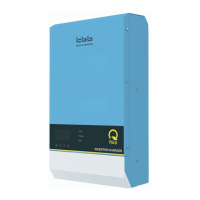
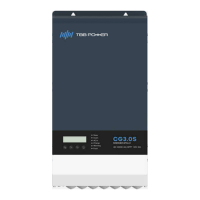
Illustrates the physical layout and components of the Energier Apollo and its accessories.
Provides detailed size specifications for the Energier Apollo and RCH remote.
Shows the dimensions for the Cyber and Digital Shunt accessories.
Identifies and explains the purpose of each port and switch on the front panel.
Details DIP switch settings for work mode, battery type, LVD, and grid charger.
Explains how to set battery capacity for optimal charging current.
Provides a detailed guide to the functions of each DIP switch for system configuration.
Lists included materials and specifies environmental conditions for installation.
Provides minimum wire sizes for AC, DC, and PV connections based on system capacity.
Offers essential tips for safe installation, including power cutoff and output connection.
Provides steps for securely mounting the Energier Apollo unit on a wall or floor.
Details how to connect battery, PV, and AC cables, emphasizing safety and correct polarity.
Guides the installation of temperature sensors, voltage sensors, and the RCH remote controller.
Explains the installation of optional Cyber system monitor and Digital Shunt.
Illustrates overall system wiring and instructions for installing an optional dust-proof net.
Covers pre-operation checks and setting the AC input current limit.
Explains how to set the unit to Power Backup or Solar Mode.
Details switching on the inverter, load connection, and LED indicators.
Explains how to switch on the grid charger and interpret related LEDs.
Describes Bulk, Absorption, and Floating stages of battery charging.
Explains how the solar charge controller works and its LED indicators.
Provides instructions and warnings for performing de-sulphation charging.
Lists key inverter parameters like voltage, power, frequency, and efficiency.
Details charger output voltage, current, AC input range, and battery types.
Lists specifications for the solar charge controller, including voltage, current, and algorithm.
Covers transfer time, connectors, dimensions, weight, cooling, and safety standards.
Explains the meaning of front panel LEDs and audible alarms for fault diagnosis.
Interprets LED indicators on the remote panel for operating status and alarms.
Explains the Battery SOC bar and Load percentage bar indicators.
Provides solutions for common operational failures like no output or charging issues.
 General
| Output Waveform | Pure Sine Wave |
|---|---|
| Efficiency | 93% (Peak) |
| Battery Voltage | 48V |
| AC Output Voltage | 220V |
| Communication | RS232 |
| Input Voltage | 12V/24V/48V |
| Output Voltage | 220/230/240VAC |
| Frequency | 50Hz/60Hz |

 To Next Page