(3) Operation
of
Inlet
Cover
(a)
Discharge
smaller
than
set
flow
rate
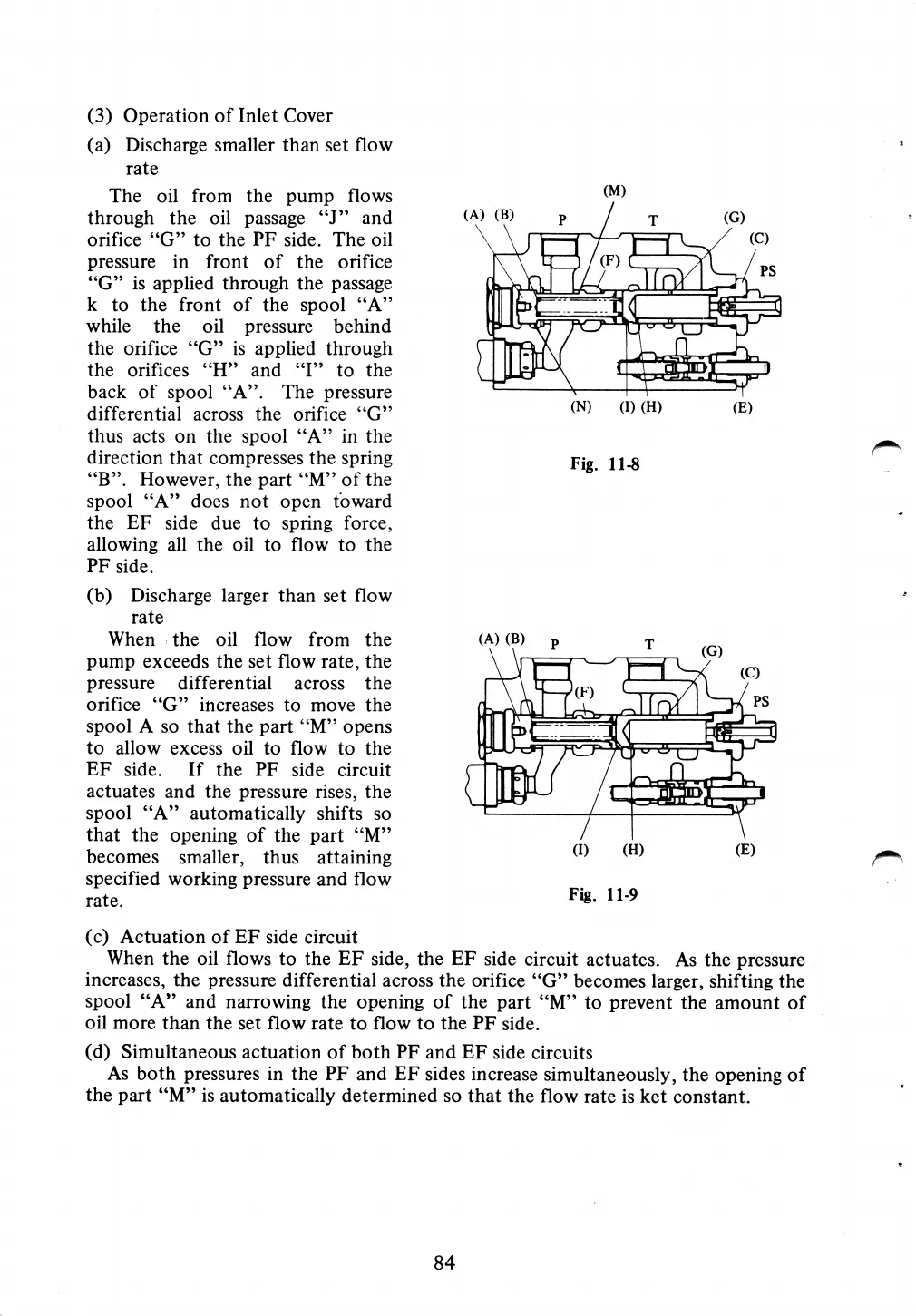
The oil
from
the
pump
flows
through
the
oil
passage
"J"
and
orifice
"G"
to
the
PF
side.
The
oil
pressure
in
front
of
the orifice
"G"
is applied through the passage
k to the front of
the
spool
"A"
while
the oil pressure behind
the orifice
"G"
is
applied through
the
orifices
"H"
and
"I"
to
the
back
of
spool
"A".
The pressure
differential
across
the
orifice
"G"
thus
acts
on
the
spool
"A"
in
the
direction
that
compresses
the
spring
"B"
However,
the
part
"M"
of
the
spool
"A"
does
not
open toward
the
EF side
due
to spring force,
allowing
all
the oil to
flow
to
the
PF
side.
(A) (B)
(M)
I
(F)
(G)
(C)
(N)
(I) (H)
(E)
Fig,
11-8
0
§
(b) Discharge larger than set flow
rate
When
=the
oil
How
from
the
pump
exceeds the set
flow
rate, the
pressure
differential
across
the
orifice
"G"
increases
to
move
the
spool
A
so
that
the part "M" opens
to
allow
excess oil to
flow
to
the
EF side.
If
the PF
side
circuit
actuates
and
the pressure rises,
the
spool
"A"
automatically shifts so
that
the
opening
of
the
part "M"
becomes
smaller,
thus
attaining
specified working pressure
and
flow
rate.
(A) (B)
\ \
P
T
(F)
(G)
(C)
(1)
(H)
(E)
Fig.
11-9
'u
(c) Actuation
of
EF side circuit
When
the oil
flows
to
the
EF
side,
the EF side
circuit
actuates.
As
the
pressure
increases, the pressure differential across the orifice
"G"
becomes larger, shifting the
spool
"A"
and
narrowing the opening
of
the part "M" to prevent
the
amount
of
oil
more
than the set
flow
rate to
flow
to the PF side.
(d)
Simultaneous
actuation of both PF
and
EF side circuits
As
both pressures
in
the PF
and
EF sides increase simultaneously, the opening of
the part "M" is automatically determined so that the
flow
rate is ket constant.
H
Q
84


 To Next Page