Need help?
Do you have a question about the Technibel PMHRV 2044 and is the answer not in the manual?
Secure anchoring for transport and risk notification for damages.
Check mains voltage correspondence and shut off power before servicing.
Refers to separate technical data for characteristics.
Do not add oil; compressor uses special polyalcohol oil, incompatible with others.
Instruments for filling/emptying must be compatible with R 407 C fluid.
Check refrigerant weight; do not use if less than 10% remaining.
Use balance and dip pipe for charging, following unit plate data.
Refrigerant charge must be done in liquid phase.
Recover and perform total charge; do not top up leaking systems.
Avoid air entry, replace filter dryer, perform vacuum operation.
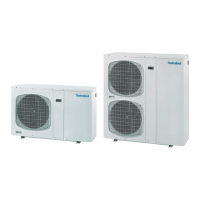
Overall dimensions, model numbers, and key connection points (air, water, power).
Details on sling attachment holes and anti-vibration pad locations.
Personnel training, unit inspection, location restrictions, and qualified personnel.
Precautions for moving the unit, including lifting and pallet removal.
Leveling, structural support, clearance, air flow, environmental factors, and protection index.
Connecting water pipes, filter, isolation valves, and flexible hoses.
Voltage, wiring, protection, and compliance with local standards.
Details on three-phase supply, phase rotation, protection, and cable specifications.
Specifics for powering the optional auxiliary heating system.
Potential-free contact for reporting overheating or low voltage faults.
Using external contacts for unit On/Off and heating/cooling mode selection.
Alarm transfer and auxiliary electric heating authorization connections.
Details on immersion heaters, safety features, and control box components.
CTN probe specifications and temperature-resistance data.
How the unit operates in heating mode via remote control and temperature thresholds.
How the unit operates in cooling mode via remote control and temperature thresholds.
Manual switchover for a secondary pump.
Details on the frost protection heater, wiring, and safety.
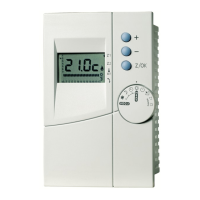
Use, characteristics, and kit contents for remote display functionality.
Steps for installing the control module, wiring, and micro-switch settings.
Cable specifications and connection details for the remote display.
Explanation of indicator lights, keys, and operational notes.
Kit for cooling mode, controls fan speed based on pressure.
Gauges display high and low pressure values for refrigeration circuits.
Precautions and considerations for ventilation when installed in a room.
Comprehensive checklist for hydraulic, electrical, and system stability before operation.
Steps for powering up and initiating the unit's operation.
Detailed checks before operation, including rotation, pressure, and flow.
Explanation of indicator lights and key functions on the display.
Configuration of micro-switches for addressing and keyboard count.
Components and connections of the primary I/O board.
Details for the I/O board specific to the second refrigerating circuit.
Table showing ohmic values for CTN probes at various temperatures.
Diagrams and descriptions for cooling and heating mode operations.
Guide to accessing, modifying, and storing controller parameters.
Procedures for responding to and clearing system alarms.
Comprehensive table detailing alarms, messages, inhibition, cancellation, and remarks.
Anti-freeze, pump control, power cut, fan speed, defrosting, and cycle inversion.
Importance of regular maintenance for performance and warranty.
Recommended annual inspections for various components and systems.
Guidelines for installation, maintenance, troubleshooting, and leak detection.
Low and high pressure curves for PMHRV models based on water outlet and outdoor temperature.
Low and high pressure curves for heating mode based on water outlet and outside wet bulb temperature.


 To Next Page
 General