IST-2293.PM02.01/B Istruzione / User’s Manual / Manuel d’utilisation Pag.4/10
TECNOCONTROL S.r.l. Via Miglioli 47 SEGRATE ( MI ) Tel: 02/26 92 28 90 Fax: 02/21 33 734
quella richiesta. Interrompere l’operazione, spegnere lo strumento e ripetere la Calibrazione). Chiudere la bombola
e togliere il TC011. A questo punto si possono verificare due casi:
LED giallo e verde accesi: la calibrazione è corretta
, dopo 8 secondi l’apparecchio si riavvia automaticamente in
funzionamento normale (vedi capitolo FUNZIONAMENTO “ Preriscaldo”).
LED giallo acceso: la calibrazione è fallita
dopo 8 secondi l’apparecchio si riavvia automaticamente e dopo il pre-
riscaldo, ripetere la “Calibrazione” senza reinserire il “Codice”. Se la condizione persiste anche dopo la sostituzione
della “Cartuccia Sensore”, inviare il rilevatore al fornitore per la riparazione.
“VERIFICA
”(Non serve Codice): serve per controllare, utilizzando la miscela di gas sopra indicata, la corretta ri-
sposta al gas e può essere eseguita dopo la “Calibrazione” o dopo l’installazione, ma va eseguita soprattutto duran-
te le manutenzioni periodiche, in quanto è l’unico metodo per controllare l’effettivo funzionamento del rilevatore.
Infilare il TC011 sul portasensore, regolare il riduttore della bombola in modo che il flussometro indichi circa 0,3
l/min (vedi Fig.3). Controllare, che con i puntali del volmetro sui Test-Point “TESTmA”, (vedi Fig.2) si raggiunga il valo-
re in mV indicato in Tabella 3-Colonna 6”. [ovvero che l’uscita in mA aumenti fino al valore indicato nella Colonna 7 (±0,2mA) e la
centrale, cui è collegato il rilevatore, indichi il valore in %LIE (± 2) indicato in Colonna 8]. Se il valore fosse diverso, eseguire la
“Calibrazione”. Terminata la “Verifica”, chiudere la bombola e togliere il TC011. L’uscita, tornerà poi a 4 mA.
Se si usa la specifica miscela Gas/Aria del gas da rilevare, il segnale d’uscita dovrà corrispondere al gas utilizzato.
(Esempio
se si deve verificare un rilevatore tarato per Idrogeno, utilizzando una bombola con H
2
a 0,8%volume
(=20%LIE) in Aria, l’uscita in mA dovrà essere circa 7,2 mA (ovvero circa 72 mV su “TESTmA”).
GB
DESCRIPTION
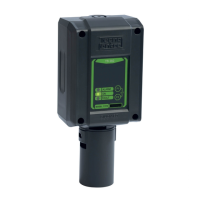
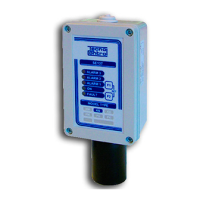
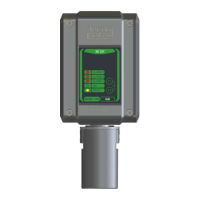
The TS293P series is a gas detector able to detect combustible gases by employing a Pellistor sensor calibrated
up to 100% LEL to different gases and find their best application in centralized alarm systems for laboratories,
manufacturing industries and environments to be protected from possible leakage of gas.
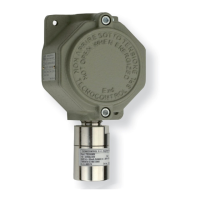
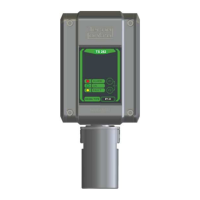
The instruments is flameproof certified and comprise of an enclosure in which the electronic circuit and the termi-
nals are mounted and a downward facing cylindrical sensor housing with inside a replaceable “Cartridge Sensor”.
The instrument has a 4÷20mA linear output (S) with 100%LEL (Lower Explosive Limit) F.S. of detected gas. This out-
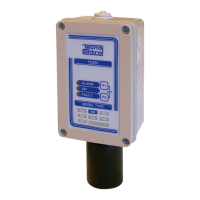
put is connectable to a remote Gas Central Unit as listed in Table 1. On the Printed Circuit Board, F1 and F2 key us-
ing for Test and Calibration routine protected by a code and 3 LED shows the working conditions:
Red LED "ALARM": 20% LEL alarm indication.
Green LED "ON": normal working condition
Yellow LED "FAULT": the sensor should be faulty, disconnected, out of scale or expired.
NOTES ON THE AVAILABLE MODELS
The above Gas value is on compliance with EN61779-1.
TS293PM (Methane CH
4
) is calibrated to detect Methane, a gas lighter than air. Its density as to air is 0.55 and
its LEL (Lower Explosive Limit) is 4.4% volume.
TS293PG
(GPL) is calibrated to detect LPG, a gas heavier than air and consists of a mixture of 20÷30% Propane
(C
3
H
8
) and 80÷70% Butane (C
4
H
10
). Propane density as to air is 1.56 while Butane' is 2.05. The LEL is 1.7% vol-
ume for Propane and 1.4% volume for Butane. Standard calibration to LPG is carried out for Butane gas.
TS293PI
(Hydrogen H
2
) is calibrated to detect Hydrogen, is a colourless, odourless, highly flammable gas and is
the lightest gas. Its density as to air is 0.07 and its LEL (Lower Explosive Limit) is 4% volume.
TS293PB
(Unleaded Gasoline/Petrol) is calibrated to detect Gasoline vapours heavier than air and highly
flammable. Its density as to air about 2.8 and its LEL (Lower Explosive Limit) is about 1.2% volume.
TS293PX
can be calibrated to detect the gases listed in Table 3, it is used in low polluted environments. If other
gases not listed in this table are present in the environment we suggest to use the model TS293PX-H.
OPERATIONAL DESCRIPTION
The catalytic Pellistor sensor is practically insensitive to humidity and temperature variations. The calibration is car-
ried out for the specific gas to be detected. Anyway, it can contemporaneously detect any other flammable gas that
should be present in the same environment.
Note
that the LEDs are not visible when the enclosure is closed.
Preheating
: when powered, the sensor needs a time of preliminary heating of about 60 seconds. During this pe-
riod the yellow LED “FAULT” flashes. After this period, the yellow LED light off, the green LED “ON” illuminates to
indicate normal functioning. After this period the unit is able to detect gas even if it attains the optimum stability
conditions after about 4 hours continual functioning.
Normal operation
: the green LED “ON” should be light on.
Alarm
: when Gas concentration attains 20% LEL the red LED “ALARM” illuminates (only if it be activate by Dip-Switch).
Faults
: the Yellow LED illuminates and the "S" output falls down to 0mA. (The different faults are listed below).
Yellow LED illuminates each 4 seconds (with green LED activate): this happens when the “Cartridge Sensor” has
overcome its period of life (about 5 years) and its correct operation is not longer guaranteed. The detector keeps on
operating normally but it is necessary to replace, as soon as possible, the “Cartridge Sensor” with a new one. The type
to be required is listed in Table 3 (2nd column). The replacement procedure is described in the attached manual.
Yellow LED activate, green LED off (0mA output signal): this signal different kind of faults. 1) The Dip Switch set
up is wrong, please verify (see Table 2). 2) The “Cartridge Sensor” is not working, please replace with new one. 3) If a
new “Cartridge Sensor” is installed, or it is not correctly connected or a not compatible one is mounted. Please check



 To Next Page
 Loading...