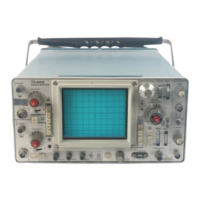
Maintenance—Type 422 AC-DC
Resistor and Capacitor Color Code
^°'or
Signifi
cant
Figures
Multiplier
Tolerance
Resis
tors
Capaci
tors
Resis
tors
Capaci
tors
Composition Resistors: Silver
io-2
---
±10%
Gold ---
10-1
---
±5%
...
C p _ s i s ' Black
0
1
1
—
±20% or
2 pF*
Brown
1
10
10
±1 %
±1% or
0.1 pF*
Red
2
102
102
±2% ±2%
Metal-Film Resistors: Orange
3
103
103 ±3%
±3%
Q Yd'0W
4
104
104
±4% +100%
-0 %
5
105
105 ±0.5%
±5% or
0.5 pF*
Blue
6 106
10G
...
...
Violet 7
---
...
...
Ceramic Capacitors: Gray
1 1
8
io-2
+80%
-2 0 %
or 0.25 pF*
1 White 9
—
io-1
—
±10% or
1 pF*
(none)
(1 ) ( 2 ) and (3 ) — l st, 2nd and 3rd significant figures;
— — —
±20%
±10% or
1 pF*
*For capacitance of 10 pF or less.
Q A j — multiplier; —tolerance;
^c) — temperature coefficient. NOTE: and/or ^c) color code for capacitors depends upon
manufacturer and capacitor type. May not be present in some cases.
Fig. 4-2. Color-code for resistors and ceramic capacitors.
farads on the side of the component body. The white
ceramic capacitors used in the Type 422 are color coded in
picofarads using a modified EIA code (see Fig. 4-2).
Diode Color-Code. The cathode end of each glass-
encased diode is indicated by a stripe, a series of stripes or a
dot. For most silicon or germanium diodes with a series of
stripes, the color-code identifies the three significant digits
of the Tektronix Part Number using the resistor color-code
system (e.g., a diode color-coded pink or blue-brown-gray-
green indicates Tektronix Part Number 152-0185-00). The
cathode and anode ends of a metal-encased diode can be
identified by the diode symbol marked on the body.
Transistor Lead Configuration. Fig. 4-3 shows the lead
configurations of the transistors used in this instrument.
This view is as seen from the bottom of the transistor.
Troubleshooting Equipment
The following equipment is useful for troubleshooting
the Type 422.
1. Transistor Tester
D escription: Tektronix Type 575 Transistor-Curve
Tracer or equivalent.
Purpose: To test the semiconductors used in this instru
ment.
2. Multimeter
Description: VTVM, 10 megohm input impedance and
0 to 500 volts range; ohmmeter, 0 to 50 megohms. Accu
racy, within 3%. Test probes must be insulated to prevent
accidental shorting.
Purpose: To check voltages and for general trouble
shooting in this instrument.
NOTE
A 20,000 ohms/volt VOM can be used to check the
voltages in this instrument if allowances are made for
the circuit loading of the VOM at high-impedance
points.
3. Test Oscilloscope
Description: DC to 15 MFIz frequency response, 50
millivolts to 50 volts/division deflection factor. A 10X
probe should be used to reduce circuit loading.
Purpose: To check waveforms in this instrument.
Troubleshooting Techniques
This troubleshooting procedure is arranged in an order
which checks the simple trouble possibilities before pro
ceeding with extensive troubleshooting. The first few
checks assure proper connection, operation and calibration.
El
4-4


 To Next Page
 Loading...