EasyManua.ls Logo

Tektronix 585 - Page 24

Tektronix 585
151 pages
Print Icon
To Next Page IconTo Next Page
To Previous Page IconTo Previous Page
Loading...
Applications
Type
585
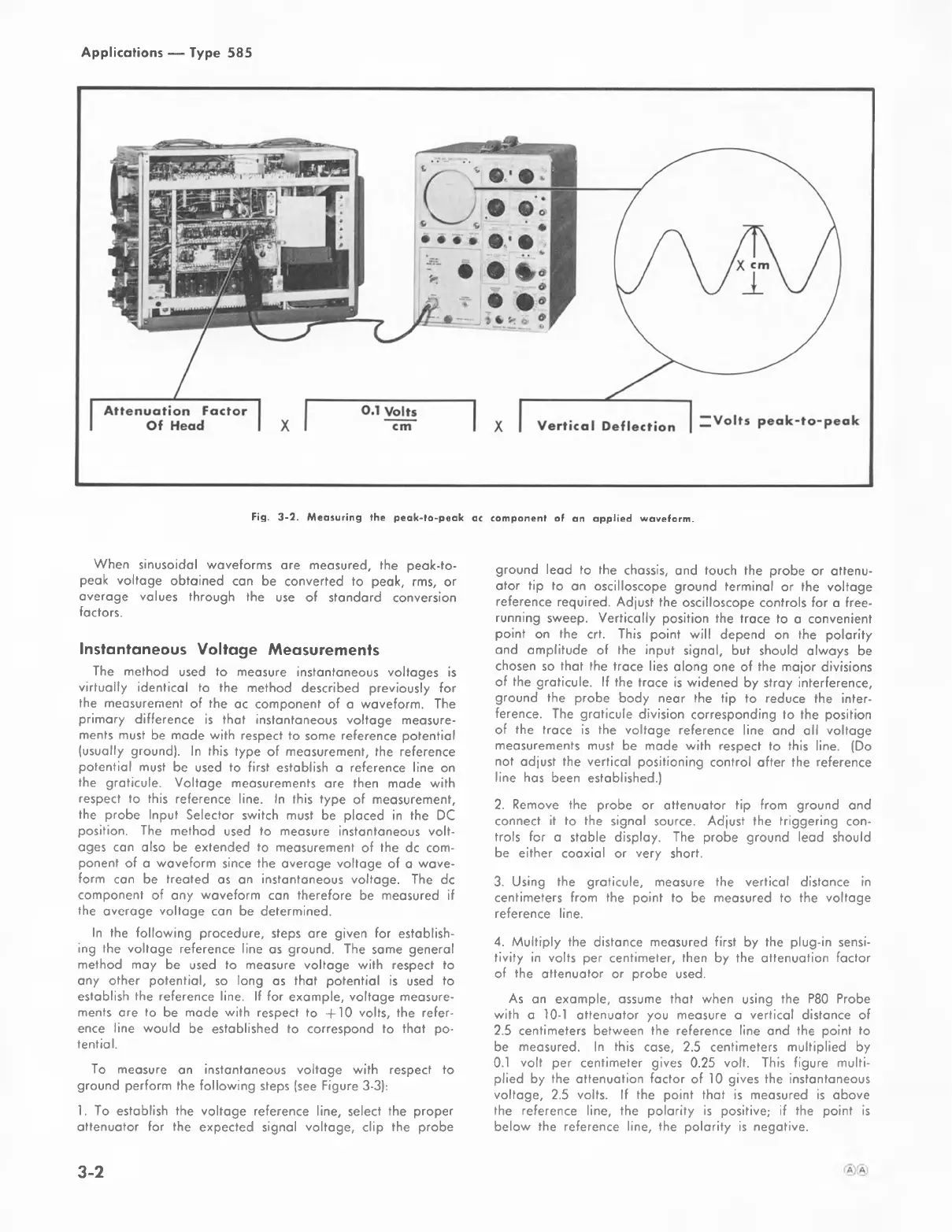
Fig.
3-2.
Measuring
the
peak-to-peak
ac
component
of
an
applied
waveform.
When
sinusoidal
waveforms
are
measured,
the
peak-to-
peak
voltage
obtained
can
be
converted
to
peak,
rms,
or
average
values
through
the
use
of
standard
conversion
factors.
Instantaneous
Voltage
Measurements
The
method
used
to
measure
instantaneous
voltages
is
virtually
identical
to
the
method
described
previously
for
the
measurement
of
the
ac
component
of
a
waveform.
The
primary
difference
is
that
instantaneous
voltage
measure
ments
must
be
made
with
respect
to
some
reference
potential
(usually
ground).
In
this
type
of
measurement,
the
reference
potential
must
be
used
to
first
establish
a
reference
line
on
the
graticule.
Voltage
measurements
are
then
made
with
respect
to
this
reference
line.
In
this
type
of
measurement,
the
probe
Input
Selector
switch
must
be
placed
in
the
DC
position.
The
method
used
to
measure
instantaneous
volt
ages
can
also
be
extended
to
measurement
of
the
d
c
com
ponent
of
a
waveform
since
the
average
voltage
of
a
wave
form
can
be
treated
as
an
instantaneous
voltage.
The
d
c
component
of
any
waveform
can
therefore
be
measured
if
the
average
voltage
can
be
determined.
In
the
following
procedure,
steps
are
given
for
establish
ing
the
voltage
reference
line
as
ground.
The
same
general
method
may
be
used
to
measure
voltage
with
respect
to
any
other
potential,
so
long
as
that
potential
is
used
to
establish
the
reference
line.
If
for
example,
voltage
measure
ments
are
to
be
made
with
respect
to
+
10
volts,
the
refer
ence
line
would
be
established
to
correspond
to
that
po
tential.
To
measure
an
instantaneous
voltage
with
respect
to
ground
perform
the
following
steps
(see
Figure
3-3):
1.
To
establish
the
voltage
reference
line,
select
the
proper
attenuator
for
the
expected
signal
voltage,
clip
the
probe
ground
lead
to
the
chassis,
and
touch
the
probe
or
attenu
ator
tip
to
an
oscilloscope
ground
terminal
or
the
voltage
reference
required.
Adjust
the
oscilloscope
controls
for
a
free-
running
sweep.
Vertically
position
the
trace
to
a
convenient
point
on
the
crt.
This
point
will
depend
on
the
polarity
and
amplitude
of
the
input
signal,
but
should
always
be
chosen
so
that
the
trace
lies
along
one
of
the
major
divisions
of
the
graticule.
If
the
trace
is
widened
by
stray
interference,
ground
the
probe
body
near
the
tip
to
reduce
the
inter
ference.
The
graticule
division
corresponding
to
the
position
of
the
trace
is
the
voltage
reference
line
and
all
voltage
measurements
must
be
made
with
respect
to
this
line.
(Do
not
adjust
the
vertical
positioning
control
after
the
reference
line
has
been
established.)
2.
Remove
the
probe
or
attenuator
tip
from
ground
and
connect
it
to
the
signal
source.
Adjust
the
triggering
con
trols
for
a
stable
display.
The
probe
ground
lead
should
be
either
coaxial
or
very
short.
3.
Using
the
graticule,
measure
the
vertical
distance
in
centimeters
from
the
point
to
be
measured
to
the
voltage
reference
line.
4.
Multiply
the
distance
measured
first
by
the
plug-in
sensi
tivity
in
volts
per
centimeter,
then
by
the
attenuation
factor
of
the
attenuator
or
probe
used.
As
an
example,
assume
that
when
using
the
P80
Probe
with
a
10-1
attenuator
you
measure
a
vertical
distance
of
2.5
centimeters
between
the
reference
line
and
the
point
to
be
measured.
In
this
case,
2.5
centimeters
multiplied
by
0.1
volt
per
centimeter
gives
0.25
volt.
This
figure
multi
plied
by
the
attenuation
factor
of
10
gives
the
instantaneous
voltage,
2.5
volts.
If
the
point
that
is
measured
is
above
the
reference
line,
the
polarity
is
positive;
if
the
point
is
below
the
reference
line,
the
polarity
is
negative.
3-2

Related product manuals