EasyManua.ls Logo

Tektronix 585 - Page 26

Tektronix 585
151 pages
Print Icon
To Next Page IconTo Next Page
To Previous Page IconTo Previous Page
Loading...
Applications
Type
585
Sweep
Magnification
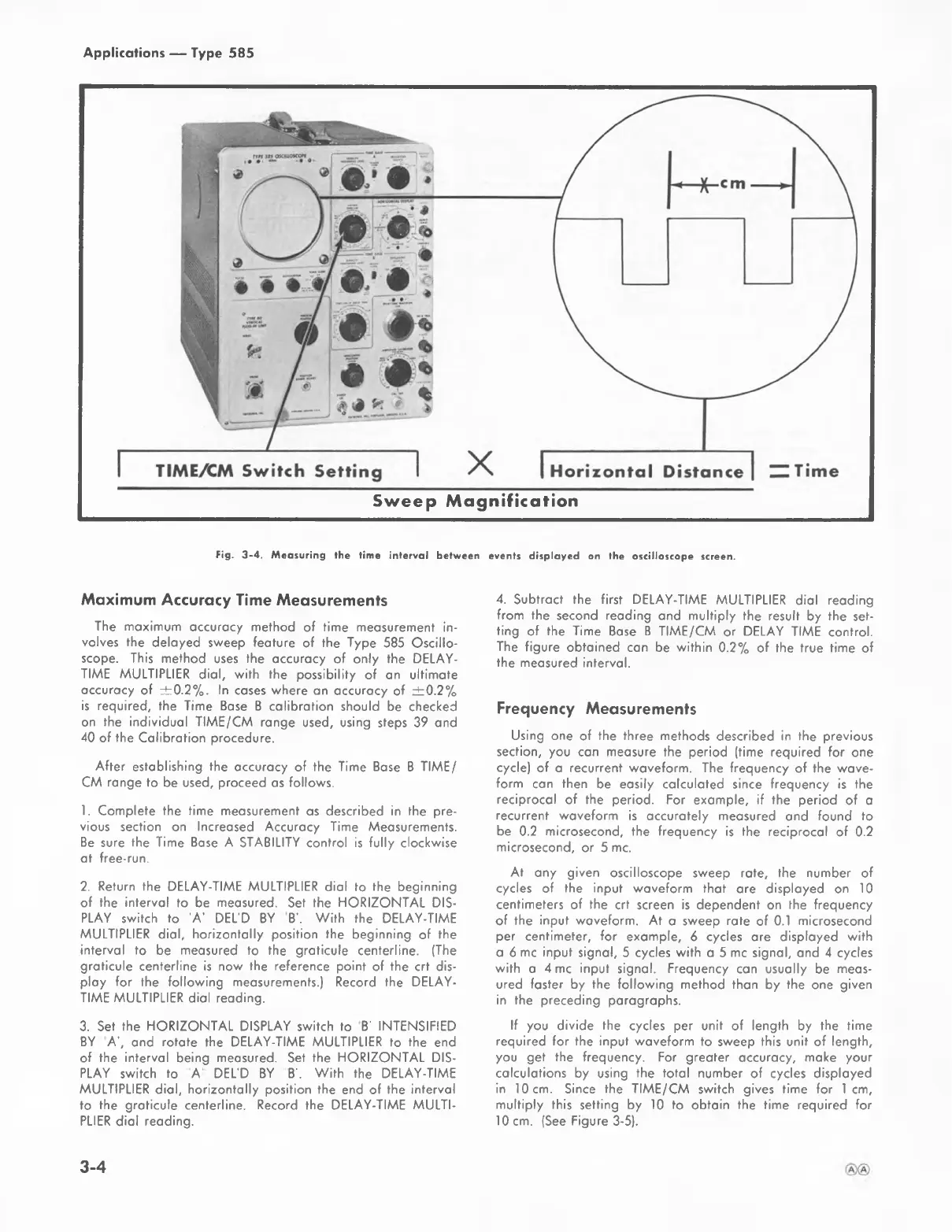
Fig.
3-4.
Measuring
the
time
interval
between
events
displayed
on
the
oscilloscope
screen.
Maximum
Accuracy
Time
Measurements
The
maximum
accuracy
method
of
time
measurement
in
volves
the
delayed
sweep
feature
of
the
Type
585
Oscillo
scope.
This
method
uses
the
accuracy
of
only
the
DELAY
TIME
MULTIPLIER
dial,
with
the
possibility
of
an
ultimate
accuracy
of
±0.2%.
In
cases
where
an
accuracy
of
±0.2%
is
required,
the
Time
Base
B
calibration
should
be
checked
on
the
individual
TIME/CM
range
used,
using
steps
39
and
40
of
the
Calibration
procedure.
After
establishing
the
accuracy
of
the
Time
Base
B
TIME/
CM
range
to
be
used,
proceed
as
follows.
1.
Complete
the
time
measurement
as
described
in
the
pre
vious
section
on
Increased
Accuracy
Time
Measurements.
Be
sure
the
Time
Base
A
STABILITY
control
is
fully
clockwise
at
free-run.
2.
Return
the
DELAY-TIME
MULTIPLIER
dial
to
the
beginning
of
the
interval
to
be
measured.
Set
the
HORIZONTAL
DIS
PLAY
switch
to
'A
DEL'D
BY
B'.
With
the
DELAY-TIME
MULTIPLIER
dial,
horizontally
position
the
beginning
of
the
interval
to
be
measured
to
the
graticule
centerline.
(The
graticule
centerline
is
now
the
reference
point
of
the
crt
dis
play
for
the
following
measurements.)
Record
the
DELAY
TIME
MULTIPLIER
dial
reading.
3.
Set
the
HORIZONTAL
DISPLAY
switch
to
B'
INTENSIFIED
BY
A',
and
rotate
the
DELAY-TIME
MULTIPLIER
to
the
end
of
the
interval
being
measured.
Set
the
HORIZONTAL
DIS
PLAY
switch
to
A
DEL
D
BY
B'.
With
the
DELAY-TIME
MULTIPLIER
dial,
horizontally
position
the
end
of
the
interval
to
the
graticule
centerline.
Record
the
DELAY-TIME
MULTI
PLIER
dial
reading.
4.
Subtract
the
first
DELAY-TIME
MULTIPLIER
dial
reading
from
the
second
reading
and
multiply
the
result
by
the
set
ting
of
the
Time
Base
B
TIME/CM
or
DELAY
TIME
control.
The
figure
obtained
can
be
within
0.2%
of
the
true
time
of
the
measured
interval.
Frequency
Measurements
Using
one
of
the
three
methods
described
in
the
previous
section,
you
can
measure
the
period
(time
required
for
one
cycle)
of
a
recurrent
waveform.
The
frequency
of
the
wave
form
can
then
be
easily
calculated
since
frequency
is
the
reciprocal
of
the
period.
For
example,
if
the
period
of
a
recurrent
waveform
is
accurately
measured
and
found
to
be
0.2
microsecond,
the
frequency
is
the
reciprocal
of
0.2
microsecond,
or
5
m
c
.
At
any
given
oscilloscope
sweep
rate,
the
number
of
cycles
of
the
input
waveform
that
are
displayed
on
10
centimeters
of
the
crt
screen
is
dependent
on
the
frequency
of
the
input
waveform.
At
a
sweep
rate
of
0.1
microsecond
per
centimeter,
for
example,
6
cycles
are
displayed
with
a
6
m
c
input
signal,
5
cycles
with
a
5
m
c
signal,
and
4
cycles
with
a
4
m
c
input
signal.
Frequency
can
usually
be
meas
ured
faster
by
the
following
method
than
by
the
one
given
in
the
preceding
paragraphs.
If
you
divide
the
cycles
per
unit
of
length
by
the
time
required
for
the
input
waveform
to
sweep
this
unit
of
length,
you
get
the
frequency.
For
greater
accuracy,
make
your
calculations
by
using
the
total
number
of
cycles
displayed
in
10
cm.
Since
the
TIME/CM
switch
gives
time
for
1
cm,
multiply
this
setting
by
10
to
obtain
the
time
required
for
10
cm.
(See
Figure
3-5).
3-4

Related product manuals