EasyManua.ls Logo

Tektronix 585 - Page 28

Tektronix 585
151 pages
Print Icon
To Next Page IconTo Next Page
To Previous Page IconTo Previous Page
Loading...
Applications
Type
585
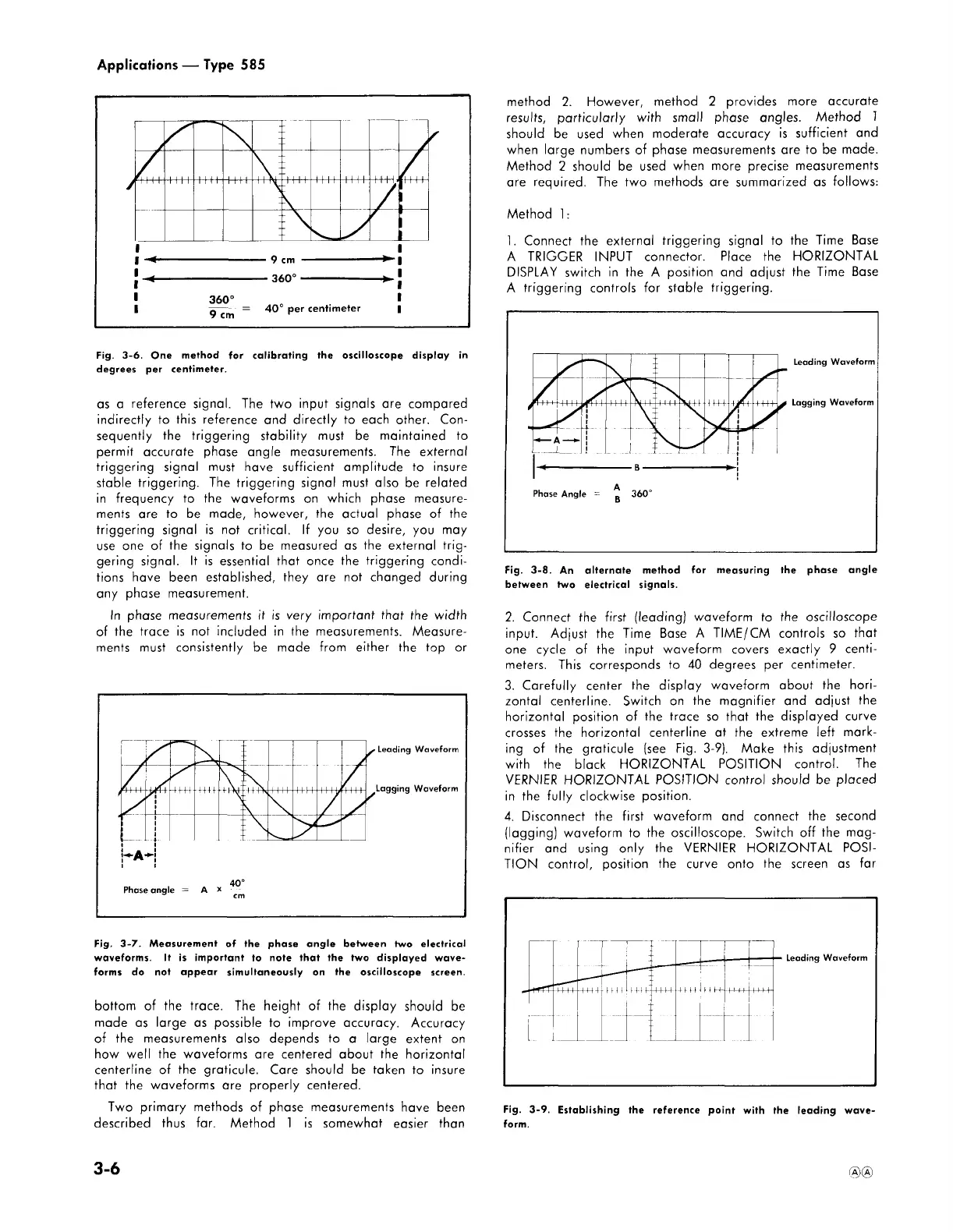
Fig.
3-6.
One
method
for
calibrating
the
oscilloscope
display
in
degrees
per
centimeter.
as
a
reference
signal.
The
two
input
signals
are
compared
indirectly
to
this
reference
and
directly
to
each
other.
Con
sequently
the
triggering
stability
must
be
maintained
to
permit
accurate
phase
angle
measurements.
The
external
triggering
signal
must
have
sufficient
amplitude
to
insure
stable
triggering.
The
triggering
signal
must
also
be
related
in
frequency
to
the
waveforms
on
which
phase
measure
ments
are
to
be
made,
however,
the
actual
phase
of
the
triggering
signal
is
not
critical.
If
you
so
desire,
you
may
use
one
of
the
signals
to
be
measured
as
the
external
trig
gering
signal.
It
is
essential
that
once
the
triggering
condi
tions
have
been
established,
they
are
not
changed
during
any
phase
measurement.
In
phase
measurements
it
is
very
important
that
the
width
of
the
trace
is
not
included
in
the
measurements.
Measure
ments
must
consistently
be
made
from
either
the
top
or
Fig.
3-7.
Measurement
of
the
phase
angle
between
two
electrical
waveforms.
It
is
important
to
note
that
the
two
displayed
wave
forms
do
not
appear
simultaneously
on
the
oscilloscope
screen.
bottom
of
the
trace.
The
height
of
the
display
should
be
made
as
large
as
possible
to
improve
accuracy.
Accuracy
of
the
measurements
also
depends
to
a
large
extent
on
how
well
the
waveforms
are
centered
about
the
horizontal
centerline
of
the
graticule.
Care
should
be
taken
to
insure
that
the
waveforms
are
properly
centered.
Two
primary
methods
of
phase
measurements
have
been
described
thus
far.
Method
1
is
somewhat
easier
than
method
2.
However,
method
2
provides
more
accurate
results,
particularly
with
small
phase
angles.
Method
1
should
be
used
when
moderate
accuracy
is
sufficient
and
when
large
numbers
of
phase
measurements
are
to
be
made.
Method
2
should
be
used
when
more
precise
measurements
are
required.
The
two
methods
are
summarized
as
follows:
Method
1:
1.
Connect
the
external
triggering
signal
to
the
Time
Base
A
TRIGGER
INPUT
connector.
Place
the
HORIZONTAL
DISPLAY
switch
in
the
A
position
and
adjust
the
Time
Base
A
triggering
controls
for
stable
triggering.
Fig.
3-8.
An
alternate
method
for
measuring
the
phase
angle
between
two
electrical
signals.
2.
Connect
the
first
(leading)
waveform
to
the
oscilloscope
input.
Adjust
the
Time
Base
A
TIME/CM
controls
so
that
one
cycle
of
the
input
waveform
covers
exactly
9
centi
meters.
This
corresponds
to
40
degrees
per
centimeter.
3.
Carefully
center
the
display
waveform
about
the
hori
zontal
centerline.
Switch
on
the
magnifier
and
adjust
the
horizontal
position
of
the
trace
so
that
the
displayed
curve
crosses
the
horizontal
centerline
at
the
extreme
left
mark
ing
of
the
graticule
(see
Fig.
3-9).
Make
this
adjustment
with
the
black
HORIZONTAL
POSITION
control.
The
VERNIER
HORIZONTAL
POSITION
control
should
be
placed
in
the
fully
clockwise
position.
4.
Disconnect
the
first
waveform
and
connect
the
second
(lagging)
waveform
to
the
oscilloscope.
Switch
off
the
mag
nifier
and
using
only
the
VERNIER
HORIZONTAL
POSI
TION
control,
position
the
curve
onto
the
screen
as
far
Fig.
3-9.
Establishing
the
reference
point
with
the
leading
wave
form.
3-6

Related product manuals