EasyManua.ls Logo

Tektronix 585 - Page 42

Tektronix 585
151 pages
Print Icon
To Next Page IconTo Next Page
To Previous Page IconTo Previous Page
Loading...
Circuit
Description
Type
585
A
MAGNIFIER
neon
glow
lamp
is
located
on
the
front
panel
immediately
below
the
HORIZONTAL
DISPLAY
switch;
circuitry
for
the
lamp
is
shown
with
the
5X
MAGNIFIER
switching
detail
of
the
Horizontal
Amplifier
diagram.
Output
Stage
The
Output
Amplifier
stage
V364A-V384A
is
a
paraphase
amplifier
with
output
from
both
plates.
Cathode
followers
V364B-V384B
provide
high-impedance,
low-capaitance
loads
which
help
to
maintain
the
gain
of
the
stage
constant
over
the
sweep
range
of
the
instrument.
The
Output
CF's
also
provide
the
necessary
low-impedance
output
to
drive
the
capacitance
of
the
horizontal
deflection
plates.
Bootstrap
capacitors
C364
and
C384
improve
the
response
at
the
fastest
sweep
rates
by
supplying
additional
current
from
the
Output
CF
stage
to
charge
and
discharge
the
stray
capaci
tance
in
the
plate
circuit
of
the
Output
Amplifier.
Capacitance
Driver
At
the
fastest
sweep
rates
the
current
through
the
left
hand
deflection
plate
Output
CF
tube
is
too
small
to
dis
charge
the
stray
capacitance
in
the
cathode
circuit
at
the
required
rate.
Additional
current
to
discharge
the
stray
capacitance
is
provided
by
the
gated
pentode
V398
con
nected
in
the
cathode
circuit
of
V364B.
This
permits
the
cathode
of
V364B
to
run
down
at
the
required
rate.
A
sim
ilar
current
boost
is
not
required
for
V384B
since
this
tube
is
the
positive-sawtooth
cathode
follower
and
the
cathode
runs
down
during
the
retrace
when
speed
and
linearity
are
not
important.
Because
the
plate
current
of
a
pentode
is
fairly
constant
over
a
large
range
of
plate
voltage,
the
current
through
V398
will
remain
nearly
constant
even
though
its
plate
falls
about
150
volts
due
to
the
negative
sweep
sawtooth
wave
form.
The
additional
current
required
for
fastest
sweep
rates
is
obtained
by
applying
a
positive
flat-topped
pulse
to
the
grid
of
pentode
V398
during
the
period
of
the
sweep.
The
pulse
is
derived
by
differentiating
the
positive-going
saw
tooth
from
the
cathode
of
V384B
with
C390
and
R390.
The
pulse
amplitude
is
proportional
to
the
slope
of
the
sawtooth,
and
thus
proportional
to
the
sweep
rate.
The
pulse
first
becomes
noticeable
when
the
sawtooth
voltage
at
the
cathode
of
V384B
exceeds
the
rate
of
about
1.6
volts/
second.
External
Horizontal
Amplifier
The
External
Horizontal
Amplifier
is
a
cathode
coupled
circuit
providing
the
necessary
gain
to
drive
the
horizontal
amplifier
from
external
signals.
An
input
attenuator
and
a
gain
control
provide
horizontal
deflection
factors
between
approximately
0.2
and
15
volts
per
centimeter.
A
front-panel
binding
post
labeled
HORIZ.
INPUT
couples
externally-derived
signals
to
the
Horizontal
Amplifier
circuit
when
the
HORIZONTAL
DISPLAY
switch
is
in
either
of
the
EXT.
positions.
A
preamplifier
stage,
V314
amplifies
the
external
signals
before
applying
them
to
the
input
attenu
ator
of
the
Horizontal
Amplifier.
The
position
of
the
HORI
ZONTAL
DISPLAY
switch
determines
whether
the
signal
is
directly
coupled
to
the
grid
circuit
of
V314A,
or
whether
a
10:1
frequency-compensated
attenuator
is
connected
in
the
signal
path.
In
either
case
the
input
resistance
is
1
megohm
paralleled
by
approximately
4Z
picofarads.
The
External
Horizontal
Preamplifier
V314
is
a
cathode-
coupled
amplifier.
V314A
is
a
cathode-follower
and
V314B
is
a
grounded-grid
amplifier
stage.
The
VARIABLE
10-1
control
provides
a
means
for
adjusting
the
gain
over
a
10
to
1
range.
The
Ext.
Horiz.
DC.
Bal.
control
R31Z
adjusts
the
d
c
level
of
V314B
grid
so
that
its
cathode
is
at
the
same
voltage
as
the
cathode
of
V314A
under
no
signal
conditions.
With
the
cathodes
at
the
same
voltage
there
is
no
current
through
the
variable
attenuator
control
R314.
By
this
ar
rangement
an
adjustment
of
the
VARIABLE
10-1
gain
control
does
not
change
the
d
c
level
at
the
plate
of
V314B
and
therefore
does
not
affect
the
positioning
of
the
c
rt
beam.
Delay
Pickoff
Circuit
General
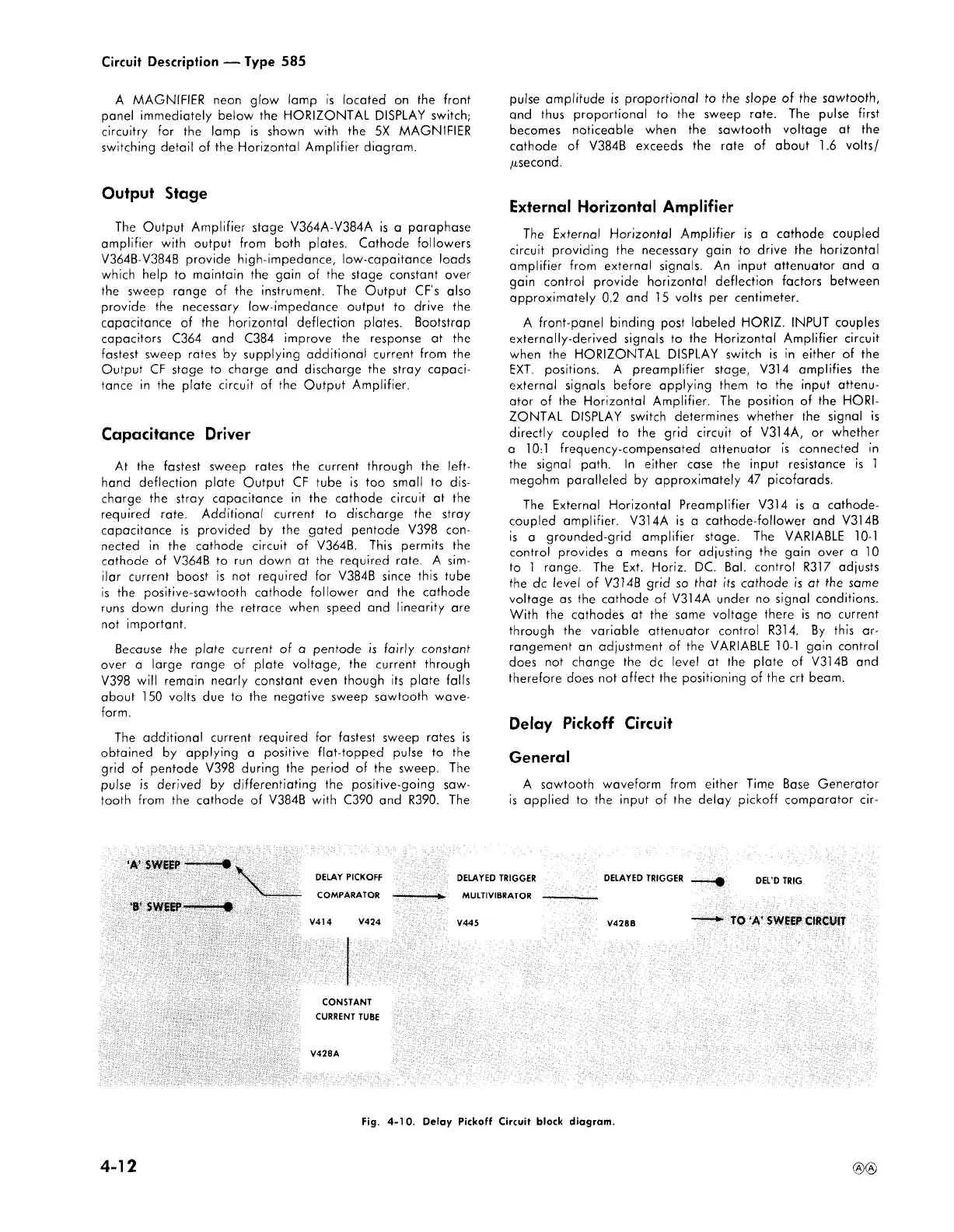
A
sawtooth
waveform
from
either
Time
Base
Generator
is
applied
to
the
input
of
the
delay
pickoff
comparator
cir
A
SWEEP
B
SWEEP
DELAY
PICKOFF
COMPARATOR
V414
V424
DELAYED
TRIGGER
MULTIVIBRATOR
DELAYED
TRIGGER
DEL
D
TRIG
V445
V428B
---------
TO
A
SWEEP
CIRCUIT
CONSTANT
CURRENT
TUBE
V428A
Fig.
4-10.
Delay
Pickoff
Circuit
block
diagram.
4-12

Related product manuals