EasyManua.ls Logo

Tektronix 585 - Page 60

Tektronix 585
151 pages
Print Icon
To Next Page IconTo Next Page
To Previous Page IconTo Previous Page
Loading...
Maintenance
Type
585
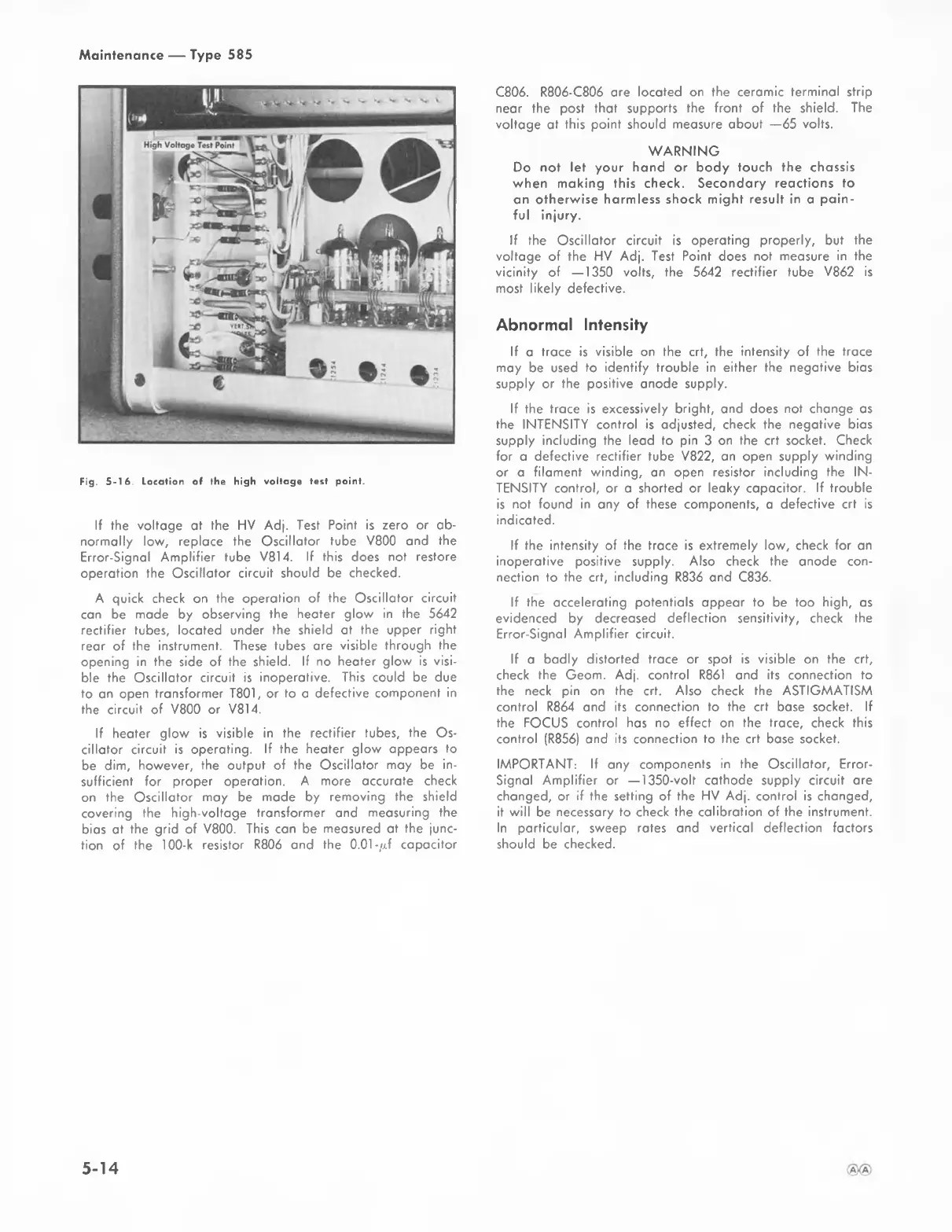
Fig.
5-16.
Location
of
the
high
voltage
test
point.
If
the
voltage
at
the
HV
Adj.
Test
Point
is
zero
or
ab
normally
low,
replace
the
Oscillator
tube
V800
and
the
Error-Signal
Amplifier
tube
V814.
If
this
does
not
restore
operation
the
Oscillator
circuit
should
be
checked.
A
quick
check
on
the
operation
of
the
Oscillator
circuit
can
be
made
by
observing
the
heater
glow
in
the
5642
rectifier
tubes,
located
under
the
shield
at
the
upper
right
rear
of
the
instrument.
These
tubes
are
visible
through
the
opening
in
the
side
of
the
shield.
If
no
heater
glow
is
visi
ble
the
Oscillator
circuit
is
inoperative.
This
could
be
due
to
an
open
transformer
T801,
or
to
a
defective
component
in
the
circuit
of
V800
or
V814.
If
heater
glow
is
visible
in
the
rectifier
tubes,
the
Os
cillator
circuit
is
operating.
If
the
heater
glow
appears
to
be
dim,
however,
the
output
of
the
Oscillator
may
be
in
sufficient
for
proper
operation.
A
more
accurate
check
on
the
Oscillator
may
be
made
by
removing
the
shield
covering
the
high-voltage
transformer
and
measuring
the
bias
at
the
grid
of
V800.
This
can
be
measured
at
the
junc
tion
of
the
100-k
resistor
R806
and
the
0.01
f
capacitor
C806.
R806-C806
are
located
on
the
ceramic
terminal
strip
near
the
post
that
supports
the
front
of
the
shield.
The
voltage
at
this
point
should
measure
about
65
volts.
WARNING
Do
not
let
your
hand
or
body
touch
the
chassis
when
making
this
check.
Secondary
reactions
to
an
otherwise
harmless
shock
might
result
in
a
pain
ful
injury.
If
the
Oscillator
circuit
is
operating
properly,
but
the
voltage
of
the
HV
Adj.
Test
Point
does
not
measure
in
the
vicinity
of
1350
volts,
the
5642
rectifier
tube
V862
is
most
likely
defective.
Abnormal
Intensity
If
a
trace
is
visible
on
the
c
rt,
the
intensity
of
the
trace
may
be
used
to
identify
trouble
in
either
the
negative
bias
supply
or
the
positive
anode
supply.
If
the
trace
is
excessively
bright,
and
does
not
change
as
the
INTENSITY
control
is
adjusted,
check
the
negative
bias
supply
including
the
lead
to
pin
3
on
the
c
rt
socket.
Check
for
a
defective
rectifier
tube
V822,
an
open
supply
winding
or
a
filament
winding,
an
open
resistor
including
the
IN
TENSITY
control,
or
a
shorted
or
leaky
capacitor.
If
trouble
is
not
found
in
any
of
these
components,
a
defective
c
rt
is
indicated.
If
the
intensity
of
the
trace
is
extremely
low,
check
for
an
inoperative
positive
supply.
Also
check
the
anode
con
nection
to
the
c
rt,
including
R836
and
C836.
If
the
accelerating
potentials
appear
to
be
too
high,
as
evidenced
by
decreased
deflection
sensitivity,
check
the
Error-Signal
Amplifier
circuit.
If
a
badly
distorted
trace
or
spot
is
visible
on
the
c
rt,
check
the
Geom.
Adj.
control
R861
and
its
connection
to
the
neck
pin
on
the
c
rt.
Also
check
the
ASTIGMATISM
control
R864
and
its
connection
to
the
c
rt
base
socket.
If
the
FOCUS
control
has
no
effect
on
the
trace,
check
this
control
(R856)
and
its
connection
to
the
c
rt
base
socket.
IMPORTANT:
If
any
components
in
the
Oscillator,
Error-
Signal
Amplifier
or
1350-volt
cathode
supply
circuit
are
changed,
or
if
the
setting
of
the
HV
Adj.
control
is
changed,
it
will
be
necessary
to
check
the
calibration
of
the
instrument.
In
particular,
sweep
rates
and
vertical
deflection
factors
should
be
checked.
5-14

Related product manuals