EasyManua.ls Logo

Telefunken M 204 E - Drive Mechanism Principles; Motor Belt Replacement; Tape Path Alignment Procedures; Feed;Take-Up Plates and Head Adjustments

Telefunken M 204 E
14 pages
Print Icon
To Next Page IconTo Next Page
To Previous Page IconTo Previous Page
Loading...
Feed
Plate,
left
Functional
Principles
of
the
Drive
Mechanism
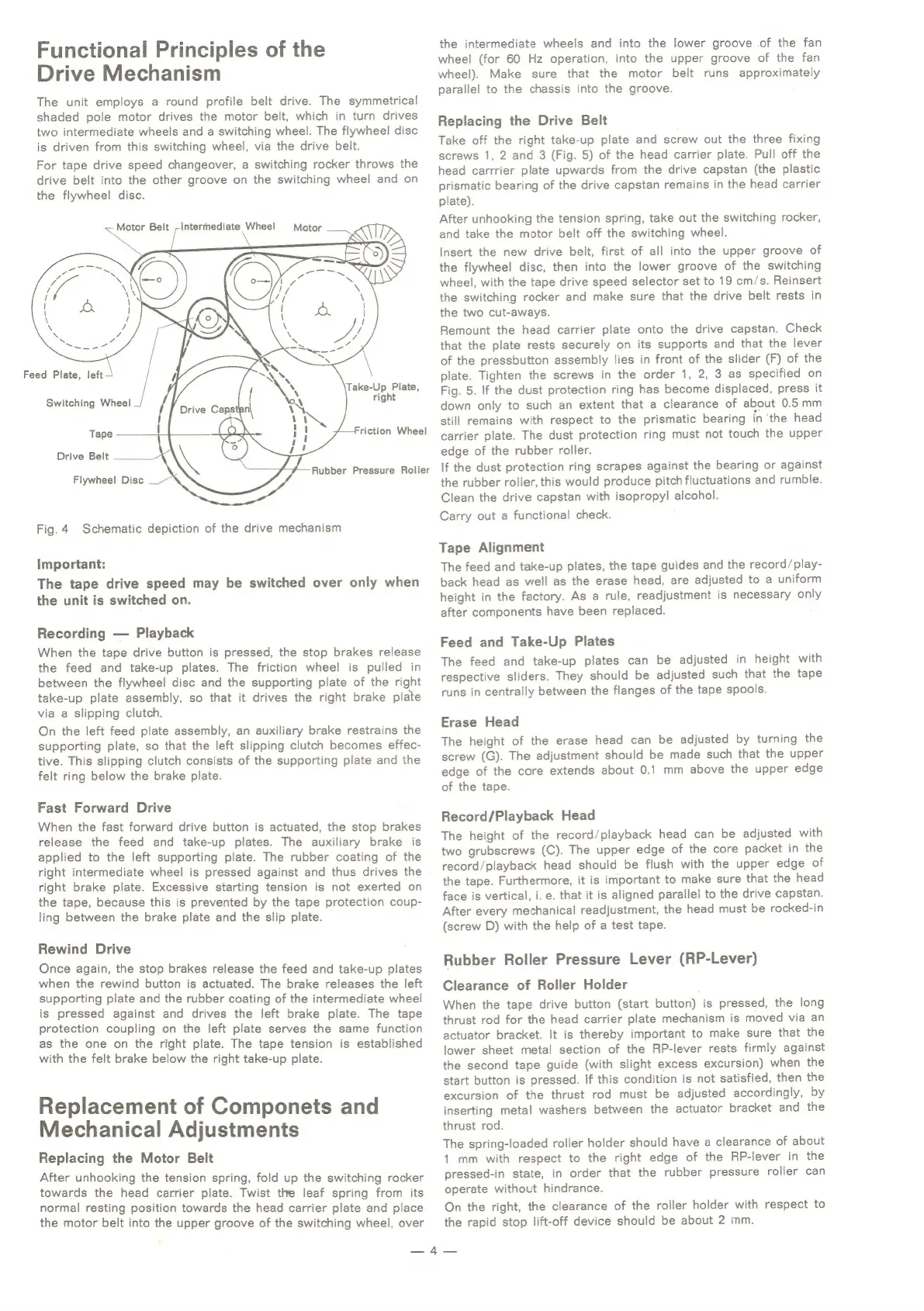
The
unit
employs
a
round
profile
belt
drive.
The
symmetrical
shaded
pole
motor
drives
the
motor
belt,
which
in
turn
drives
two
intermediate
wheels
and
a
switching
wheel.
The
flywheel
disc
is
driven
from
this
switching
wheel,
via
the
drive
belt.
For
tape
drive
speed
changeover,
a
switching
rocker
throws
the
drive
belt
into
the
other
groove
on
the
switching
wheel
and
on
the
flywheel
disc.
~
Belt
Interrnediate
Wheel
Motor
Switching
Wheel
Tape
Drive
Belt
Flywheel
Disc
Fig.
4
Schematic
depiction
of
the
drive
mechanism
Important:
The
tape
drive
speed
may
be
switched
over
only
when
the
unit
is
switched
on.
Recording
Playback
When
the
tape
drive
button
is
pressed,
the
stop
brakes
release
the
feed
and
take-up
plates.
The
friction
wheel
is
pulled
in
between
the
flywheel
disc
and
the
supporting
plate
of
the
right
take-up
plate
assembly,
so
that
it
drives
the
right
brake
plate
via
a
slipping
clutch.
On
the
left
feed
plate
assembly,
an
auxiliary
brake
restrains
the
supporting
plate,
so
that
the
left
slipping
clutch
becomes
effec-
tive.
This
slipping
clutch
consists
of
the
supporting
plate
and
the
felt
ring
below
the
brake
plate.
Fast
Forward
Drive
When
the
fast
forward
drive
button
is
actuated,
the
stop
brakes
release
the
feed
and
take-up
plates.
The
auxiliary
brake
is
applied
to
the
left
supporting
plate.
The
rubber
coating
of
the
right
intermediate
wheel
is
pressed
against
and
thus
drives
the
right
brake
plate.
Excessive
starting
tension
is
not
exerted
on
the
tape,
because
this
is
prevented
by
the
tape
protection
coup-
ling
between
the
brake
plate
and
the
slip
plate.
Rewind
Drive
Once
again,
the
stop
brakes
release
the
feed
and
take-up
plates
when
the
rewind
button
is
actuated.
The
brake
releases
the
left
supporting
plate
and
the
rubber
coating
of
the
intermediate
wheel
is
pressed
against
and
drives
the
left
brake
plate.
The
tape
protection
coupling
on
the
left
plate
serves
the
same
function
as
the
one
on
the
right
plate.
The
tape
tension
is
established
with
the
felt
brake
below
the
right
take-up
plate.
Replacement
of
Componets
and
Mechanical
Adjustments
Replacing
the
Motor
Belt
After
unhooking
the
tension
spring,
fold
up
the
switching
rocker
towards
the
head
carrier
plate.
Twist
the
leaf
spring
from
its
normal
resting
position
towards
the
head
carrier
plate
and
place
the
motor
belt
into
the
upper
groove
of
the
switching
wheel,
over
the
intermediate
wheels
and
into
the
lower
groove
of
the
fan
wheel
(for
60
Hz
operation,
into
the
upper
groove
of
the fan
wheel).
Make
sure
that
the
motor
belt
runs
approximately
parallel
to
the
chassis
into
the
groove.
Replacing
the
Drive
Belt
Take
off
the
right
take-up
plate
and
screw
out
the
three
fixing
screws
1,
2
and
3
(Fig.
5)
of
the
head
carrier
plate.
Pull
off
the
head
carrrier
plate
upwards
from
the
drive
capstan
(the
plastic
prismatic
bearing
of
the
drive
capstan
remains
in
the
head
carrier
plate).
After
unhooking
the
tension
spring,
take
out
the
switching
rocker,
and
take
the
motor
belt
off
the
switching
wheel.
Insert
the
new
drive
belt,
first
of
all
into
the
upper
groove
of
the
flywheel
disc,
then
into
the
lower
groove
of
the
switching
wheel,
with
the
tape
drive
speed
selector
set
to
19
cm/s.
Reinsert
the
switching
rocker
and
make
sure
that
the
drive
belt
rests
in
the
two
cut-aways.
Remount
the
head
carrier
plate
onto
the
drive
capstan.
Check
that
the
plate
rests
securely
on
its
supports
and
that
the
lever
of
the
pressbutton
assembly
lies
in
front
of
the
slider
(F)
of
the
plate.
Tighten
the
screws
in
the
order
1,
2,
3
as
specified
on
Fig.
5.
If
the
dust
protection
ring
has
become
displaced,
press
it
down
only
to
such
an
extent
that
a
clearance
of
about
0.5mm
still
remains
with
respect
to
the
prismatic
bearing
in
‘the
head
carrier
plate.
The
dust
protection
ring
must
not
touch
the
upper
edge
of
the
rubber
roller.
If
the
dust
protection
ring
scrapes
against
the
bearing
or
against
the
rubber
rolier,
this
would
produce
pitch
fluctuations
and
rumble.
Clean
the
drive
capstan
with
isopropyl
alcohol.
Carry
out
a
functional
check.
Tape
Alignment
The
feed
and
take-up
plates,
the
tape
guides
and
the
record/play-
back
head
as
well
as
the
erase
head,
are
adjusted
to
a
uniform
height
in
the
factory.
As
a
rule,
readjustment
is
necessary
only
after
components
have
been
replaced.
Feed
and
Take-Up
Plates
The
feed
and
take-up
plates
can
be
adjusted
in
height
with
respective
sliders.
They
should
be
adjusted
such
that
the
tape
runs
in
centrally
between
the
flanges
of
the
tape
spools.
Erase
Head
The
height
of
the
erase
head
can
be
adjusted
by
turning
the
screw
(G).
The
adjustment
should
be
made
such
that
the
upper
edge
of
the
core
extends
about
0.1
mm
above
the
upper
edge
of
the
tape.
Record/Playback
Head
The
height
of
the
record/playback
head
can
be
adjusted
with
two
grubscrews
(C).
The
upper
edge
of
the
core
packet
in
the
record/playback
head
should
be
flush
with
the
upper
edge
of
the
tape.
Furthermore,
it
is
important
to
make
sure
that
the
head
face
is
vertical,
i.
e.
that
it
is
aligned
parallel
to
the
drive
capstan.
After
every
mechanical
readjustment,
the
head
must
be
rocked-in
(screw
D)
with
the
help
of
a
test
tape.
Rubber
Roller
Pressure
Lever
(RP-Lever)
Clearance
of
Roller
Holder
When
the
tape
drive
button
(start
button)
is
pressed,
the
long
thrust
rod
for
the
head
carrier
plate
mechanism
is
moved
via
an
actuator
bracket.
It
is
thereby
important
to
make
sure
that
the
lower
sheet
metal
section
of
the
RP-lever
rests
firmly
against
the
second
tape
guide
(with
slight
excess
excursion)
when
the
start
button
is
pressed.
If
this
condition
is
not
satisfied,
then
the
excursion
of
the
thrust
rod
must
be
adjusted
accordingly,
by
inserting
metal
washers
between
the
actuator
bracket
and
the
thrust
rod.
The
spring-loaded
roller
holder
should
have
a
clearance
of
about
1.
mm
with
respect
to
the
right
edge
of
the
RP-lever
in
the
pressed-in
state,
in
order
that
the
rubber
pressure
roller
can
operate
without
hindrance.
On
the
right,
the
clearance
of
the
roller
holder
with
respect
to
the
rapid
stop
lift-off
device
should
be
about
2
mm.
a