EasyManua.ls Logo

Telefunken M 204 E - Rubber Roller Pressure Measurement; Drive Mechanism Adjustments; Clearance Checks (FF;Rewind); Friction Wheel, Slipping Clutch, Tape Tension, and Brakes

Telefunken M 204 E
14 pages
Print Icon
To Next Page IconTo Next Page
To Previous Page IconTo Previous Page
Loading...
Measuring
and
Adjusting
the
Rubber
Roller
Pressure
Measurement:
The
pressure
of
the
rubber
roller
should
be
measured
with
a
tape
inserted
and
the
tape
drive
button
de-
pressed.
Apply
a
contactor
or
a
spring
balance
(1000p)
to
the
right
end
of
the
roller
holder.
Therewith
lift
off
the
rubber
roller
from
the
tape
and
drive
capstan,
and
slowly
return
it
to
the
tape,
parallel
to
the
drive
capstan,
until
the
tape
just
commences
to
run.
The
reading
should
then
be
660
to
730
p,
corresponding
to
a
roller
pressure
of
900
to
1000
p.
Adjustment:
The
force
of
the
pressure
spring
can
be
adjusted
by
turning
the
nut
(H).
Fast
Forward
Drive
In
the
“Stop“
setting,
the
clearance
between
the
right
inter-
mediate
wheel
and
the
right
engagement
plate
should
be
greater
than
0.5
mm.
The
tension
spring
for
the
fast
forward
drive
should
be
hooked
in
such
that
a
force
of
1100
+
100
p
results
when
the
right
intermediate
wheel
engages
the
brake
plate.
This
force
must
be
measured
with
a
contactor
at
the
measuring
point
opposite
to
the
hook-in
toothing
on
the
lever.
The
fast
forward
drive
button
must
not
be
pressed
for
this
measurement.
Fast
Rewind
In
the
setting
“Stop",
the
clearance
between
the
left
intermediate
wheel
and
the
left
engagement
plate
should
be
greater
than
0.5
mm.
Measuring
the
Friction
Wheel
Pressure
The
friction
wheel
is
situated
between
the
right
take-up
wheel
and
the
flywheel
disc.
During
playback,
the
force
with
which
the
intermediate
wheel
is
pulled
against
the
flywheel
disc
and
the
take-up
plate
should
lie
between
160
and
200
p,
as
measured
in
the
direction
of
the
pull-in
force
at
the
measuring
point
A.
When
the
unit
is
lying
horizontal,
these
values
increase
by
about
50
p
(self
weight
of
slider).
The
intermediate
wheel
slider
must
move
lightly.
Slipping
Clutch
(50
mm
diameter
measuring
spool)
The
upper
slipping
clutch
in
the
feed
plate
and
take-up
plate
assemblies
is
adjusted
with
the
star
spring
such
that
a
slip
torque
of
1100
to
1500
pem
is
obtained,
corresponding
to
a
force
of
440
to
600
p.
The
slip
torque
of
the
lower
slipping
clutch
of
the
left
feed
plate
assembly
should
lie
between
100
and
140
pcm,
corresponding
to
a
force
of
40
to
60
p.
The
lower
slipping
clutch
in
the
right
take-up
plate
assembly
is
adjusted
with
the
three
star
springs
such
that
a
slip
torque
of
330
to
470
pem
is
obtained,
corresponding
to
a
force
of
130
to
190
p.
The
auxiliary
brake
on
the
right
bottom
feed
plate
is
adjusted
with
the
tension
spring
such
that
the
braking
torque
in
the
rewind
setting
is
100
to
180
pcm,
corresponding
to
a
force
of
40
to
70
p.
Measuring
the
Tape
Tension
The
felt
pad
pressure
on
the
record/playback
head
should
be
40
to
60
p.
The
following
tape
tension
values
are
permissible
for
recording
and
playback
operation:
at
start
of
tape:
greater
than
30p
at
end
of
tape:
less
than
140p
The
measurement
should
be
made
during
playback
operation.
The
rubber
pressure
roller
must
thereby
be
lifted
off
the
drive
capstan.
After
inserting
a
full
or
nearly
empty
18
cm
diam.
tape
reel,
respectively,
pull
the
tape
with
hooked-in
spring
balance
(250
p)
past
the
heads
and
the
drive
capstan
to
the
right,
with
about
the
nominal
speed
of
9.5
cm/s.
The
tape
tension
fluctuations
over
any
one
full
revolution
of
the
left
engagement
plate
should
not
exceed
+
5
p
about
the
mean
value.
Brakes
It
is
important
to
ensure
that
the
brake
linings
and
the
brake
surfaces
of
the
feed
and
take-up
plates
are
clean.
When
neces-
sary,
they
must
be
cleaned
with
isopropyl
alcohol.
In
the
resting
state,
the
stop
brakes
must
wedge-in
securely.
In
order
to
ensure
this,
a
clearance
of
1
mm
must
exist
between
the
ends
of
the
brake
slider
plate
and
the
brake
levers
at
the
points
E.
Adjust
the
sheet
metal
ends
accordingly.
With
the
tape
drive
button
actuated,
the
clearance
between
the
brake
rubber
and
the
feed
or
take-up
plate
must
be
greater
than
1
mm.
the
auxiliary
brake
on
the
supporting
plate
of
the
left
feed
plate
assembly
must
lift
off
when
‘the
rewind
button
is
pressed.
In
all
other
operating
states,
the
auxiliary
brake
must
restrain
the
supporting
plate.
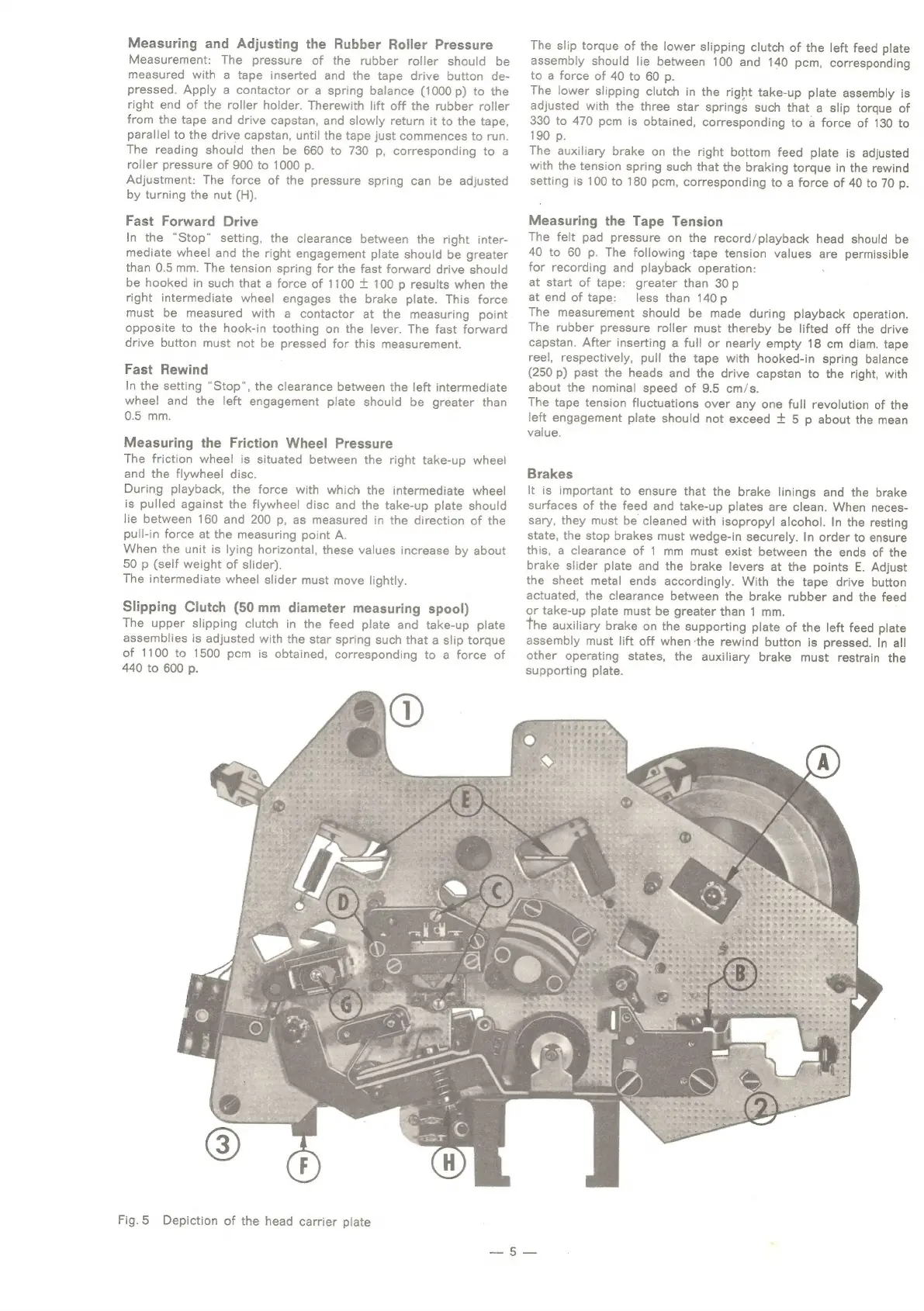
Fig.5
Depiction
of
the
head
carrier
plate