EasyManua.ls Logo

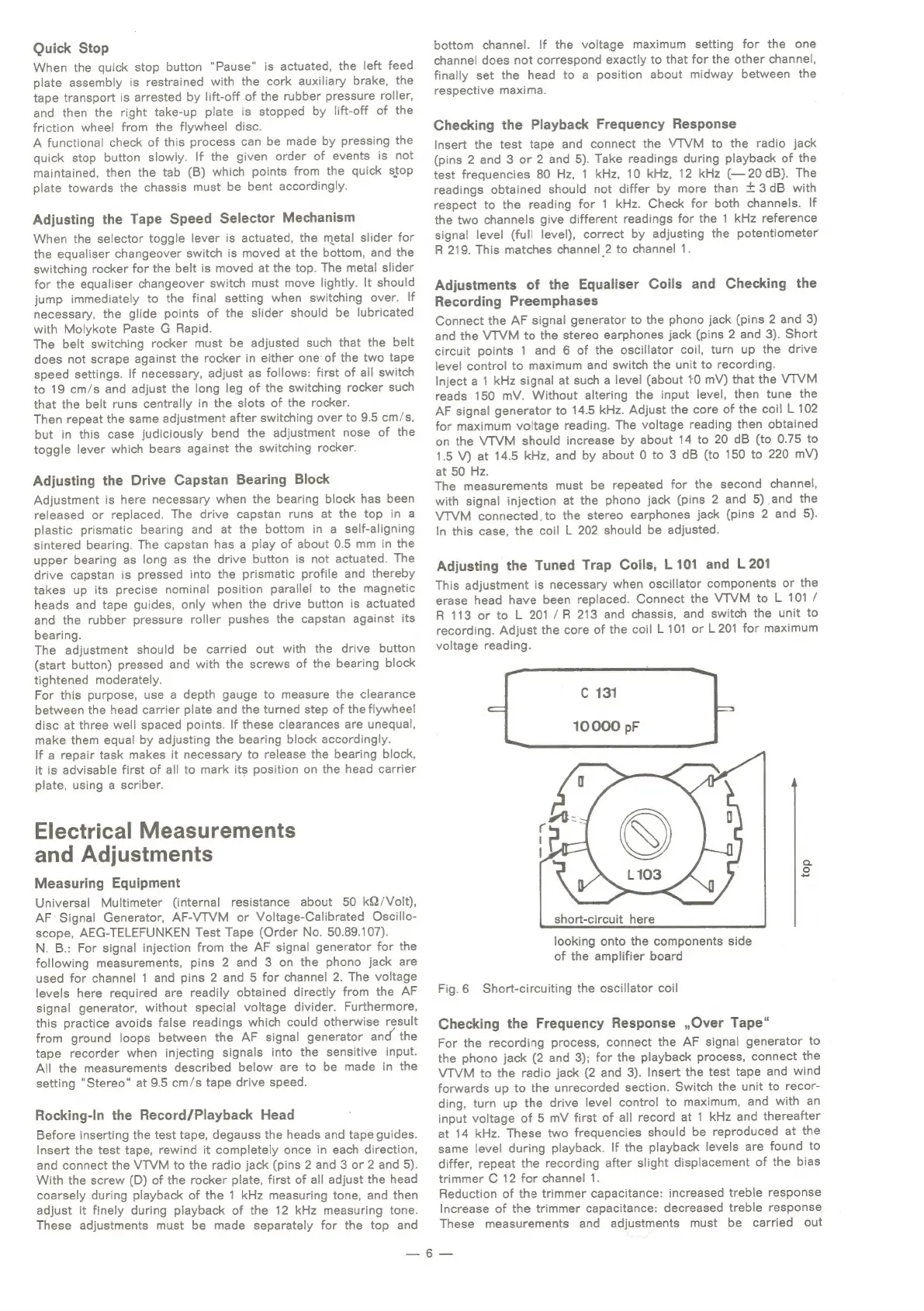
Telefunken M 204 E - Mechanical Adjustments and Operation; Quick Stop, Tape Speed Selector, and Capstan Bearing; Electrical Measurements and Adjustments; Head Alignment and Frequency Response Checks

Telefunken M 204 E
14 pages
Print Icon
To Next Page IconTo Next Page
To Previous Page IconTo Previous Page
Loading...
Quick
Stop
When
the
quick
stop
button
ā€œPauseā€œ
is
actuated,
the
left
feed
plate
assembly
is
restrained
with
the
cork
auxiliary
brake,
the
tape
transport
is
arrested
by
lift-off
of
the
rubber
pressure
roller,
and
then
the
right
take-up
plate
is
stopped
by
lift-off
of
the
friction
wheel
from
the
flywheel
disc.
A
functional
check
of
this
process
can
be
made
by
pressing
the
quick
stop
button
slowly.
If
the
given
order
of
events
is
not
maintained,
then
the
tab
(B)
which
points
from
the
quick
stop
plate
towards
the
chassis
must
be
bent
accordingly.
Adjusting
the
Tape
Speed
Selector
Mechanism
When
the
selector
toggle
lever
is
actuated,
the
metal
slider
for
the
equaliser
changeover
switch
is
moved
at
the
bottom,
and
the
switching
rocker
for
the
belt
is
moved
at
the
top.
The
metal
slider
for
the
equaliser
changeover
switch
must
move
lightly.
It
should
jump
immediately
to
the
final
setting
when
switching
over.
If
necessary,
the
glide
points
of
the
slider
should
be
lubricated
with
Molykote
Paste
G
Rapid.
The
belt
switching
rocker
must
be
adjusted
such
that
the
belt
does
not
scrape
against
the
rocker
in
either
one
of
the
two
tape
speed
settings.
If
necessary,
adjust
as
follows:
first
of
all
switch
to
19
cm/s
and
adjust
the
long
leg
of
the
switching
rocker
such
that
the
belt
runs
centrally
in
the
slots
of
the
rocker.
Then
repeat
the
same
adjustment
after
switching
over
to
9.5
cm/s,
but
in
this
case
judiciously
bend
the
adjustment
nose
of
the
toggle
lever
which
bears
against
the
switching
rocker.
Adjusting
the
Drive
Capstan
Bearing
Block
Adjustment
is
here
necessary
when
the
bearing
block
has
been
released
or
replaced.
The
drive
capstan
runs
at
the
top
in
a
plastic
prismatic
bearing
and
at
the
bottom
in
a
self-aligning
sintered
bearing.
The
capstan
has
a
play
of
about
0.5
mm
in
the
upper
bearing
as
long
as
the
drive
button
is
not
actuated.
The
drive
capstan
is
pressed
into
the
prismatic
profile
and
thereby
takes
up
its
precise
nominal
position
parallel
to
the
magnetic
heads
and
tape
guides,
only
when
the
drive
button
is
actuated
and
the
rubber
pressure
roller
pushes
the
capstan
against
its
bearing.
The
adjustment
should
be
carried
out
with
the
drive
button
(start
button)
pressed
and
with
the
screws
of
the
bearing
block
tightened
moderately.
For
this
purpose,
use
a
depth
gauge
to
measure
the
clearance
between
the
head
carrier
plate
and
the
turned
step
of
the
flywheel
disc
at
three
well
spaced
points.
If
these
clearances
are
unequal,
make
them
equal
by
adjusting
the
bearing
block
accordingly.
If
a
repair
task
makes
it
necessary
to
release
the
bearing
block,
it
is
advisable
first
of
all
to
mark
its
position
on
the
head
carrier
plate,
using
a
scriber.
Electrical
Measurements
and
Adjustments
Measuring
Equipment
Universal
Multimeter
(internal
resistance
about
50
kQ/Volt),
AF’
Signal
Generator,
AF-VTVM
or
Voltage-Calibrated
Oscillo-
scope,
AEG-TELEFUNKEN
Test
Tape
(Order
No.
50.89.107).
N.
B.:
For
signal
injection
from
the
AF
signal
generator
for
the
following
measurements,
pins
2
and
3
on
the
phono
jack
are
used
for
channel
1
and
pins
2
and
5
for
channel
2.
The
voltage
levels
here
required
are
readily
obtained
directly
from
the
AF
signal
generator,
without
special
voltage
divider.
Furthermore,
this
practice
avoids
false
readings
which
could
otherwise
result
from
ground
loops
between
the
AF
signal
generator
and
the
tape
recorder
when
injecting
signals
into
the
sensitive
input.
All
the
measurements
described
below
are
to
be
made
in
the
setting
ā€œStereoā€
at
9.5
cm/s
tape
drive
speed.
Rocking-In
the
Record/Playback
Head
Before
inserting
the
test
tape,
degauss
the
heads
and
tape
guides.
Insert
the
test
tape,
rewind
it
completely
once
in
each
direction,
and
connect
the
VTVM
to
the
radio
jack
(pins
2
and
3
or
2
and
5).
With
the
screw
(D)
of
the
rocker
plate,
first
of
all
adjust
the
head
coarsely
during
playback
of
the
1
kHz
measuring
tone,
and
then
adjust
it
finely
during
playback
of
the
12
kHz
measuring
tone.
These
adjustments
must
be
made
separately
for
the
top
and
bottom
channel.
If
the
voltage
maximum
setting
for
the
one
channel
does
not
correspond
exactly
to
that
for
the
other
channel,
finally
set
the
head
to
a
position
about
midway
between
the
respective
maxima.
Checking
the
Playback
Frequency
Response
Insert
the
test
tape
and
connect
the
VTVM
to
the
radio
jack
(pins
2
and
3
or
2
and
5).
Take
readings
during
playback
of
the
test
frequencies
80
Hz,
1
kHz,
10
kHz,
12
kHz
(—20
dB).
The
readings
obtained
should
not
differ
by
more
than
+3dB
with
respect
to
the
reading
for
1
kHz.
Check
for
both
channels.
If
the
two
channels
give
different
readings
for
the
1
kHz
reference
signal
level
(full
level),
correct
by
adjusting
the
potentiometer
R
219.
This
matches
channel
2
to
channel
1.
Adjustments
of
the
Equaliser
Coils
and
Checking
the
Recording
Preemphases
Connect
the
AF
signal
generator
to
the
phono
jack
(pins
2
and
3)
and
the
VTVM
to
the
stereo
earphones
jack
(pins
2
and
3).
Short
circuit
points
1
and
6
of
the
oscillator
coil,
turn
up
the
drive
level
control
to
maximum
and
switch
the
unit
to
recording.
Inject
a
1
kHz
signal
at
such
a
level
(about
t0
mV)
that
the
VTVM
reads
150
mV.
Without
altering
the
input
level,
then
tune
the
AF
signal
generator
to
14.5
kHz.
Adjust
the
core
of
the
coil
L
102
for
maximum
voltage
reading.
The
voltage reading
then
obtained
on
the
VTVM
should
increase
by
about
14
to
20
dB
(to
0.75
to
1.5
V)
at
14.5
kHz,
and
by
about
0
to
3
dB
(to
150
to
220
mV)
at
50
Hz.
The
measurements
must
be
repeated
for
the
second
channel,
with
signal
injection
at
the
phono
jack
(pins
2
and
5)
and
the
VTVM
connected,to
the
stereo
earphones
jack
(pins
2
and
5).
In
this
case,
the
coil
L
202
should
be
adjusted.
Adjusting
the
Tuned
Trap
Coils,
L101
and
L201
This
adjustment
is
necessary
when
oscillator
components
or
the
erase
head
have
been
replaced.
Connect
the
VTVM
to
L
101
/
R
113
or
to
L
201/R
213
and
chassis,
and
switch
the
unit
to
recording.
Adjust
the
core
of
the
coil
L101
or
L201
for
maximum
voltage
reading.
C
131
10000
pF
top
short-circuit
here
looking
onto
the
components
side
of
the
amplifier
board
Fig.6
Short-circuiting
the
oscillator
coil
Checking
the
Frequency
Response
,,Over
Tapeā€œ
For
the
recording
process,
connect
the
AF
signal
generator
to
the
phono
jack
(2
and
3);
for
the
playback
process,
connect
the
VTVM
to
the
radio
jack
(2
and
3).
Insert
the
test
tape
and
wind
forwards
up
to
the
unrecorded
section.
Switch
the
unit
to
recor-
ding,
turn
up
the
drive
level
control
to
maximum,
and
with
an
input
voltage
of
5
mV
first
of
all
record
at
1
kHz
and
thereafter
at
14
kHz.
These
two
frequencies
should
be
reproduced
at
the
same
level
during
playback.
If
the
playback
levels
are
found
to
differ,
repeat
the
recording
after
slight
displacement
of
the
bias
trimmer
C
12
for
channel
1.
Reduction
of
the
trimmer
capacitance:
increased
treble
response
Increase
of
the
trimmer
capacitance:
decreased
treble
response
These
measurements
and
adjustments
must
be
carried
out
a
IGS