Page 28 of 28
TVP Manual (full) March 2007 CE rev 03.doc
2.09 Leak checking the cryo-coil and refrigerant lines
CAUTION
Connection of the refrigerant line and final preparation of the system must be carried out by a
fully qualified and experienced refrigeration engineer.
CAUTION
Leak checking should always be carried out with a helium mass spectrometer leak detector.
Any other method may lead to contamination of the system, leaks and system failure.
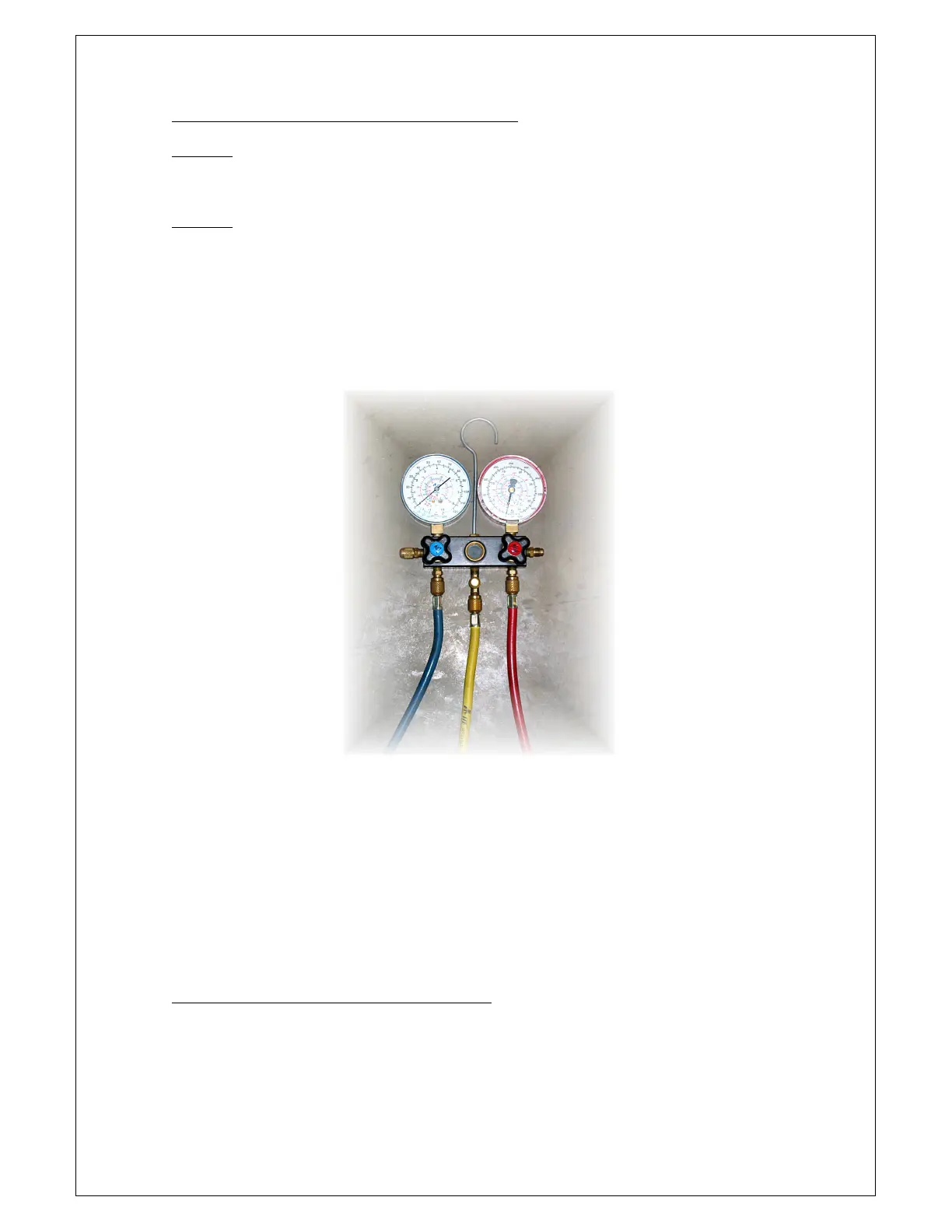
Connect a refrigeration manifold gauges suction hose (low pressure) to the TVP access hand
valve. Open the valve control stem to mid-point. Connect the helium cylinder to the manifold
gauge centre port. Pressurise the refrigerant line and cryo-coil to 150 psig (10 bar). The
system may be back filled with nitrogen. (Helium at least 3 bar minimum is required before
backfilling with a minimum of 10 bar dry Nitrogen)
Diagram Refrigeration manifold
Detecting leaks without a helium mass spectrometer can be time consuming. The target leak
rate should be less than 5 x 10
-8
mbar/L/S this is outside of the detection range of hand held
halogen detectors.
It is however possible to locate gross leaks using a standard refrigeration leak detector and
refrigerant. Interference from the glue and the foam insulation of the refrigerant lines makes
effective leak detection difficult. It is illegal in many countries to use refrigerants as trace
gases for leak detection. Following the procedure above replacing helium for refrigerant works
well with thermal conductivity type leak detectors.
Using a refrigerant leak detector to identify leaks.
Check each connection that has been made at both TVP and feed-through end with a halogen
leak detector, check each coupling carefully. Couplings have two holes, which help identify
the specific location. Covering one of the holes and detecting at the other side is an effective
method of checking a coupling (both Parker and VCR types)



 To Next Page