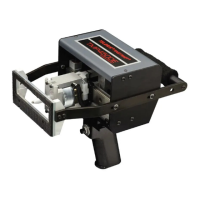
TMP4500E/TMC600 Marking System
78811A © 2014 Telesis Technologies, Inc. – All Rights Reserved 8 of 9
Host Communications (continued)
Extended Protocol. This protocol selection includes error checking and transmission acknowledgment. It should be used in applications
where serial communication is a vital part of the marking operation. All communications are carried out in a parent/child relationship with
the host being the parent. Only the host has the ability to initiate communications. If the host does not receive a response within three
seconds, it should re-transmit its original message. If no response is received after three tries, it should declare the link to be down.
The following describes the Extended Protocol message format as sent from the host to the TMC600 controller
SOH TYPE [##] STX [DATA] ETX BCC CR
Where:
SOH ASCII Start of Header character (001H). The controller
ignores all characters received prior to the SOH.
TYPE A single, printable ASCII character that defines the
meaning (type) and content of the message
downloaded from the host, where:
1 Message Type 1 overwrites a specific field in
currently loaded pattern with data supplied in the
host message. See [DATA] for details.
P Message Type P specifies the pattern name to be
loaded for printing. See [DATA] for details.
Q Message Type Q updates a specific query buffer
with data supplied in the host message.
See [DATA] for details.
V Message Type V updates the variable text in a
specific text field of the currently loaded pattern
with data supplied in the host message.
See [DATA] for details.
O Message Type O resets marker and places it
online
G Message Type G initiates a print cycle to mark the
currently loaded pattern
I Message Type I requests the marker return the
status of standard output and input signals. The
system will return a hexadecimal code for the 6
output signals and 12 input signals in the following
format:
OO;III
where:
bit 1 READY 0x01
bit 2 DONE 0x02
bit 3 PAUSED 0x04
bit 4 SPARE_1 0x08
bit 5 SPARE_2 0x10
bit 6 SPARE_3 0x20
bit 1 START 0x001
bit 2 STOP 0x002
bit 3 SEL_0 0x004
bit 4 SEL_1 0x008
bit 5 SEL_2 0x010
bit 6 SEL_3 0x020
bit 7 SEL_6 0x040
bit 8 SEL_4 0x080
bit 9 SEL_5 0x100
bit 10 SPARE_1 0x200
bit 11 SPARE_2 0x400
bit 12 SPARE_3 0x800
Input SEL_6 may be configured to place machine
online (default) or for Remote Pattern Selection.
{##] Optional two-digit ASCII number that specifies the
Station ID of the controller when used in multi-drop network
applications. The Station ID may range from 00-31. Note that “00”
is reserved for applications where only one controller is used. In
such applications, this field may be eliminated and “00” will be
assumed.
STX ASCII Start of Text Character (002H).
[DATA] Optional character string that may be required for
certain message types (e.g., Type 1, P, Q, and V).
Typically, data is sent in the format:
nn<string>
where:
nn = two-digit field number or query text
buffer where data will be placed.
Note: Not used with Message Type P.
<string> = For Message Type P, indicates the
pattern name to be loaded.
For Message Types 1, Q, or V,
indicates the data to be inserted into the
field or the query text buffer, as
applicable.
ETX ASCII end of text character (003H).
BCC Optional Block Check Code that is generated and sent
to improve link reliability by providing fault detection.
The BCC is calculated by taking an eight bit addition of
the TYPE and DATA TEXT characters and transmitting
them as a three digit ASCII decimal number in the
range from 000 to 255. If the sum is greater than 255,
the most significant bit overflows and is discarded.
CR ASCII Carriage Return Character (00DH).


 To Next Page
 Loading...