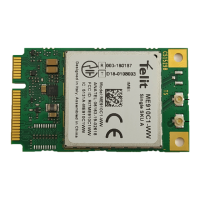
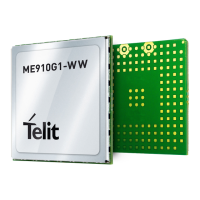
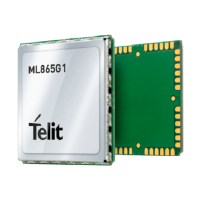
As shown in the above figure, Telit GPS receivers defaults to the geodetic reference
(datum) WGS-84, an ECEF (Earth Centered, Earth Fixed) coordinate system that consists
in an ellipsoid approximating the total mass of the Earth.
WGS-84 provides a worldwide common grid system that can be translated into local
coordinate systems or map datums. Many different reference ellipsoids are used around
the world: a specific reference is chosen to minimize the local differences between the
geoid and the ellipsoid separation or other mapping distortions. Local map datums are
the best fit to the local shape of the earth and are not universally applicable.
GNSS - Global Navigation Satellite System
In addition to the GPS constellation, other satellite navigation systems are currently in
operation or under development. The working principles of these systems are similar to
those of the GPS systems described in the previous section.
When the system has global coverage, it is referred to as Global Navigation Satellite
System (GNSS).
Galileo (European Union), BeiDou (China), GPS (USA), and GLONASS (Russia) are the
GNSSs currently in operation, although Galileo and Beidou are not yet fully operational.
Furthermore, additional regional navigation and augmentation systems are under
development (QZSS, NAVIC, and so on).
Time to First Fix (TTFF)
One of the parameters characterizing the performance of a GNSS receiver is the Time to
First Fix (TTFF). TTFF indicates the time required for a GNSS device to get and process
adequate satellite signals and data to provide accurate positional information (a “fix”).
To provide an accurate position, GNSS receivers use the following data sets:
• Satellite signals
• Timing information (for example, GPS time)
• Almanac data
• Ephemeris data
When a GNSS device is switched off for an extended time, the acquired information can
expire and, when it is switched on again, it will take longer to re-acquire these data sets,
resulting in a longer "Time to First Fix". One way to speed up the TTFF is to use the
Assisted-GPS (A-GPS) Positioning Technique.


 To Next Page
 Loading...