Rear Axle Group - Wheel Rim and Tyre
6
Section 160-0050
SM 1970 4-00
All machines whose tyres are factory inflated with dry
nitrogen gas will be identified by a decal on the body
or frame.
Nitrogen gas improves tyre pressure retention,
increases tyre life by reducing carcass oxidation from
within, minimizes rim rust and has no detrimental
effects on the tyre. It also reduces the potential of a
tyre explosion because it is an inert gas and will not
support combustion inside the tyre.
The same tyre inflation pressure used for air inflation
should be used for nitrogen inflation. Tyre valves
formerly used with air inflation are entirely satisfactory
for use with nitrogen gas.
Nitrogen Tyre Inflation Kit
WARNINGS
DO NOT USE charging assembly, Part No.
9359489, for tyre inflation because this
assembly does not include a pressure
regulator, safety relief valve, and adequate
pressure gauging which is mandatory for tyre
inflation purposes. Tyre volume is as much as
90 times greater than the average accumulator
volume and hence it takes very much longer to
inflate a tyre - up to 40 minutes or more for
very large tyres.
Nitrogen gas cylinders used to inflate
tyres are generally charged to approximately
152 bar (2 200 lbf/in
2
). A tyre blowout and/or
rim failure could occur if inflation equipment is
not properly used. Proper nitrogen charging
equipment and personnel training for its use is
a must to avoid over inflation.
1. A nitrogen tyre inflation kit is available from your
dealer and consists of the following. Refer to Fig. 7.
a. Pressure regulator, 0 - 13 bar (0 - 200 lbf/in
2
), with
two dual pressure gauges.
b. Safety relief valve, 8.6 bar (125 lbf/in²), that will
assure an upper limit to the pressure available for tyre
inflation.
c. A 15.2 m (50 ft) length of flexible hose with
interconnecting fittings. On the tyre end of the hose is
a large bore quick connect/disconnect clip-on chuck.
2. The pressure regulator is connected to a nitrogen
compressed gas cylinder available from local suppliers.
SM - 208
Inflation
Note: Always use tyre inflation equipment with an air
filter that removes moisture from the air supply, when
available, to prevent moisture corrosion of internal rim
parts.
1. Inflate tyre to 1 bar (15 lbf/in²) initially to seat
components and tap lock ring lightly to ensure correct
seating. Visually check that all components are in
place, then continue inflation observing all safety
precautions. (See Step 2).
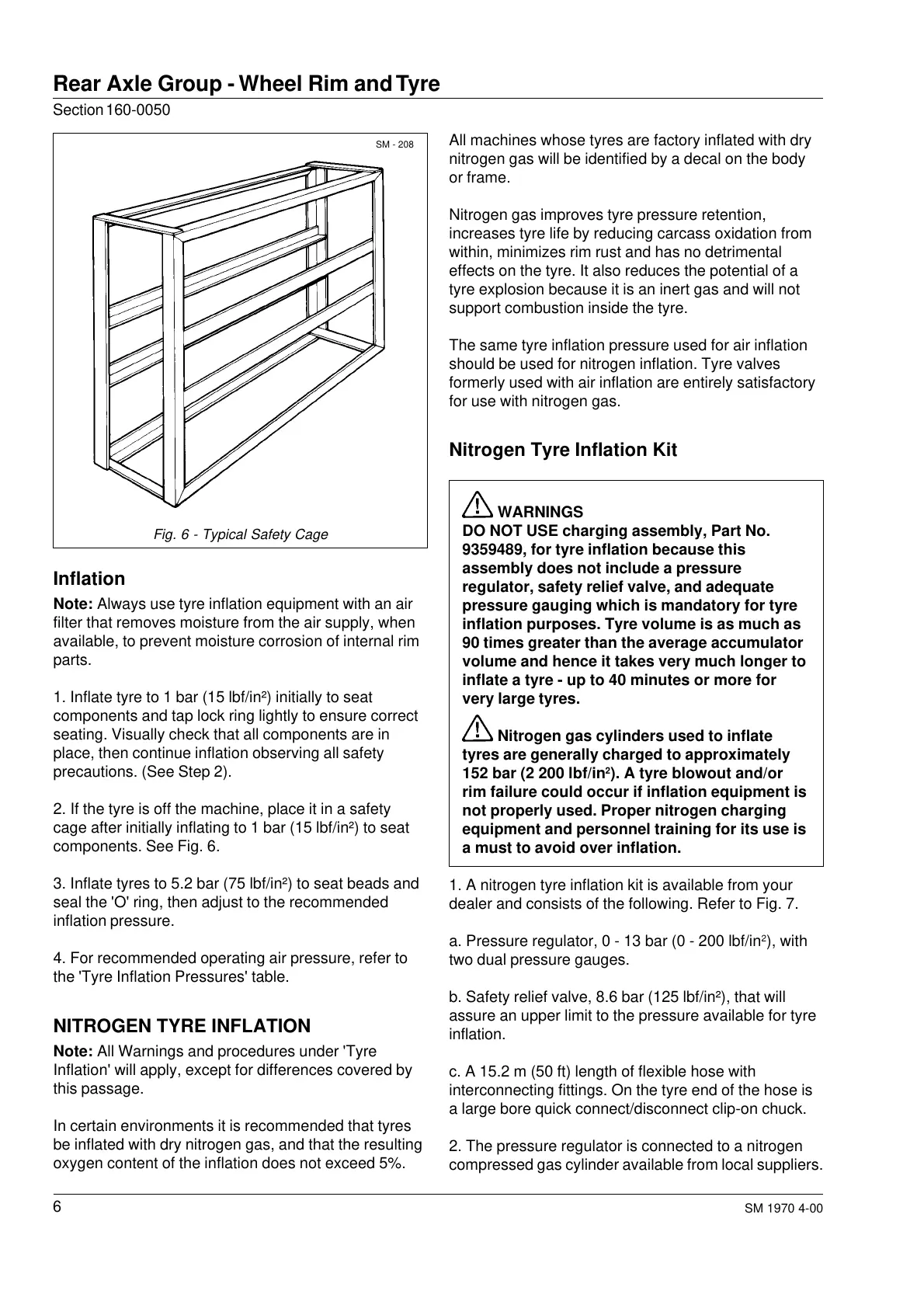
2. If the tyre is off the machine, place it in a safety
cage after initially inflating to 1 bar (15 lbf/in²) to seat
components. See Fig. 6.
3. Inflate tyres to 5.2 bar (75 lbf/in²) to seat beads and
seal the 'O' ring, then adjust to the recommended
inflation pressure.
4. For recommended operating air pressure, refer to
the 'Tyre Inflation Pressures' table.
NITROGEN TYRE INFLATION
Note: All Warnings and procedures under 'Tyre
Inflation' will apply, except for differences covered by
this passage.
In certain environments it is recommended that tyres
be inflated with dry nitrogen gas, and that the resulting
oxygen content of the inflation does not exceed 5%.
Fig. 6 - Typical Safety Cage
Courtesy of Machine.Market


 To Next Page
 Loading...