Rear Axle Group - Wheel Rim and Tyre
8
Section 160-0050
SM 1970 4-00
WARNING (cont.)
The machine should be moved to a remote
area, but only when this can be done with
complete safety to the operator operating or
towing the machine. All other persons should
stay clear of the machine. The fire or
overheated brakes, wheel, etc. should be
extinguished or cooled from a safe distance.
Do not attempt to extinguish the fire or cool
the machine by use of hand-held fire
extinguishers.
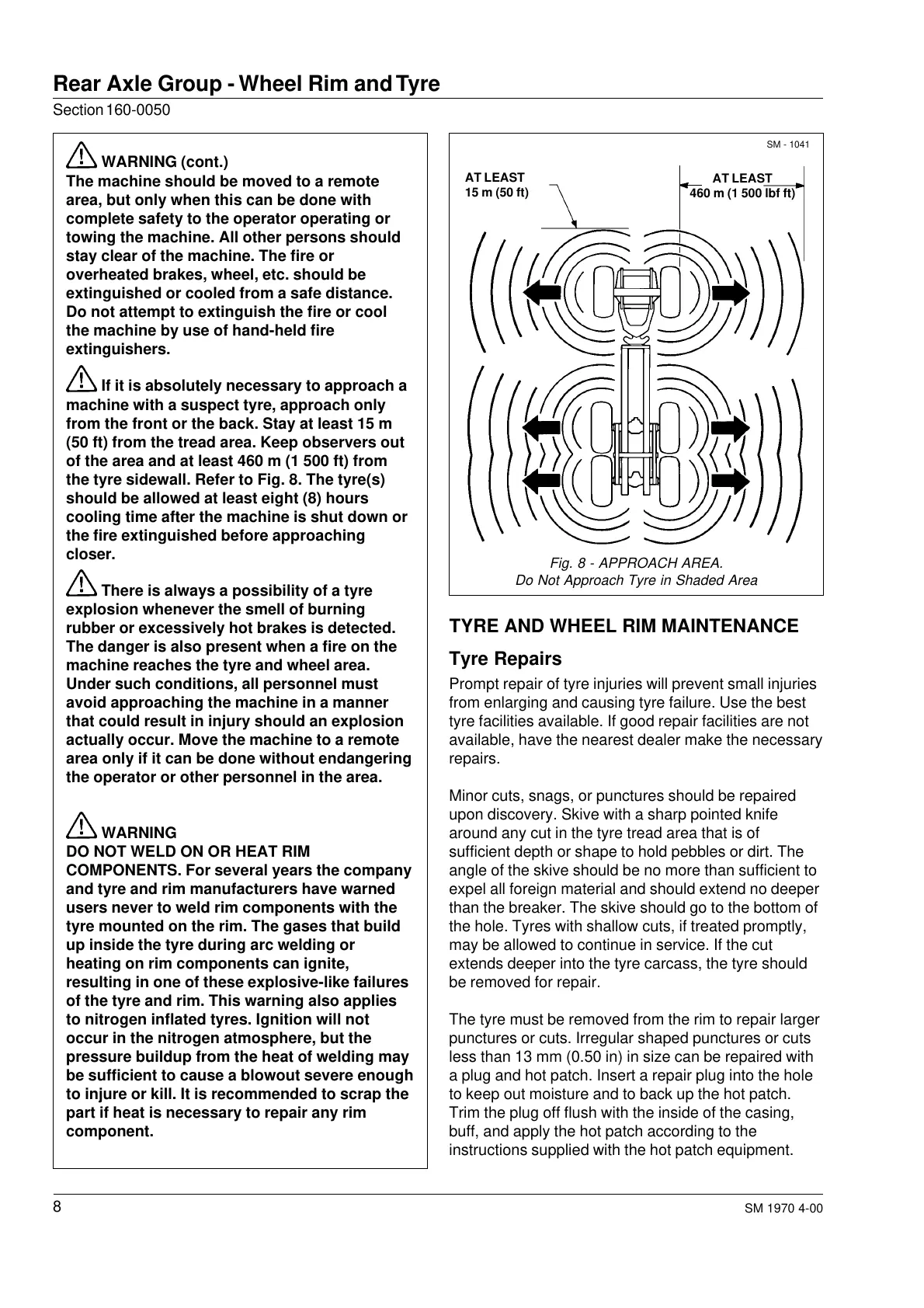
If it is absolutely necessary to approach a
machine with a suspect tyre, approach only
from the front or the back. Stay at least 15 m
(50 ft) from the tread area. Keep observers out
of the area and at least 460 m (1 500 ft) from
the tyre sidewall. Refer to Fig. 8. The tyre(s)
should be allowed at least eight (8) hours
cooling time after the machine is shut down or
the fire extinguished before approaching
closer.
There is always a possibility of a tyre
explosion whenever the smell of burning
rubber or excessively hot brakes is detected.
The danger is also present when a fire on the
machine reaches the tyre and wheel area.
Under such conditions, all personnel must
avoid approaching the machine in a manner
that could result in injury should an explosion
actually occur. Move the machine to a remote
area only if it can be done without endangering
the operator or other personnel in the area.
WARNING
DO NOT WELD ON OR HEAT RIM
COMPONENTS. For several years the company
and tyre and rim manufacturers have warned
users never to weld rim components with the
tyre mounted on the rim. The gases that build
up inside the tyre during arc welding or
heating on rim components can ignite,
resulting in one of these explosive-like failures
of the tyre and rim. This warning also applies
to nitrogen inflated tyres. Ignition will not
occur in the nitrogen atmosphere, but the
pressure buildup from the heat of welding may
be sufficient to cause a blowout severe enough
to injure or kill. It is recommended to scrap the
part if heat is necessary to repair any rim
component.
SM - 1041
TYRE AND WHEEL RIM MAINTENANCE
Tyre Repairs
Prompt repair of tyre injuries will prevent small injuries
from enlarging and causing tyre failure. Use the best
tyre facilities available. If good repair facilities are not
available, have the nearest dealer make the necessary
repairs.
Minor cuts, snags, or punctures should be repaired
upon discovery. Skive with a sharp pointed knife
around any cut in the tyre tread area that is of
sufficient depth or shape to hold pebbles or dirt. The
angle of the skive should be no more than sufficient to
expel all foreign material and should extend no deeper
than the breaker. The skive should go to the bottom of
the hole. Tyres with shallow cuts, if treated promptly,
may be allowed to continue in service. If the cut
extends deeper into the tyre carcass, the tyre should
be removed for repair.
The tyre must be removed from the rim to repair larger
punctures or cuts. Irregular shaped punctures or cuts
less than 13 mm (0.50 in) in size can be repaired with
a plug and hot patch. Insert a repair plug into the hole
to keep out moisture and to back up the hot patch.
Trim the plug off flush with the inside of the casing,
buff, and apply the hot patch according to the
instructions supplied with the hot patch equipment.
Fig. 8 - APPROACH AREA.
Do Not Approach Tyre in Shaded Area
AT LEAST
460 m (1 500 lbf ft)
AT LEAST
15 m (50 ft)
Courtesy of Machine.Market


 To Next Page
 Loading...