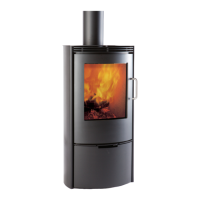
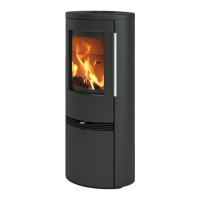
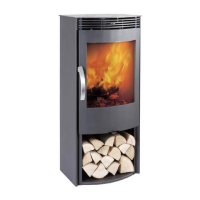
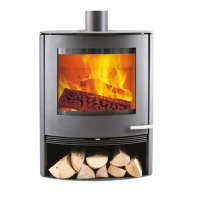
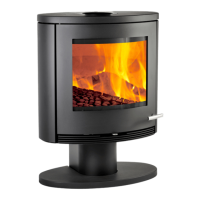
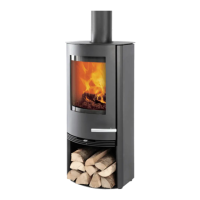
This document serves as a user and mounting manual for TermaTech wood-burning stoves, specifically models TT10, TT10S, TT10H, TT10HS, and TT10G. It provides comprehensive instructions for installation, operation, maintenance, and troubleshooting, ensuring optimal performance and safety.
Function Description:
The TermaTech wood-burning stove is designed for "intermittent combustion," meaning it is intended for heating during specific periods rather than continuous overnight burning. Its primary function is to provide warmth and a cozy atmosphere through the combustion of dry, clean wood. The stove is delivered "ready for mounting," requiring connection to a chimney via a smoke pipe. A key design feature is the self-closing door, equipped with a spring, which can be optionally removed in countries where it's not a requirement. The stove's operation is simplified with a single knob/damper located below the door for controlling air input, ranging from no air input (left position) to maximum air input (middle position). A "start help" feature allows for faster lighting by temporarily adding air from below.
Important Technical Specifications:
The manual provides detailed dimensions and weights for the different models:
-
TT10 + TT10S + TT10G:
- Height: 1009mm (TT10+TT10G), 1044mm (TT10S)
- Width: 518mm (TT10+TT10G), 525mm (TT10S)
- Depth: 462mm (TT10+TT10G), 490mm (TT10S)
- Weight: 111kg (TT10+TT10G), 205kg (TT10S)
-
TT10H + TT10HS:
- Height: 1244mm (TT10H), 1279mm (TT10HS)
- Width: 518mm (TT10H), 525mm (TT10HS)
- Depth: 462mm (TT10H), 490mm (TT10HS)
- Weight: 145kg (TT10H), 260kg (TT10HS)
Average values for testing of TT10 models include:
- Exhaust gas temperature: 320 °C
- Exhaust gas mass flow: 4.5 g/s
- Effect degree: 82%
- Nominal effect: 5.1 kW
- Uptake: 12 Pa
The stove is CE approved according to DS/EN13240, DS (Danish Standard), DIN (Deutsche Industrienorm), SINTEF (Norwegian Standard), and 15A (Austria).
Usage Features:
- Fuel: Only dry and clean wood should be used, with a maximum log size of 30 cm in length and 10 cm in diameter. Dry wood should have a maximum of 20% water content, achieved by outdoor storage for 1-2 years. Waste, synthetic materials, and treated/impregnated materials are strictly prohibited. Bio-briquettes can be used (max 2 kg/hour), but energy coke is not allowed due to its high sulfur content.
- Lighting: The first time the stove is lit, it should be done gently with proper ventilation to allow the Senotherm varnish to harden. For regular lighting, the ashpan must be closed. The damper/start-up device is opened, about 10 kindling sticks are arranged in a log house pattern with firelighters, and the door is left ajar for 8-10 minutes before being fully closed. Once the wood has burned to embers, 2-3 pieces of firewood (approx. 1.7 kg total) are added, and the damper is adjusted to control the flame.
- Airflow Control: The single knob/damper below the door controls air input. Pushing it down and to the right provides "start help" for faster lighting. For continuous firing, the damper is typically set between 1/3 and 2/3 open, depending on chimney draught.
- Safety: Surfaces, knobs, handles, and the window become very hot during use, requiring protective material for handling. Children should be kept away from the stove.
- Chimney Requirements: The chimney must be at least 3.5 m high from the top of the stove, with a minimum internal diameter of Ø150mm. It must have an easily accessible cleaning hatch and provide a draught of at least 1.2 mm water gauge (12Pa). All joints and connections must be tight.
- Installation: The stove must be placed on a non-inflammable foundation extending at least 150 mm on each side and 300 mm in front. Minimum distances to flammable materials are 100 mm behind, 200 mm beside, and 900 mm in front. For non-flammable materials, 80-100 mm behind and beside is recommended for heat disposal and cleaning. The installation must be reported to a local Hetas installer/Building control.
- Combustion Air: Sufficient airflow is crucial for clean combustion. Air is usually taken from the room, but an external air valve may be necessary. Exhaust fans in the same room should not be used simultaneously with the stove. TT10 models are available with a combustion air branch.
Maintenance Features:
- Frequency: Maintenance and cleaning should only be performed when the stove is cold. Daily maintenance is minimal, but a thorough check and cleaning should be done once a year.
- Cleaning: The combustion chamber should be cleaned of ashes and soot. The surface can be cleaned with a soft, long-haired brush, vacuum cleaner with a brush, or a duster. The glass can be cleaned with TermaTech's glass cleaner, only when cold.
- Lubrication: Door hinges and the closing mechanism should be lubricated with copper grease annually.
- Parts Replacement: Jointings should be changed as needed to maintain a sealed stove for good combustion and a clean window. Insulation plates (Vermiculite) in the combustion chamber, if broken or worn (beyond half their original thickness), can be easily changed as they are loosely fixed. Only original TermaTech parts should be used for replacements.
- Painting: Spots or small scratches can be covered with Senotherm-spray. Larger damages require grinding with fine steel wool, vacuuming, and then spraying from 15-20 cm distance. Ensure the stove is not in use and completely cold, and provide sufficient ventilation when spraying.
- Chimney Sweeping: The smoke pipe and chimney should be checked and cleaned annually by a professional chimney sweep.
- Troubleshooting: The manual includes a section for common malfunctions, such as difficulty controlling the stove (burning too fast), poor draught, glass sooting up, and smoke/soot smell. Solutions often involve checking jointings, ashpan closure, wood moisture, damper settings, and chimney condition. If problems persist, contacting the dealer, installer, or chimney sweep is recommended.
- Storage of Firewood: Firewood should be stored under a roof with good ventilation, on a wooden pallet, for 1-2 years to achieve 15-20% moisture content.
- Ash Disposal: Ashes should be cooled for 1-2 days before disposal in a rubbish bin to prevent accidental ignition.

 Need help?
 General

 To Next Page