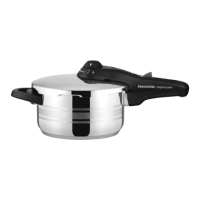
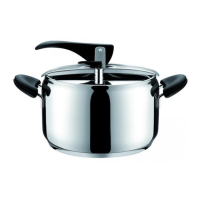
position (Fig. J). Cooking at a high pressure is quicker and uses
a higher temperature. It is suitable in particular for cooking meat and
meals that require longer thermal treatment.
3.
You may select any pressure between positions and for cooking;
4.
Place the correctly lled and closed pressure cooker set to the desired
amount of pressure onto a heat source set .
5.
After a short while steam will begin to escape with moderate hissing from
the aperture below the handle. The hissing will cease after a moment and
the . This means that the
pressure in the vessel has reached the required level; at this moment
(Fig. K).
6.
Now reduce heat so that only escapes from
the operating valve. A low heat will usually be enough.
7.
The IMPRESSION pressure cooker enables you to smoothly change pres-
sure settings while cooking. Given the hot steam escaping from the ope-
rating valve, we recommend using a suitable tool or an to
control pressure during the cooking process.
BEWARE! A MINUTE AMOUNT OF STEAM MAY ALSO ESCAPE FROM THE
APERTURE BELOW THE HANDLE DURING THE COOKING PROCESS.
If a escapes from the pressure cooker at the beginning
of the cooking process, the pressure cooker has not been correctly closed. Incorrect
closing is usually due to the following:
a) The lid is attached incorrectly – close the pressure cooker again.
b)
The operating valve is set to the steam release position – set it to the low
or high pressure-cooking position.
c) The silicone seal is incorrectly positioned in the lid – check its position.
d) The silicone seal is faulty – replace it with a new original Tescoma seal.
ALWAYS RELEASE STEAM ONLY AFTER REMOVING THE PRESSURE COOKER FROM
HEAT!
After the time required for cooking your meal elapses,
.
Leave the pressure cooker aside for a while to allow the temperature and pressure in
the pressure cooker to drop spontaneously.
Turn the operating valve to the steam release position and
(Fig. L).
The red lid closure lock slips in after the steam is released and the
(Fig. E).
If the is in the upper position and the pressure cooker cannot be
opened, . Make sure that the operating valve is
set to the steam release position. If the pressure cooker still cannot be opened, put it
into the sink and cool the lid
until the red lid closure lock .
NEVER COOL THE PRESSURE COOKER ABRUPTLY, DO NOT LET WATER RUN ONTO
PLASTIC PARTS AND DO NOT IMMERSE THE ENTIRE PRESSURE COOKER IN WATER.
The operating valve
continuously releases excess steam and releases all steam from
the pressure cooker after the end of cooking.
The safety valve operates as a
. Immediately from the heat sour-
ce if steam ceases to escape from the operating valve and starts to escape intensely
from the aperture below the lid handle (safety valve). After the pressure cooker cools
down, open it and clean the operating valve.
BEWARE! APART FROM THE STEAM ESCAPING FROM THE OPERATING VALVE DURING
COOKING, A MINUTE AMOUNT OF STEAM MAY ESCAPE ALSO FROM THE SAFETY VAL-
VE – THE APERTURE BELOW THE LID HANDLE DURING COOKING.
If the operating valve and the safety valve become clogged at once, the pressure in
the pressure cooker pushes the silicone seal
, which causes an immediate .
IF THE SILICONE SEAL IS PUSHED THROUGH THE APERTURE IN THE RIM OF THE LID,
DO NOT REPAIR THE PRESSURE COOKER YOURSELF; INSTEAD BRING IT IN FOR PRO-
FESSIONAL SERVICING.
Prevents until all steam and pressure escape from the pressure
cooker and the pressure drops entirely.
THE DIAMETER OF THE COOKING RANGE MUST BE IDENTICAL OR SMALLER THAN THE
DIAMETER OF THE BOTTOM OF THE PRESSURE COOKER!
Always use an appropriate size of cooking range or ame for cooking. Flame must
. Use the dispenser
net or cooking range when cooking on gas.
Make use of the heat retaining properties of the three-layer sandwich bottom. Switch
before the end of cooking. Thanks to the three-layer san-
dwich bottom, the accumulated heat energy is transferred into the pressure cooker
even after the heat has been switched off.
The vessel of the pressure cooker may also be used
.
NEVER PUT THE VESSEL OR THE LID OF THE PRESSURE COOKER INTO THE OVEN OR
MICROWAVE OVEN!


 To Next Page
 Loading...