Operation
28 Testboy
®
20 Plus
Cable break detection
The cable break detection is intended
for non-contact localization of cable
breaks on non-exposed live lines.
When the metal clip located in the
back of the Testboy
®
20 Plus is held
over a live cable (> 110 V AC) starting
from the feeding point, the V~ LED will
illuminate before breaking point.
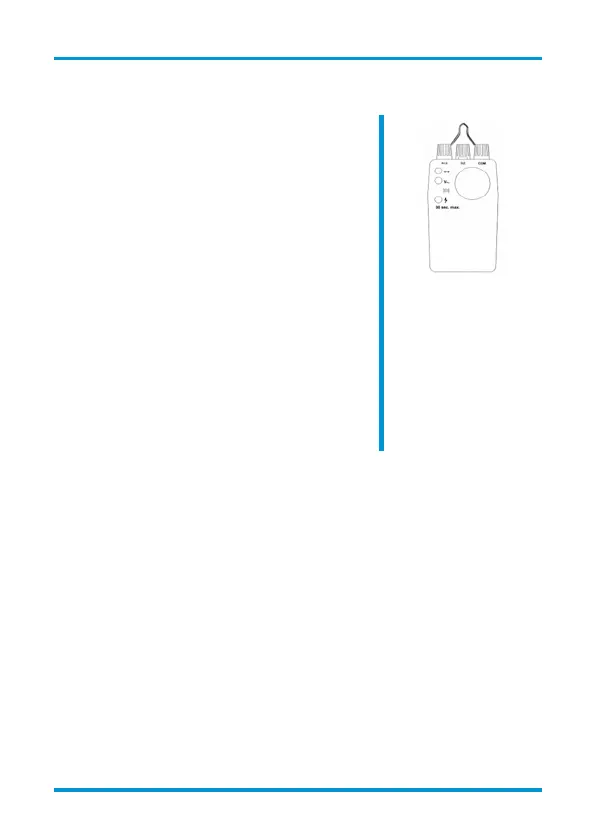
No test leads need to be attached (as
show in Figure 2)!
A flowing current is not required! The
metal clip acts here as an extended
sensor.
Do not apply the metal clip on uninsu-
lated hazardous live conductors,
which may render electric shock, elec-
tric burn, or arc flash.
Figure 2
When carrying out the cable break detection, if the V~ LED
does not illuminate, a dangerous high voltage (> 33 V AC or
70 V DC) may nevertheless be present. The non-contact sensor
can only detect voltage generated by sufficiently strong electric
fields from power sources (grids, > 110 V AC). If the field
strength is low, the instrument may not detect applied voltage
and thus cannot locate the cable break correctly. If the instru-
ment does not detect any existing voltage, this can be due to
the following factors, amongst other things:
- Shielded wires/cables
- Thickness and type of insulation
- Distance from the voltage source
- Condition of the Tester and Batteries



 To Next Page