
 Need help?
Do you have a question about the Texas Instruments TI-84+ and is the answer not in the manual?
Configure table settings like start value and increment via the [tblset] menu.
Display values for active functions by pressing 2nd GRAPH to access the table.
Use arrow keys to move between cells and change columns; press PLUS to alter table increment.
View Y-values individually. Set Independent to AUTO, Dependent to ASK in [tblset].
Navigate to Y-column, press ENTER per row to reveal values one by one.
Set Independent to ASK, Dependent to AUTO for manual X-value entry in [tblset].
Enter specific X-values to generate corresponding Y-values for comparison.
Combine graph and table views by selecting GRAPH-TABLE mode via the MODE menu.
Reduce ATbl increment to analyze key points like intercepts and extrema more closely.
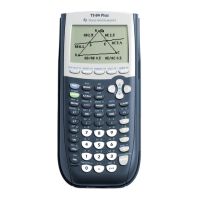
This document outlines the various functionalities and usage features of the TI-84+ Graphing Calculator, specifically focusing on its table capabilities. The calculator offers several ways to generate and interact with tables of values for functions, enhancing the user's ability to analyze mathematical relationships.
The TI-84+ Graphing Calculator allows users to input one or more functions into the Y= editor. Once functions are entered, the calculator can generate a table of corresponding X and Y values. This table functionality serves as a powerful tool for observing how functions behave, identifying key points, and comparing the outputs of multiple functions.
The calculator provides three primary modes for generating and interacting with tables: Default Tables, Dynamic Tables (Option 1: AUTO-ASK), and Dynamic Tables (Option 2: ASK-AUTO). Additionally, it offers a Graph-Table Split Screen view and a "Zooming In" feature for detailed analysis.
This is the standard method for generating tables.
2nd WINDOW to access the [tblset] menu. Here, they can set the TblStart value, which determines the initial X-value in the table, and the table increment ΔTbl, which specifies the step size between consecutive X-values. The Indpnt (Independent variable) and Depend (Dependent variable) settings are typically set to Auto Ask for Indpnt and Auto Ask for Depend in this mode, meaning the calculator automatically generates X-values based on TblStart and ΔTbl, and automatically calculates the corresponding Y-values.2nd GRAPH accesses the [table] screen, where the table of values for all active functions is displayed.UP/DOWN arrows to move between X-values and the RIGHT/LEFT arrows to switch between function columns (Y1, Y2, etc.). A unique feature in this mode is the ability to change the table increment directly from the table screen. By pressing PLUS +, users can adjust the ΔTbl value without needing to return to the [tblset] menu. This allows for quick adjustments to the table's granularity, which is useful for exploring function behavior in more detail.This mode is designed for viewing Y-values one at a time, providing a more interactive way to explore function outputs.
2nd WINDOW to access [tblset]. The Indpnt variable is set to Auto, meaning the calculator automatically generates X-values. Crucially, the Depend variable is set to Ask, which means the Y-values will not be displayed automatically.2nd GRAPH is pressed to access [table], only the X-values are initially displayed. To view a Y-value for a specific X-value, the user must navigate to the desired Y-value column using the RIGHT/LEFT arrows and then move down the column. Pressing ENTER for each row will then display the corresponding Y-value. This process must be repeated for additional columns if multiple functions are active. This feature is particularly useful for observing how a function's output changes as the X-value increases, allowing for a focused, step-by-step analysis.This mode allows users to manually enter X-values and have the calculator automatically compute the corresponding Y-values.
2nd WINDOW to access [tblset]. The Indpnt variable is set to Ask, meaning the calculator will wait for user input for X-values. The Depend variable is set to Auto, ensuring that Y-values are automatically calculated once an X-value is provided.2nd GRAPH is pressed to access [table], the table is initially blank. As the user enters an X-value and presses ENTER, the calculator automatically fills in the corresponding Y-values for all active functions in all columns. This feature is highly versatile. It enables users to:
The calculator offers a split-screen view that simultaneously displays both the graph of a function and its corresponding table of values.
MODE and select GRAPH-TABLE from the display options.TRACE or CALC tools are used, allowing for graphical analysis. The table side becomes active when 2nd GRAPH is pressed for TABLE, enabling table-based analysis. This integrated view is excellent for visualizing the relationship between a function's graphical representation and its numerical values, providing a comprehensive understanding of its behavior.This feature allows for detailed examination of specific intervals within a function's table, particularly useful for identifying key points like intercepts and extrema.
[tblset] menu (or uses the PLUS + shortcut in Default Tables mode) and chooses a smaller ΔTbl increment, such as 0.1 or 0.01. This effectively "zooms in" on the table, providing more granular data within the chosen interval.Y = x² – 3x − 1, if a sign change in Y-values is observed between x = 3 and x = 4, "zooming in" by setting ΔTbl to 0.1 would reveal that the X-intercept lies between 3.3 and 3.4, and is closer to 3.3. This iterative process of narrowing down the interval and decreasing the ΔTbl allows for precise localization of critical points.The document does not explicitly detail maintenance features for the TI-84+ Graphing Calculator. However, the consistent use of menus like [tblset] for configuration and Y= for function input implies a structured and user-friendly interface that simplifies managing the calculator's settings and functions. The ability to easily adjust table parameters and switch between different table modes contributes to the overall usability and adaptability of the device, indirectly supporting its long-term utility by making it easy to configure for various tasks. The clear navigation instructions and visual cues (like the NORMAL FLOAT AUTO REAL RADIAN MP indicator) help users understand the calculator's current state and make appropriate adjustments, which is crucial for effective and error-free operation.
 General
| Screen Resolution | 96 x 64 pixels |
|---|---|
| Power Source | 4 AAA batteries |
| Connectivity | I/O port |
| Programming | TI-BASIC |
| Apps | Yes, pre-loaded and downloadable |
| Processor | Zilog Z80 |
| Weight | 7.4 oz (210 g) |




 To Next Page