Need help?
Do you have a question about the TFA 60.2547 and is the answer not in the manual?
Read the manual carefully to familiarize yourself with the device, its functions, and parts before first use.
Follow instructions to prevent damage and loss of rights. Avoid misuse and unauthorized repairs. Keep out of reach of children.
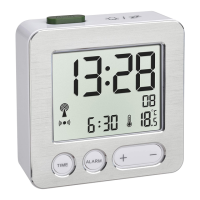
Details the components of the display (A) and housing (C) as shown in Fig. 1.
Instructions for opening the battery compartment, inserting batteries, and closing the compartment.
Explains the DCF signal source, transmission, range, and automatic DST adjustment.
Recommendations to avoid interference and improve signal reception, especially in concrete walls.
Explains fast mode using +/- buttons and automatic exit from setting mode.
Procedure for setting time, date, timezone, day language, and temperature units.
Guide on setting alarm times for Alarm 1 and Alarm 2, including activation.
How to activate backlight manually, its duration, and automatic activation via light sensor.
Instructions for cleaning the device, battery removal for extended storage, and keeping it dry.
Details on when to replace batteries and the procedure for inserting new ones with correct polarity.
Provides solutions for 'No display' and 'No DCF reception' problems.
Guidelines for environmentally friendly disposal of the product and batteries, and explanation of heavy metal symbols.
Lists power consumption, measuring ranges for temperature and humidity, housing dimensions, and weight.
States compliance with Directive 2014/53/EU and provides internet address for full declaration.
 General
| Alarm Function | Yes |
|---|---|
| Temperature Display | Yes |
| Case material | Plastic |
| Display | Digital |
| Mounting | Tabletop |
| Time signal | DCF-77 |
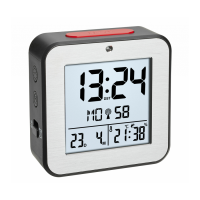
| Type | Radio controlled digital alarm clock |

 To Next Page