››› Did you know? A lever
is a two-bar linkage!
LINKAGES
All of the models in this kit make use of
mechanisms called linkages.
A linkage is a mechanical assembly of
rigid links (or rods) connected at movable
joints. Picture the rigid rods in this kit linked
together with the rotating joint pins:
that is a linkage! Linkages can be open
or closed chains, in which each link is
connected to at least one other link. In open
linkages, the end of a rod is not connected
to another rod. In closed linkages, all of the
rods’ ends are connected to other rods.
Engineers use linkages to change the
direction of a motion or change the size of
a force. Applying a force on one part of a
linkage produces a predictable resulting
force at another part of a linkage. Linkages
can be used in very clever ways to achieve
exactly the direction and magnitude of force
desired.
Linkages are often grouped by the number of rods:
two-bar, three-bar, and four-bar linkages are
common.
Four very common types of linkages are as follows.
Try building these linkages with the pieces in your kit.
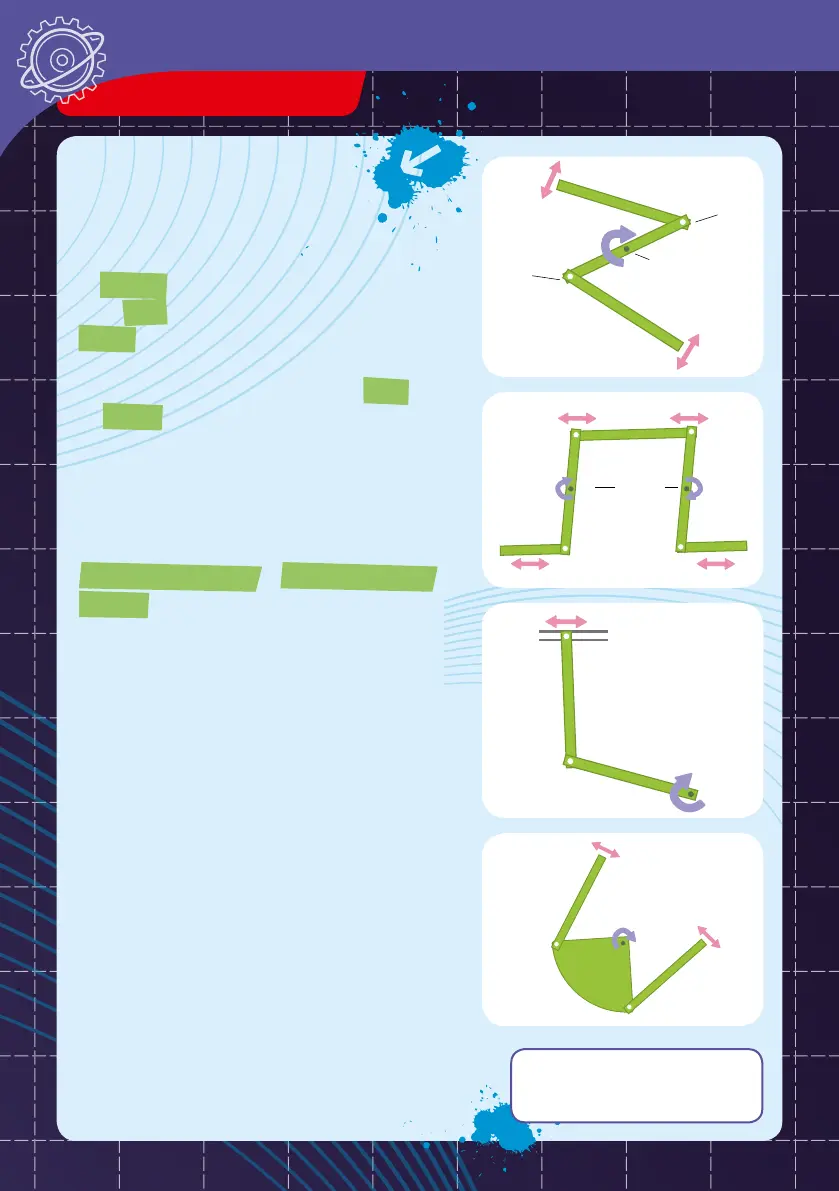
. Reverse Motion linkage: One rod moves in one
direction when the other moves in the opposite
direction.
. Parallel Motion Linkage: The rods move but at least
two rods remain parallel to each other at all times.
. Crank and Slider Linkage: A rod moves along a
straight line in a slider.
. Bell Crank Linkage: Horizontal movement is
converted perpendicularly into vertical movement.
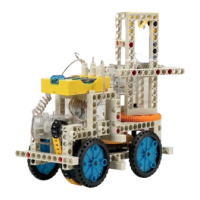
Make these linkages with your kit! Can you find all the
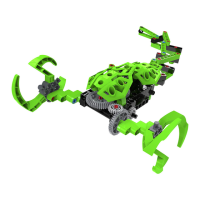
linkages in the models you built?
Pivot
Pivot
Fixed Pivot Point
Fixed Pivot Point
.
.
.
.
› › › CHECK IT OUT



 To Next Page