ELECTRONIC PERSONAL DOSEMETER HANDBOOK
EPD/HB/40521/000
INTRODUCTION
ISSUE 5
Thermo
Page 1
SECTION 1
INTRODUCTION
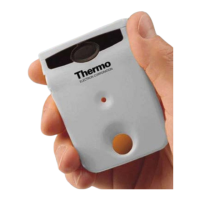
This handbook is for the Thermo Electron Corporation Electronic Personal
Dosemeter (EPD), Beat/Gamma variant, Mks 2.0, 2.1, 2.2 & 2.3. The EPD Mk2
family is lighter and slimmer than the original Mk1 EPD and has new micro-
circuitry, case design and software. The Mk2 EPDs also have a number of
enhanced dosimetry features and user functions. To simplify nomenclature the
term EPD has been used throughout this handbook and should be read to signify
the EPD Mk2 Beta/Gamma dosemeter.
1.1 General
The EPD is a personal radiation monitor that detects and measures beta and
gamma radiation. Radiation that is detected by the EPD is processed to give an
indication of penetrating dose, superficial dose and the dose rates. This
information is displayed to the user via an LCD display on the top of the EPD.
The EPD contains three silicon diode detectors. Each detector feeds a chain of
dedicated amplifiers and counter circuits to measure soft gamma, hard gamma
and beta radiation. The outputs from each detector chain are processed to
calculate and display penetrating and superficial dose and dose rate. Other
functions include: EEPROM storage of detected radiation, annunciation of alarm
conditions (LED and sounder), Infra-red (IR) communication and a user interface
comprising an LCD display and button. Each of the above functions is described
in detail in this handbook.
The EPD has a rich feature set which can be configured to the users requirements
over the IR communication link using suitable software such as EasyEPD2. These
configuration options are explained in this handbook but the user is also referred to
the EasyEPD2 User Manual which describes the parameters in more detail and
how they are accessed. Note that a few parameters are accessible only by the
manufacturer and must be determined before delivery takes place (calibration lock
and PTB Approval are examples). These manufacturer settings may constrain
what the end user can configure in the EPD, see section 4.5.2.


 To Next Page
 Loading...