Need help?
Do you have a question about the Thiel Coherent Source CS.5 and is the answer not in the manual?
Identifies four key areas for describing musical performance: tonal, spatial, transient, and dynamic fidelity.
Discusses natural spatial reproduction, dynamic drivers, and challenges like diaphragm and cabinet resonances.
Translates musical performance goals into technical requirements, focusing on accuracy and fidelity.
Lists the major technical design goals derived from technical requirements, such as uniform frequency response and low distortion.
Details the CS.5 woofer: size, radiating area, cone material, voice coil, motor system, and magnet configuration.
Details the CS.5 tweeter: aluminum dome, short coil, ferrofluid, vented pole, and reinforced chamber cup.
Focuses on achieving accurate tonal balance through uniform octave-averaged response and minimizing errors.
Explains how aluminum diaphragms and low resonance frequencies contribute to accurate driver performance.
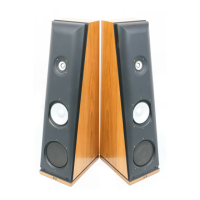
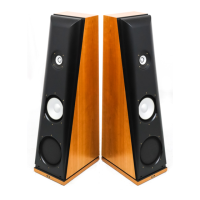
Describes the CS.5's curved grille board design to minimize cabinet edge diffraction and improve fidelity.
Highlights the importance of uniform off-axis response for natural spatial reproduction and consistent sound character.
Explains how driver placement and a sloped baffle ensure sound arrives simultaneously, preserving spatial and transient cues.
Details the use of first-order crossovers for phase coherence, avoiding waveform alteration and preserving musical accuracy.
Illustrates the speaker's ability to reproduce a step waveform accurately, demonstrating phase, time, and amplitude accuracy.
Discusses thick MDF cabinets and cast magnesium/aluminum chassis to minimize stored energy and improve clarity.
Explains how copper sleeves, short coil/long gap motors, and inductance control reduce distortion in the woofer.

 To Next Page
 General